The short answer
Buy thermal unless your household finishes the pot within twenty minutes. A hotplate keeps coffee hot by cooking it, and the result is measurably worse within half an hour: flatter, more bitter, increasingly stewed. A glass carafe is cheaper, easier to clean and easy to see into, and those are its only real advantages.
What a hotplate actually does
Brewing stops when the water leaves the grounds, but chemistry does not. Hot coffee continues to oxidize and to lose the volatile aromatics that make it smell like coffee, and heat accelerates both.
A hotplate holds the carafe at a temperature high enough to keep driving those reactions. Within about twenty minutes the difference is obvious to anyone drinking it, and after an hour the pot tastes burnt in a way the beans never were.
A thermal carafe does the opposite thing to the same problem: it adds no heat and slows the loss of what is already there. The coffee still ages - it is simply not being cooked while it does.
What thermal costs you
- Money. Thermal machines sit a bracket above their glass equivalents, roughly across the market.
- Cleaning. You cannot see inside a steel carafe, and a narrow neck needs a bottle brush rather than a sponge.
- Pouring. Some thermal lids drip or need a quarter-turn; glass carafes generally just pour.
- Visibility. With glass you can see how much is left from across the kitchen.
Not all thermal carafes are equal
Double-wall stainless is the common construction and it works. Glass-lined stainless - as on the Moccamaster KBGT - puts a glass surface against the coffee, which avoids the faint metallic note some owners report from bare steel.
Preheating matters more than the lining. Rinsing the carafe with hot water before brewing costs ten seconds and is the single biggest thing you can do for how long a thermal pot stays hot.
Quick picks
The answer first. Tap any row to jump to the full reasoning for that pick.
| # | Product | Best for | Award | Price |
|---|---|---|---|---|
| 1 | 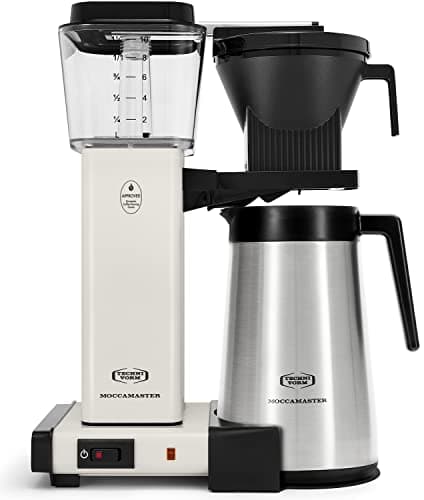 | A full pot that still tastes right at 8 a.m. | Thermal, done properly | |
| 2 | 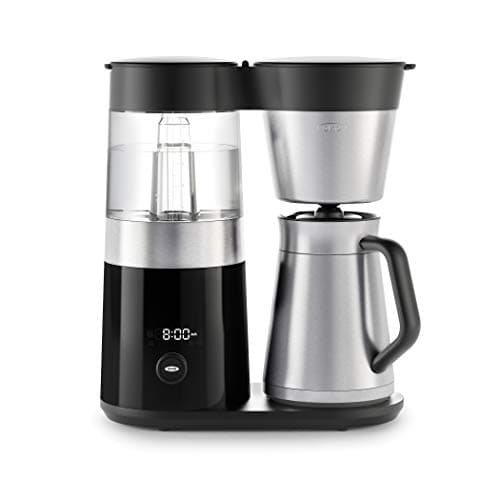 | Proper brewing without the Dutch price | Thermal, for less | |
| 3 | 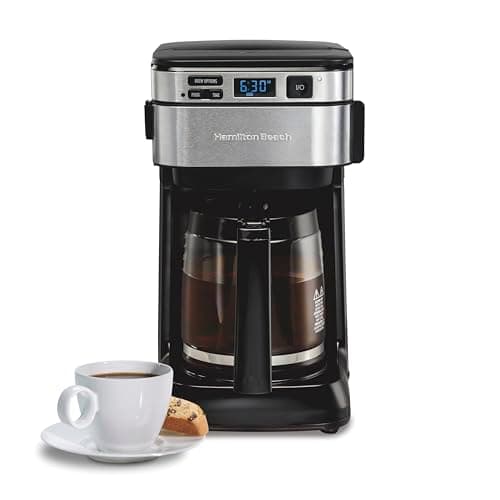 | A programmable pot for a household that drinks it fast | Glass, and honest about it |
1. Thermal, done properly
Technivorm Moccamaster KBGT
Premium tier · The Moccamaster built around a glass-lined stainless thermal carafe instead of a glass jug on a hot plate.
A glass-lined stainless carafe, no hotplate anywhere, and a five-year warranty.
The KBGT is the Moccamaster built around a glass-lined stainless thermal carafe, rated to hold coffee for up to an hour. There is no hot plate in the machine at all.
Glass-lined means the inner surface is glass rather than bare steel, which is the construction that avoids the metallic edge cheap steel carafes can leave.
A drip-stop in the brew basket halts the flow when you lift the carafe, so you can pour a cup mid-brew without a puddle.
It is hand-built in the Netherlands with a five-year warranty and parts sold individually, which is the reason these machines get repaired instead of replaced.
It stands 16 in tall and is optimized for full-pot brewing, so half batches are not its strength.
Specification
- Carafe
- Glass-lined stainless steel thermal; holds coffee for up to an hour
- Drip-stop
- Brew basket stops the flow when the carafe is removed
- Warranty
- 5 years
- Height
- 16"
- Optimized for
- Full-pot brewing
- Assembly
- Hand-built in the Netherlands
What it does well
- Hand-built and fully serviceable - parts are sold rather than the machine being replaced
- No hot plate anywhere, so brewed coffee is never cooked
- Copper heating element reaches brew temperature quickly and holds it
Where it gives ground
- Optimized for a full pot, so half batches are not its strength
- Taller than the glass models, which matters under a cabinet
- Expensive, and the brewing is manual rather than programmable
Skip it if
Skip it if you brew a single mug at a time. It is built around filling the carafe.
2. Thermal, for less
OXO Brew 9-Cup Coffee Maker
Mid tier · An SCA-certified drip brewer with a bloom cycle and a rain-style showerhead.
SCA certified, a 45-second bloom, and a double-wall thermal carafe.
The OXO Brew 9-Cup is an SCA Certified Home Brewer that holds 197.6 to 204.8 F through the cycle - the specification most machines in its bracket decline to publish.
Its 45-second bloom is rare in an automatic machine: pre-wetting the bed lets fresh coffee degas before extraction starts.
A rainmaker showerhead spreads water across the bed rather than drilling a hole in the middle of it, which is the other half of even extraction.
The double-wall thermal carafe means no hotplate, so the coffee you pour at 8:30 is the coffee that was brewed at 7:30 rather than a reduced version of it.
It is tall, so measure cabinet clearance, and there is more plastic in the build than the price suggests.
Specification
- Certification
- SCA Certified Home Brewer
- Brew temperature
- 197.6-204.8 F, held through the cycle
- Bloom
- 45-second pre-infusion
- Showerhead
- Rainmaker, even saturation
- Carafe
- Double-wall thermal
What it does well
- A real bloom cycle, which is rare in an automatic drip machine
- Thermal carafe means no hotplate cooking the coffee
- Single-cup and full-carafe modes on one machine
Where it gives ground
- Tall - measure your cabinet clearance first
- The interface is fussier than the Moccamaster single switch
- More plastic in the build than the price suggests
Skip it if
Skip it if you want one switch and no menu. Its interface is fussier than a Moccamaster's.
3. Glass, and honest about it
Hamilton Beach FrontFill 12-Cup Programmable
Budget tier · A programmable 12-cup drip machine with a front-filling reservoir.
12 cups, front-fill, programmable - and a hotplate under the carafe.
The FrontFill is a 12-cup programmable machine with a 1.7 L glass carafe, a front-filling reservoir and a swing-open basket.
Front filling is the detail that matters in a real kitchen: the machine never has to be pulled out from under a cabinet to be refilled.
It programs up to 24 hours ahead and shuts off automatically after two hours, and it includes a reusable mesh filter.
It has no SCA certification and publishes no brew temperature, so what happens inside is unverified.
Its hotplate is the point of this comparison: it keeps coffee hot by continuing to heat it, and brewed coffee degrades noticeably inside about twenty minutes on one.
Specification
- Capacity
- 12 cups; 1.7 L glass carafe
- Filling
- Front-fill reservoir, swing-open brew basket
- Strength
- Select-a-Brew: regular, bold, 1-4 cup
- Programming
- Up to 24 hours ahead
- Shutoff
- Automatic after 2 hours
- Filter
- Reusable mesh included
What it does well
- Front filling means it does not have to be pulled out from under a cabinet
- Programmable the night before, which is the point of a drip machine
- Swing-open basket is genuinely easier to load than a lift-out one
Where it gives ground
- No SCA certification, so brew temperature is not independently verified
- Glass carafe on a hotplate keeps cooking the coffee
- 1-4 cup mode is a strength setting, not a true small-batch brew
Skip it if
Skip it if the pot sits for an hour. That is precisely when a hotplate does its damage.
Side by side
Scroll the table sideways to see every column.
When glass is the right answer
If the pot is drunk within twenty minutes - a household of three on a weekday, an office of two - the hotplate never gets time to do harm, and a glass machine is the cheaper, simpler purchase.
Switch the hotplate off manually if the machine allows it. A glass carafe off the heat behaves like a poor thermal carafe rather than like a hotplate, which is a large improvement for no money.