The short answer
Fix your dose and your target yield, then change only the grind until the shot runs in the right time. Sour means under-extracted, so grind finer. Bitter and drying means over-extracted, so grind coarser. Change one thing per shot and write down what you changed.
The three numbers
Scroll the table sideways to see every column.
These are starting points, not targets. A great many coffees are excellent at 1:2.5 and some are best at 1:1.5. What matters is that you hold two of the three constant while changing the third - which is impossible without measuring them.
The method
Step 1
Fix the dose and stop changing it
Weigh the same dose every time - 18 g is a reasonable default for a double basket. If your basket is a different size, use what it is rated for. Do not adjust the dose while you are adjusting the grind: two moving variables cannot be diagnosed.
Step 2
Fix the target yield
Set a target of twice the dose - 36 g out from 18 g in - and weigh it in the cup. Stop the shot when the scale reads the target, whatever the timer says. The time is the reading, not the goal.
Step 3
Prepare the puck the same way every time
Grind into the basket, break up clumps with a needle tool, level the surface, tamp square and consistent. If preparation varies, nothing else you measure means anything.
Step 4
Pull a shot and record what happened
Dose, yield, time. Then taste it. Write all four down - on paper, in a note, anywhere. Memory across a week of shots is not reliable enough to work from.
Step 5
Read the result and change the grind only
Too fast, and sour or thin: grind finer. Too slow, and bitter or drying: grind coarser. Move one click or one small increment, not three. The temptation to make a big change is why so many people oscillate around the answer without landing on it.
Step 6
Repeat until the time lands in range
You are aiming for the yield to arrive somewhere around 25-30 seconds, at the same dose. Three or four shots is normal for a new bag. If you are still swinging after six, see the equipment section below.
Step 7
Only now adjust the ratio to taste
Once the grind is settled, change the yield to taste. A shorter yield gives more intensity and body; a longer one gives more clarity and less texture. Keep the grind fixed while you do this.
Reading the cup
Scroll the table sideways to see every column.
When it is the equipment rather than you
Three signs that no amount of dialing will help:
- 1One grind setting runs too fast and the next runs too slow. That is coarse adjustment resolution and it is a hardware limit. See espresso grinders.
- 2The same setting behaves differently on consecutive shots. That is grind inconsistency or dose drift, both of which come from the grinder.
- 3The shot runs fast and pale whatever you do. Usually stale coffee - carbon dioxide has gone and there is nothing to build resistance. Check the roast date before blaming anything else.
Quick picks
The answer first. Tap any row to jump to the full reasoning for that pick.
Prices shown are checked daily against the retailer, as of October 23, 2026. We never write a price into the text of a page.
| # | Product | Best for | Award | Price |
|---|---|---|---|---|
| 1 | 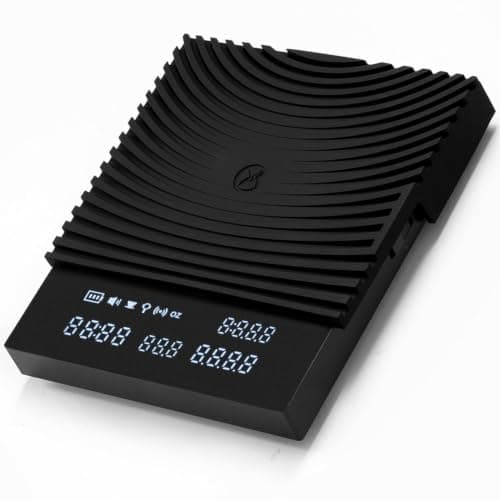 | Anyone dialing in a shot | You cannot do this without one | |
| 2 | 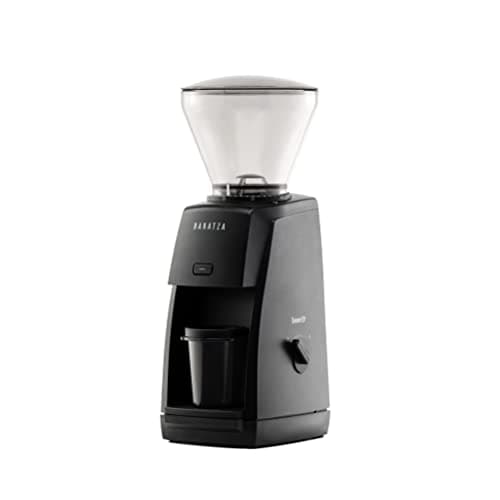 | Anyone whose grinder has coarse steps | The grinder that makes it possible | |
| 3 | 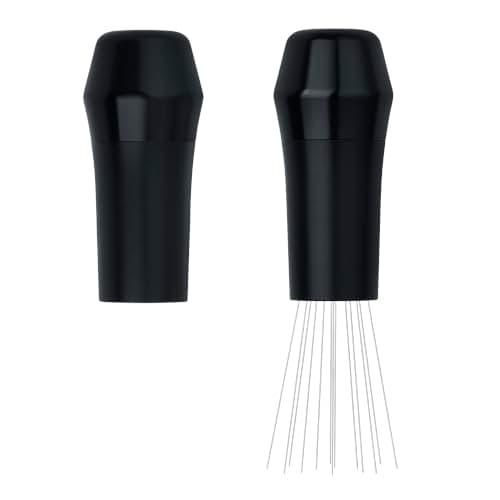 | Removing channeling from the equation | Rules out the biggest confounder |
1. You cannot do this without one
Timemore Black Mirror Basic Plus
Mid tier · A rechargeable coffee scale with auto-timing and a flow-rate readout.
Dialing in means holding two variables while changing a third. A scale is how you hold them.
This process is arithmetic: a dose, a yield and a time. Without a scale two of those three are guesses, and the method below does not work on guesses.
The Black Mirror Basic Plus publishes 2000 g capacity with 0.1 g resolution and a 0.5 g minimum detectable weight, plus automatic timing and a flow-rate readout on the current version.
It measures 152 x 130 x 26 mm, which fits on most espresso drip trays with a cup on top, and the 1600 mAh battery charges over USB-C.
Automatic timing matters here specifically: the timer starts when liquid arrives, so you are not pressing a button with a portafilter in one hand.
Specification
- Capacity
- 2000 g
- Resolution
- 0.1 g; minimum detectable 0.5 g
- Timer
- Automatic timing
- Battery
- 1600 mAh, up to 10 hours, USB-C
- Size
- 152 x 130 x 26 mm, about 380 g
What it does well
- Auto-timing and flow rate at a fraction of an Acaia
- USB-C rechargeable rather than a drawer full of coin cells
- Small enough for a drip tray, big enough for a dripper
Where it gives ground
- Not waterproof
- Response is quick but not espresso-instant
- The mirrored top shows every fingerprint
Skip it if
Skip it if you already own a scale reading to 0.1 g. Any accurate scale works; this one is just convenient.
2. The grinder that makes it possible
Baratza Encore ESP
Entry tier · The Encore re-geared for espresso: the same 40 mm burrs on a dual-resolution collar.
If your smallest grind change overshoots the target, the process cannot converge.
The most common reason dialing in fails is not technique. It is that one grind setting runs too fast and the next runs too slow, with nothing available in between.
The Encore ESP publishes approximately 20 microns per click across steps 1 to 20 for espresso, and about 90 microns per click across steps 21 to 40 for filter, on 40 mm M2 steel conical burrs made by Etzinger, held at 550 rpm.
Twenty microns is fine enough that the correction you want is usually available. That is the entire difference between a process that converges and one that oscillates.
It is stepped rather than stepless, so occasionally the setting you want will still sit between two clicks - at which point you adjust the dose instead.
Specification
- Burrs
- 40 mm M2 steel conical (Etzinger)
- Settings
- 40 stepped, dual resolution
- Espresso range
- Steps 1-20, 20 microns per click
- Filter range
- Steps 21-40, 90 microns per click
- Burr speed
- 550 rpm
What it does well
- 20 microns per click in the espresso range is real dialing resolution
- Redesigned burr housing makes cleaning and shimming easy
- Shims included in the box
Where it gives ground
- Still a stepped grinder - you cannot land between clicks
- Retention is normal-for-the-class, not low
- Same plastic body and noise as the Encore
Skip it if
Skip it if you already own a grinder with fine adjustment. Do not replace a working grinder on principle.
3. Rules out the biggest confounder
Normcore WDT Tool V4
Entry tier · A retractable needle tool for breaking up clumps in the basket before tamping.
You cannot dial in a shot that channels, because the numbers stop meaning anything.
Dialing in assumes the shot behaves predictably: finer grind, more resistance, longer time. Channeling breaks that assumption, because water is bypassing the puck rather than passing through it.
A needle tool breaks up the clumps that cause it. Nine needles, with 0.3 mm and 0.4 mm sets included, 304 stainless in an anodized aluminum handle, in 54 mm and 58 mm.
The needles retract with a twist so they store without bending.
Use it before every shot while dialing in. Consistency of preparation is what lets you attribute a change in the cup to the change you made.
Specification
- Needles
- 9 needles; 0.3 mm and 0.4 mm sets included
- Material
- 304 stainless needles, anodized aluminum handle
- Mechanism
- Twist to extend or retract
- Sizes
- 54 mm and 58 mm
What it does well
- The cheapest meaningful improvement to an espresso shot, by some distance
- Retracting needles means it lives in a drawer without bending
- Two needle gauges cover fine and coarser grinds
Where it gives ground
- Adds a step to every single shot
- Needles will eventually bend whatever you do
- Does nothing at all for filter coffee
Skip it if
Skip it if you own one already. It is cheap enough that most people should.
How long a bag should take
Expect three or four shots to dial in a new bag if your setup is settled. Expect more with an unfamiliar roast, and expect to move slightly finer as the bag ages over two or three weeks - degassing changes the puck's resistance.
That gradual drift is normal and it is one of the reasons keeping notes matters: the setting that worked on day three of a bag will usually not be the setting for day eighteen.
What we are not doing here
We are not going to give you a temperature to chase or a pressure profile to copy. Both matter, both interact with your specific machine and beans, and neither is worth touching until dose, yield, time and puck preparation are consistent. Numbers copied from someone else's setup are not portable.