The short answer
Espresso is the finest common grind and sits below about 250 microns - which is why grinders whose range stops there cannot pull a shot. Moka pot sits just above it, AeroPress is medium-fine (AeroPress names Baratza Encore 11 to 13), pour-over and drip are medium, and French press and cold brew are the coarsest, up near the 1200-micron top of a typical grinder's range. Adjust by taste, not by photograph: sour means grind finer, bitter means grind coarser.
The chart, referenced to published ranges
Most grind charts show photographs of sand and salt, which is close to useless because two grinders photographed the same look nothing alike in a brewer. The figures below are anchored to numbers manufacturers actually publish: Baratza's 250 to 1200 micron Encore range, AeroPress's own setting recommendation, and Fellow's statement that the Ode bottoms out around 250 to 300 microns.
Scroll the table sideways to see every column.
How to adjust: two rules and nothing else
Sour, thin, weak, or it brewed too fast? Grind finer. A finer grind slows the water down and exposes more surface area, so more dissolves.
Bitter, harsh, dry, or it brewed too slowly? Grind coarser. A coarser grind speeds the water up and reduces surface area, so less dissolves.
Change one thing at a time, and change it by one click or two. Chasing a fault with simultaneous changes to dose, temperature and grind is how people end up with three variables and no answer - the same discipline as how to dial in espresso.
Why the same setting behaves differently
- Bean density. Light roasts are harder and grind coarser at the same setting than dark roasts do.
- Freshness. Fresh beans release CO2, which changes how the bed behaves in the first days after roasting.
- Burr wear. Burrs dull over years and drift coarser.
- Humidity. Static and clumping change day to day, which is why one click can seem to do nothing and then two do a lot.
Quick picks
The answer first. Tap any row to jump to the full reasoning for that pick.
| # | Product | Best for | Award | Price |
|---|---|---|---|---|
| 1 | 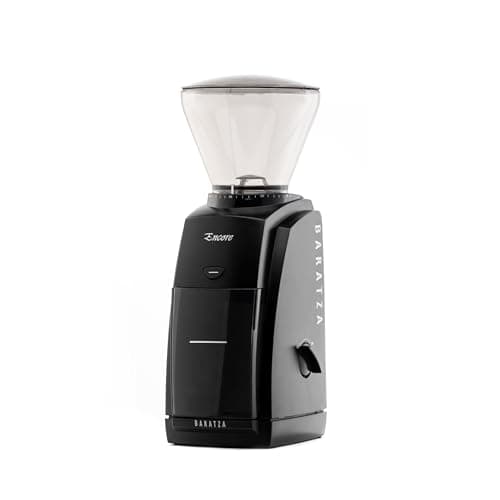 | Following any filter recipe you find | The reference grinder | |
| 2 | 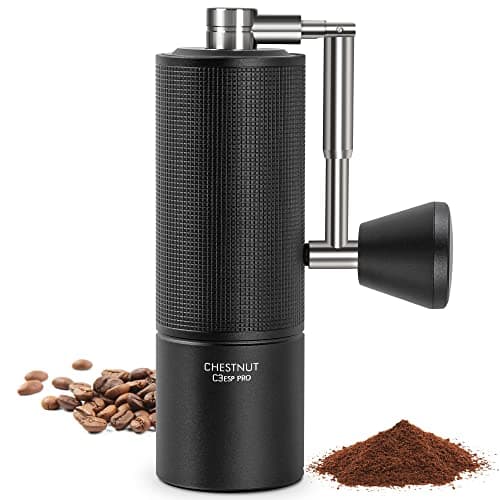 | Converting a recipe to clicks | The hand-grinder reference | |
| 3 | 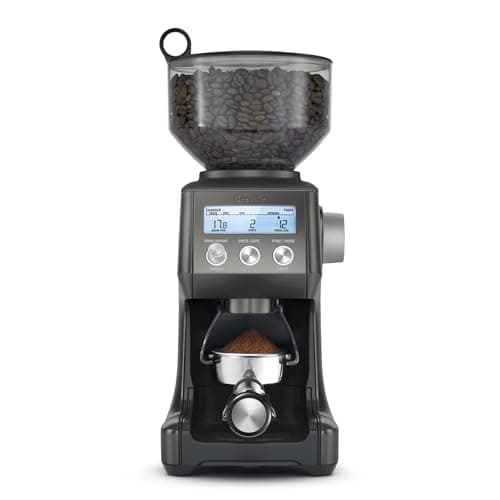 | One grinder crossing the whole chart | If you brew several ways |
1. The reference grinder
Baratza Encore
Entry tier · The standard entry burr grinder for filter brewing.
250 to 1200 microns across 40 steps - the range most published recipes assume.
Baratza publishes the Encore's range as 250 to 1200 microns across 40 stepped settings, which is why it turns up as the reference point in other manufacturers' instructions.
AeroPress, for instance, names Encore settings 11 to 13 in its own brewing guide rather than saying 'medium-fine' and leaving you to guess.
Divided across its 39 gaps, each step averages roughly 24 microns. Baratza does not publish a per-step figure, so treat that as arithmetic rather than specification.
Its 40 mm conical burrs run at roughly 450 to 550 rpm, which keeps heat and static down across the whole range.
Its fine end stops at 250 microns, which is exactly why it cannot do espresso - see the Encore review.
Specification
- Burrs
- 40 mm conical, made in Europe
- Settings
- 40 stepped
- Grind range
- 250-1200 microns
- Burr speed
- Roughly 450-550 rpm to limit heat and static
What it does well
- The reference answer for pour-over, drip and French press
- Fully serviceable, with parts sold individually for years
- Low burr speed keeps static and heat down
Where it gives ground
- Bottom of its range is too coarse for espresso - that is the ESP model job
- Stepped settings only
- Plastic body and a loud motor
Skip it if
Skip it if you need espresso. The chart below shows where its range runs out.
2. The hand-grinder reference
Timemore Chestnut C3
Manual tier · The budget hand grinder that made stainless conical burrs cheap.
About 36 settings at roughly 23 microns per click.
The C3's roughly 36 settings move about 0.0233 mm - around 23 microns - per click, which is close enough to the Encore's average step that recipes translate.
Its 38 mm S2C stainless burrs at 55 to 58 HRC cover filter brewing comfortably.
Capacity is 25 g, so it grinds one pour-over or AeroPress dose at a time.
Counting clicks from fully closed is how you record a setting on any external-adjustment grinder - write the number down the first time it tastes right.
Espresso resolution is marginal, so the fine end of this chart is not its territory.
Specification
- Burrs
- 38 mm S2C stainless conical, 55-58 HRC
- Settings
- Roughly 36, about 0.0233 mm per click
- Capacity
- 25 g
- Weight
- About 530 g
- Build
- Aluminum body, double-bearing axis, no plastic internals
What it does well
- Filter-grade grind quality at a genuinely low price
- Metal internals and double bearings, not a toy
- Small and light enough to travel with
Where it gives ground
- 38 mm burrs make an espresso dose slow work
- Espresso resolution is marginal
- 25 g capacity limits you to one brew at a time
Skip it if
Skip it for espresso dialing. Twenty-three microns per click is a coarse step at that end.
3. If you brew several ways
Breville Smart Grinder Pro
Mid tier · A hopper-fed conical grinder that doses straight into a portafilter cradle.
60 settings from espresso to French press, dosing straight into a portafilter.
The Smart Grinder Pro's 60 settings and adjustable upper burr cover espresso through French press, which is the full width of the chart below.
Its digital timer doses in 0.2-second increments, and portafilter cradles at 50 to 54 mm and 58 mm let it grind hands-free into a basket.
A 450 g hopper suits a household that drinks a lot of coffee and works against one that does not - beans sitting in a hopper go stale.
Timed dosing drifts as beans age and change density, so a scale still earns its place.
Its espresso end is usable rather than precise, which is the usual compromise in a grinder that spans everything.
Specification
- Burrs
- Stainless steel conical, adjustable upper burr
- Settings
- 60
- Dosing
- Digital timer in 0.2-second increments
- Hopper
- 450 g
- Cradles
- 50-54 mm and 58 mm portafilter
What it does well
- Hands-free grinding into the portafilter
- 60 settings covers espresso through French press in one machine
- Big hopper suits a household that drinks a lot of coffee
Where it gives ground
- Large hopper means stale beans unless you actually get through them
- Timed dosing drifts as beans age
- Espresso end is usable rather than precise
Skip it if
Skip it if you brew one way. A narrower grinder does that one thing better for the money.
Recording your settings
On a stepped grinder, write down the number. On an external-adjustment hand grinder, count clicks from fully closed and write that down. On a stepless grinder, mark the collar yourself - it ships with nothing to reference.
Keep one line per method: brewer, dose, grind setting, time. That page is worth more than any chart, because it is about your grinder and your coffee - see best coffee scales for the other half of repeatability.