The short answer
The machine is a fraction of the cost of owning one. Over a few years the beans dominate everything else by a wide margin, the grinder is effectively half the initial purchase on most machines, and electricity, descaler, filters and eventual burr replacement make up the rest. The purchase price is the least useful number in the calculation.
The five costs, in order of size
Scroll the table sideways to see every column.
1. Beans, which are the whole answer
Work out your own number and you will stop worrying about the rest. Take your dose - 18 g for a double - and multiply by drinks per day, then by 365.
Two doubles a day is 36 g, which is about 13.1 kg of coffee a year. Whatever you pay per kilo, multiply. For most households that figure exceeds the price of the machine within the first year or two, and it continues every year afterwards.
This is also the cost you have most control over. The gap between a 2.2 lb supermarket bag and 12 oz bags of specialty coffee is several-fold per kilo, and it is the single largest lever in the entire calculation. Our beans section covers what the difference actually buys.
2. The grinder, which is not optional
Five of the machines we recommend have no grinder. That is not an omission in the listing - it is half the purchase, and a machine bought without budgeting for it will underperform a cheaper all-in-one.
The honest way to compare an all-in-one against a grinder-less machine is at the total. A Barista Express against a Bambino plus an Encore ESP is a real comparison; a Barista Express against a Bambino alone is not.
Over a longer horizon the separates setup usually wins, because each half can be replaced on its own schedule and a good grinder outlives several machines. The full comparison is here.
Quick picks
The answer first. Tap any row to jump to the full reasoning for that pick.
Prices shown are checked daily against the retailer, as of October 23, 2026. We never write a price into the text of a page.
| # | Product | Best for | Award | Price |
|---|---|---|---|---|
| 1 | 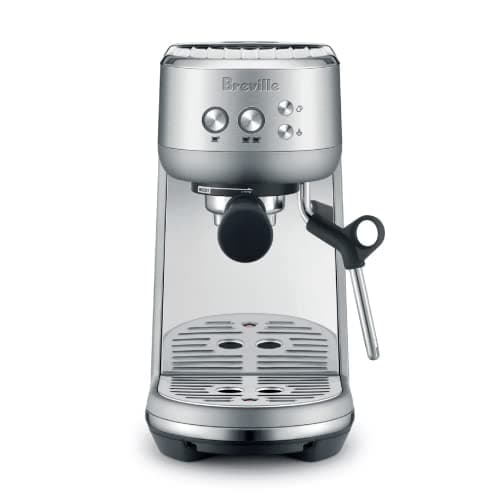 | Understanding what the real budget is | Lowest total cost of entry | |
| 2 | 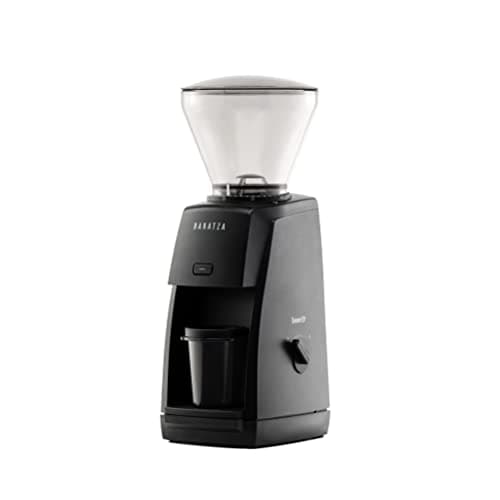 | Keeping the long-term number down | The other half of the purchase | |
| 3 | 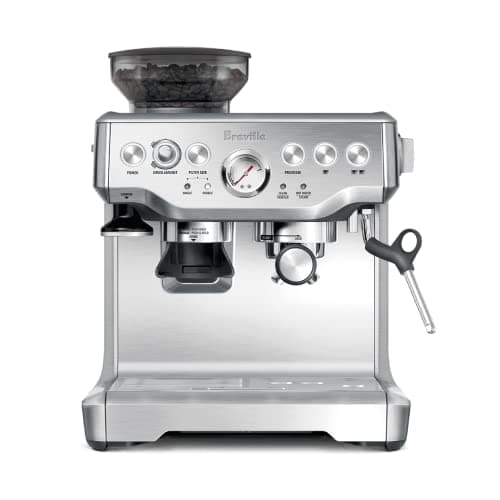 | Comparing an all-in-one against separates over years | The integrated alternative |
1. Lowest total cost of entry
Breville Bambino
Entry tier · A compact 54 mm espresso machine with a manual steam wand and no grinder.
No grinder included, which is the honest starting point for the arithmetic.
The Bambino is a useful worked example because it makes the hidden cost visible: it publishes no grinder at all, so the second purchase is unavoidable and obvious.
The machine itself is a 54 mm portafilter taking an 18 g dose, ThermoJet heating in three seconds, low-pressure pre-infusion before 9 bar extraction, in a body measuring 11.9 x 6.1 x 13.5 inches.
The three-second heat-up matters to running cost as well as convenience: a machine that reaches temperature almost instantly spends far less time drawing power to hold temperature than one that needs a long warm-up.
Add a grinder and this is the cheapest genuinely capable setup in the arithmetic below.
Specification
- Portafilter
- 54 mm, 18 g dose
- Heating
- ThermoJet, ready in 3 seconds
- Extraction
- Low-pressure pre-infusion, then 9 bar
- Footprint
- 11.9 x 6.1 x 13.5 in
- Grinder
- None - buy separately
What it does well
- Three-second heat-up means it is genuinely usable on a weekday
- The narrowest footprint of any machine here
- Real steam wand you control yourself
Where it gives ground
- No grinder, so the real budget is machine plus grinder
- Manual milk texturing has a learning curve
- Small tank means frequent refills if you pull several drinks
Skip it if
Skip it if you have not budgeted for a grinder. The machine alone is not a working setup.
2. The other half of the purchase
Baratza Encore ESP
Entry tier · The Encore re-geared for espresso: the same 40 mm burrs on a dual-resolution collar.
Serviceable, with parts sold individually - which is a running-cost decision as much as a quality one.
The grinder is where long-term cost is decided, and not only through purchase price.
The Encore ESP publishes 40 mm M2 hardened alloy steel conical burrs made by Etzinger, 40 stepped settings with about 20 microns per click across the espresso range and 90 microns across filter, and a burr speed of 550 rpm.
The reason it belongs in a cost article is Baratza's parts policy: components are sold individually and have been for years, so an Encore is repaired rather than replaced.
Burrs are a genuine consumable - they wear and eventually need replacing - and a grinder whose burrs you can buy is a grinder with a much lower lifetime cost than one whose are unavailable.
Specification
- Burrs
- 40 mm M2 steel conical (Etzinger)
- Settings
- 40 stepped, dual resolution
- Espresso range
- Steps 1-20, 20 microns per click
- Filter range
- Steps 21-40, 90 microns per click
- Burr speed
- 550 rpm
What it does well
- 20 microns per click in the espresso range is real dialing resolution
- Redesigned burr housing makes cleaning and shimming easy
- Shims included in the box
Where it gives ground
- Still a stepped grinder - you cannot land between clicks
- Retention is normal-for-the-class, not low
- Same plastic body and noise as the Encore
Skip it if
Skip it if you never make espresso. The standard Encore covers filter for less.
3. The integrated alternative
Breville Barista Express
Mid tier · The all-in-one: espresso machine with a conical burr grinder built into the case.
One purchase, and a grinder you cannot replace independently.
The all-in-one changes the cost profile rather than just the price. The Barista Express publishes a 54 mm portafilter, a thermocoil running at 200 F under PID control, and an integrated conical burr grinder with 16 grind settings, in a 15.9 x 13.1 x 12.4 inch body.
Up front it is one purchase and usually cheaper than a comparable machine plus a standalone grinder.
Over years the arithmetic shifts. The grinder cannot be replaced independently, so when either half fails or becomes limiting, you replace both.
That is not an argument against buying one - it is an argument for factoring in replacement rather than only purchase.
Specification
- Portafilter
- 54 mm stainless
- Grinder
- Integrated conical burr, 16 settings
- Heating
- Thermocoil, 200 F, PID controlled
- Footprint
- 15.9 x 13.1 x 12.4 in
What it does well
- One box, one price, one plug - nothing else to buy
- PID temperature control at this level is not a given
- Enormous owner base, so parts and answers are easy to find
Where it gives ground
- 16 grind settings is coarse resolution for espresso dialing
- The built-in grinder is the weakest component and cannot be upgraded
- Wide footprint for a single-boiler machine
Skip it if
Skip it if you expect to keep improving. Sixteen grind settings is a ceiling, and it is bolted to the machine.
3. Electricity, with the arithmetic shown
This is the cost people most overestimate, and it is straightforward to calculate.
The US Energy Information Administration puts the average residential electricity rate at about 18.34 cents per kilowatt-hour as of September 2026, with substantial regional variation - New England averages considerably higher and other regions lower. Use your own rate from your bill.
The energy used is the machine's power draw multiplied by the time it actually spends drawing it. A Breville Infuser publishes a 1650 W thermocoil; a Gaggia Classic Evo Pro publishes 1425 W total with 1375 W to the boiler; a Rancilio Silvia publishes a 1000 W element.
The critical point is that these are peak draws, not continuous ones. A thermoblock machine heats on demand and draws its rated power for seconds at a time. A boiler machine draws its rated power while heating and then cycles - drawing intermittently to hold temperature.
- A 1500 W machine drawing full power for one minute uses 1500 W x (1/60) hour = 0.025 kWh. At 18.34 cents that is under half a cent.
- Left on for an hour, cycling to hold temperature at perhaps a quarter of peak draw, the same machine uses roughly 0.375 kWh - around 7 cents.
- A machine left on all day is where the cost actually lives, and it is the one behavior worth changing.
The conclusion: brewing costs almost nothing in electricity. Idling costs meaningfully more. A fast-heating machine that is ready in seconds removes the incentive to leave it on, which is where the saving is.
4. Consumables
Descaler, water filter cartridges and group-head cleaner are modest individually and recurring. The frequency is what varies, and it is largely decided by your water.
Hard water means more frequent descaling, and it also shortens the life of a filter cartridge. Filtered water reduces both. The interval is genuinely individual - our descaling guide covers how to work out your own rather than copying a number.
5. Burrs, repairs and the serviceability question
Burrs wear. It takes a long time at home volumes - years, not months - but it happens, and a grinder whose burrs are available as a spare part has a fundamentally different lifetime cost from one whose are not.
The same logic applies to machines. A Rancilio Silvia is built from commercial-line parts with a repair path measured in decades; a sealed appliance is replaced. That difference does not show up in any purchase price comparison and it dominates the ten-year number.
Putting it together
- 1Calculate your annual bean spend first. Dose x drinks per day x 365. This is the number that matters.
- 2Budget machine and grinder together, and split the total grinder-first rather than machine-first.
- 3Add electricity using your own rate, and expect it to be small unless you leave the machine on.
- 4Add consumables based on your water hardness, not on a generic figure.
- 5Weight serviceability heavily if you intend to keep the setup. It is the difference between repairing and replacing.
Do that and the ranking of machines often changes, because the purchase price turns out to be the smallest variable in the calculation.