The short answer
Buy the Barista Express if you do not own a grinder and do not want to buy one - it is one box and it works. Buy the Bambino if you own a grinder, or will buy one, because it is the better machine and the pair upgrades independently. The espresso hardware is close enough that the grinder decision is the entire comparison.
Specification side by side
Scroll the table sideways to see every column.
Quick picks
The answer first. Tap any row to jump to the full reasoning for that pick.
Prices shown are checked daily against the retailer, as of October 23, 2026. We never write a price into the text of a page.
| # | Product | Best for | Award | Price |
|---|---|---|---|---|
| 1 | 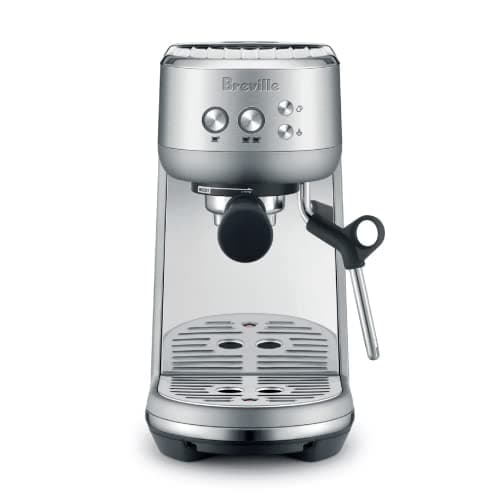 | Anyone with a real grinder, or a grinder budget | Choose this if you own a grinder | |
| 2 | 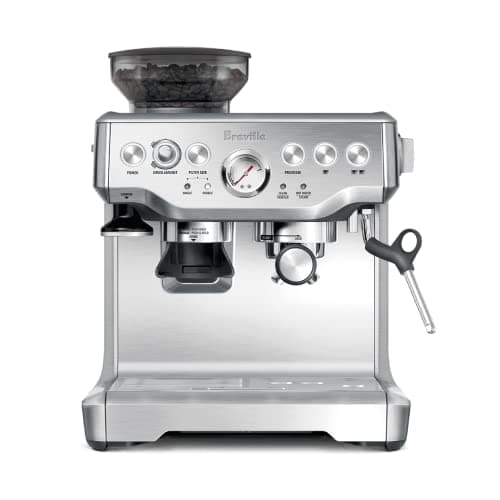 | Buyers who want nothing else to buy or research | Choose this if you do not |
1. Choose this if you own a grinder
Breville Bambino
Entry tier · A compact 54 mm espresso machine with a manual steam wand and no grinder.
Better machine, smaller footprint, and a setup that keeps improving.
The Bambino is the better espresso machine of the two on the specifications that matter for the shot itself. The ThermoJet heater reaches extraction temperature in three seconds where the Barista Express uses a thermocoil that takes considerably longer. Both use a 54 mm portafilter with an 18 g dose, both run low-pressure pre-infusion before 9 bar extraction.
The footprint difference is dramatic and underrated: 11.9 x 6.1 x 13.5 inches against 15.9 x 13.1 x 12.4. On a typical kitchen counter, the Bambino plus a standalone grinder occupies roughly the same width as the Barista Express alone.
What you give up is the grinder, and what you gain by giving it up is the ability to choose one with real adjustment resolution - and to replace it later without replacing the machine.
The steam wand is manual rather than automatic, which is a downgrade if you want convenience and an upgrade if you want to learn.
Specification
- Portafilter
- 54 mm, 18 g dose
- Heating
- ThermoJet, ready in 3 seconds
- Extraction
- Low-pressure pre-infusion, then 9 bar
- Footprint
- 11.9 x 6.1 x 13.5 in
- Grinder
- None - buy separately
What it does well
- Three-second heat-up means it is genuinely usable on a weekday
- The narrowest footprint of any machine here
- Real steam wand you control yourself
Where it gives ground
- No grinder, so the real budget is machine plus grinder
- Manual milk texturing has a learning curve
- Small tank means frequent refills if you pull several drinks
Skip it if
Skip it if the total budget genuinely will not stretch to a grinder. An unfed Bambino is worse than a Barista Express.
2. Choose this if you do not
Breville Barista Express
Mid tier · The all-in-one: espresso machine with a conical burr grinder built into the case.
One purchase, one learning curve, and a permanent ceiling you should know about.
The Barista Express is the right answer for a genuinely common situation: you want espresso, you do not want to research grinders, and you want one thing arriving in one box.
It is a capable machine. PID temperature control at 200 F is a real specification and not a given at this level, and the 54 mm basket is unpressurized so the shot responds to what you do.
The integrated grinder offers 16 settings. Espresso occupies a narrow band of particle size and 16 steps have to cover espresso through French press, so the practical experience is choosing the closest available setting rather than finding the right one. It works; it does not keep getting better.
The other consideration is that the grinder cannot be replaced separately and dies with the machine. Buying the pair separately means each half can be upgraded on its own schedule.
Specification
- Portafilter
- 54 mm stainless
- Grinder
- Integrated conical burr, 16 settings
- Heating
- Thermocoil, 200 F, PID controlled
- Footprint
- 15.9 x 13.1 x 12.4 in
What it does well
- One box, one price, one plug - nothing else to buy
- PID temperature control at this level is not a given
- Enormous owner base, so parts and answers are easy to find
Where it gives ground
- 16 grind settings is coarse resolution for espresso dialing
- The built-in grinder is the weakest component and cannot be upgraded
- Wide footprint for a single-boiler machine
Skip it if
Skip it if you already own a capable grinder - you are buying a second, worse one - or if you expect to keep refining your shots.
The hidden second purchase
The Bambino's price is not its cost. A Bambino needs a grinder capable of espresso-fine adjustment, and that is a purchase of comparable seriousness to the machine itself. The honest comparison is therefore not Bambino against Barista Express, but Bambino plus grinder against Barista Express - and at that level the Bambino setup usually costs more.
What the extra money buys is a grinder with genuine resolution instead of 16 steps. The Baratza Encore ESP, for example, publishes 20 microns per click across its first twenty settings, reserving the coarser steps for filter. That is a different order of control from anything inside an all-in-one, and it is the difference between finding a workable setting and finding the right one.
The counter-space argument, which is not trivial
People assume the all-in-one saves space. On the published dimensions it usually does not by much: the Barista Express is 15.9 inches wide, while a Bambino at 6.1 inches plus a typical standalone grinder lands in the same neighbourhood. What the all-in-one genuinely saves is a second power outlet and a second thing to clean.
Heat-up time changes how often you use it
The three-second ThermoJet heat-up on the Bambino sounds like a marketing number and behaves like a behavioural one. A machine that is ready before you have finished weighing your dose gets used on weekday mornings. A machine that needs a warm-up gets used on weekends. Since the number of shots you pull is the largest single factor in how quickly you improve, this specification has more effect on your coffee than most of the others.
Where the two genuinely tie
Both use a 54 mm unpressurized basket, so both give honest feedback about your grind and both accept the same bottomless portafilters and baskets. Both have manual steam wands. Both are single-heater machines, so neither brews and steams simultaneously. Neither is better at making espresso in a way you would notice if the grind were held constant.
The decision, stated plainly
- Own a burr grinder that reaches espresso-fine? Bambino. Do not buy a second grinder.
- Willing to buy a grinder? Bambino, and put the difference into the grinder.
- Fixed budget, no second purchase, want coffee soon? Barista Express.
- Want to pour latte art eventually? Either - both have manual wands. Avoid the Bambino Plus, whose automatic texturing removes the control.