The published specification
Scroll the table sideways to see every column.
Breville does not publish water tank capacity, weight or wattage on this product page, and we have not substituted figures from a retailer listing. Blank rows stay blank.
Quick picks
The answer first. Tap any row to jump to the full reasoning for that pick.
Prices shown are checked daily against the retailer, as of October 23, 2026. We never write a price into the text of a page.
| # | Product | Best for | Award | Price |
|---|---|---|---|---|
| 1 | 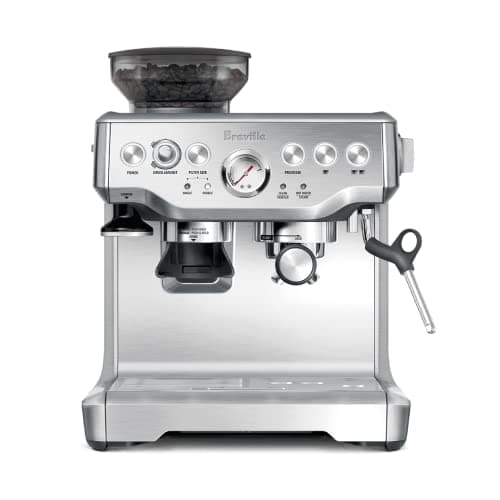 | Buyers who want espresso with exactly one purchase | The machine reviewed | |
| 2 | 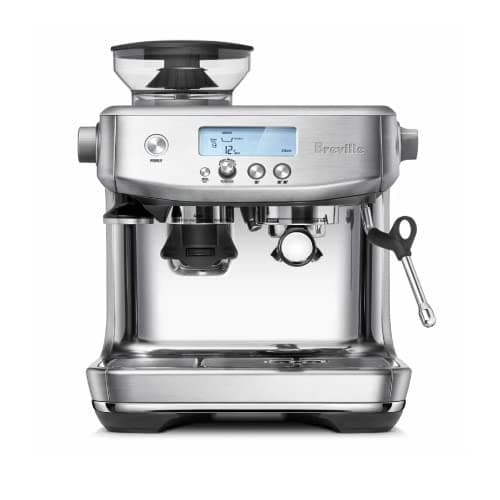 | All-in-one buyers who want the grinder to be less of a bottleneck | The upgrade worth considering | |
| 3 | 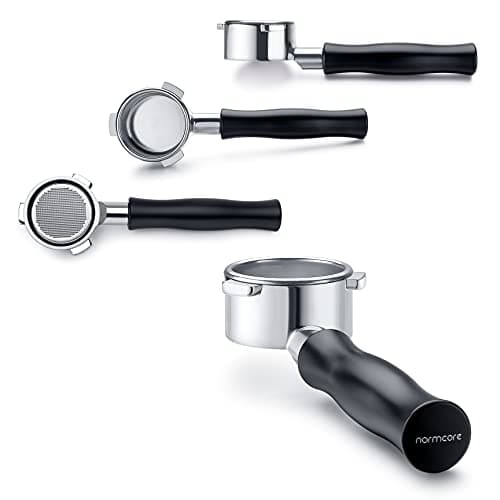 | Anyone whose Barista Express shots are inconsistent | The upgrade that costs almost nothing |
1. The machine reviewed
Breville Barista Express
Mid tier · The all-in-one: espresso machine with a conical burr grinder built into the case.
The right machine for a specific and very common buyer, with a ceiling you should know about first.
The Barista Express is a 54 mm espresso machine with a thermocoil heating system running at 200 F under PID control, and an integrated conical burr grinder with 16 grind settings and dose control, in a body measuring 15.9 x 13.1 x 12.4 inches.
PID temperature control is the specification that separates it from the tier below. Espresso extraction is temperature-sensitive, and a machine that holds a stable brew temperature produces a repeatable shot rather than a lucky one.
The basket is unpressurized, so the shot responds honestly to grind and dose - the feedback loop that lets you actually improve.
The 16 grind settings are the limit and they are permanent. Espresso occupies a narrow band of particle size, and sixteen steps have to cover espresso through French press, so in practice you find the setting closest to right and adjust dose around it. Breville's answer to exactly this is the Barista Express Impress, which publishes 25 settings and an assisted tamp on otherwise identical espresso hardware - reviewed in full here.
Specification
- Portafilter
- 54 mm stainless
- Grinder
- Integrated conical burr, 16 settings
- Heating
- Thermocoil, 200 F, PID controlled
- Footprint
- 15.9 x 13.1 x 12.4 in
What it does well
- One box, one price, one plug - nothing else to buy
- PID temperature control at this level is not a given
- Enormous owner base, so parts and answers are easy to find
Where it gives ground
- 16 grind settings is coarse resolution for espresso dialing
- The built-in grinder is the weakest component and cannot be upgraded
- Wide footprint for a single-boiler machine
Skip it if
Skip it if you already own a capable grinder - you would be buying a worse second one - or if you know you will want to keep refining the shot.
2. The upgrade worth considering
Breville Barista Pro
Mid tier · All-in-one with the fast ThermoJet heater and finer grind adjustment than the Express.
Nearly double the grind resolution and a three-second heat-up, on the same idea.
If the Barista Express's limits are the thing that gives you pause, the Barista Pro addresses both of them directly.
The grinder is upgraded to a Baratza-sourced burr set with 30 grind settings rather than 16 - close to double the resolution, and enough to make dialing in feel like finding the setting rather than picking the least-wrong one.
The heating is upgraded from a thermocoil to a ThermoJet with a three-second heat-up, which changes how often the machine gets used on a weekday.
It is still a single thermoblock, so no simultaneous brew and steam, and at 16.1 x 13.8 x 13.1 inches it is no smaller.
Specification
- Grinder
- Baratza European precision burrs, 30 settings
- Heating
- ThermoJet, 3-second heat-up
- Footprint
- 16.1 x 13.8 x 13.1 in
What it does well
- 30 grind settings - nearly double the Barista Express
- Three-second heat-up in an all-in-one body
- Burrs sourced from Baratza rather than a generic set
Where it gives ground
- Still a single thermoblock: no simultaneous brew and steam
- Large footprint
- Grinder is fixed to the machine lifespan
Skip it if
Skip it if the money would be better spent on a standalone grinder. A Bambino plus a real grinder buys more capability for similar money.
3. The upgrade that costs almost nothing
Normcore 54 mm Bottomless Portafilter
Entry tier · A naked portafilter for 54 mm Breville machines, with a basket included.
Turns the machine's honest feedback into something you can actually see.
If your shots vary and you are wondering whether to replace the machine, buy this first. It fits 54 mm Breville machines including the Barista Express, Barista Pro, Infuser and Duo-Temp, and it comes with a 16-18 g basket.
A bottomless portafilter removes the spouts, so you watch the extraction directly from underneath. Even extraction looks like a single dark stream forming; channeling looks like a jet spraying sideways from one point.
That visual is the fastest diagnostic in home espresso. It tells you whether the problem is distribution, tamping, dose or grind, in about four seconds, without any guessing.
It is made from 304 stainless with an anodized aluminum or walnut handle, and it will spray your kitchen while you learn - which is the point rather than a defect.
Specification
- Fits
- Breville 54 mm: Barista Express, Barista Pro, Infuser, Duo-Temp
- Material
- 304 stainless; anodized aluminum or walnut handle
- Basket
- 16-18 g included
What it does well
- Shows you exactly where the extraction is going wrong - nothing else does that
- Comes with a non-pressurized basket, which is the actual upgrade
- Fits the most common home machine platform in the US
Where it gives ground
- It will spray your kitchen while you learn
- Diagnoses problems; it does not fix them
- Useless without a grinder that can respond to what you see
Skip it if
Skip it if you are not willing to change your routine based on what you see. It diagnoses; it does not fix.
Why this machine sells so well
The Barista Express solves a real problem: someone who wants to make espresso at home has to make two purchasing decisions, and the second one - the grinder - requires knowledge they do not yet have. This machine removes that decision entirely.
That is not a trivial benefit and it is why we recommend it to a specific buyer without hedging. The espresso hardware is genuinely good: PID at 200 F is a real specification, and an unpressurized 54 mm basket means the shot is honest.
The 16-setting ceiling, explained properly
Grind adjustment for espresso is a precision problem. The difference between a shot running in 18 seconds and one running in 32 can be a few dozen microns of burr gap. A grinder with 16 total steps has to spread its entire range - espresso through French press - across those steps, which means each step is a large jump.
In practice this means one setting is too fast and the next is too slow, and you compensate by adjusting the dose. That is a legitimate technique and it works. It is also the reason a standalone grinder with, for instance, 20 microns per click in its espresso range is a different experience - and why so many Barista Express owners eventually buy one and use the machine's grinder for nothing.
The grinder cannot be replaced independently, and it dies with the machine. That is the argument for buying a Bambino and a separate grinder instead, if you can.
Counter space
At 15.9 inches wide and 13.1 deep this is a large appliance, and the common assumption that an all-in-one saves space is only partly true. A compact machine plus a standalone grinder occupies a similar footprint. What the all-in-one genuinely saves is a second outlet and a second thing to clean.
Living with it
- Buy a scale. The machine's dose control is time-based, so it drifts as beans age. A scale removes the guesswork.
- Buy a bottomless portafilter early. It is the cheapest diagnostic available and it fits this machine directly.
- Expect to clean the grinder chute. Integrated grinders retain grounds, and stale retained coffee ends up in the next shot.
- Do not blame the machine for stale beans. A fast, thin shot from old coffee is not a hardware problem.
Verdict
This is a good machine and an honest recommendation for someone who wants one purchase and one learning curve. It is the wrong purchase for someone who already owns a grinder, and it is a limited purchase for someone who intends to keep improving - not because the espresso hardware is weak, but because sixteen grind settings is a ceiling and it is bolted to the machine.