The short answer
Both machines use the same ThermoJet heater and the same 54 mm portafilter size. Buy the Bambino if you will pair it with a capable separate grinder; buy the Barista Pro if you want one machine that works from whole beans with nothing else to buy.
What is actually the same
Scroll the table sideways to see every column.
The heater and the portafilter size are shared, so heating and basket size are not where these two machines differ. They differ in whether the grinder is part of the machine.
Quick picks
The answer first. Tap any row to jump to the full reasoning for that pick.
Prices shown are checked daily against the retailer, as of October 25, 2026. We never write a price into the text of a page.
| # | Product | Best for | Award | Price |
|---|---|---|---|---|
| 1 | 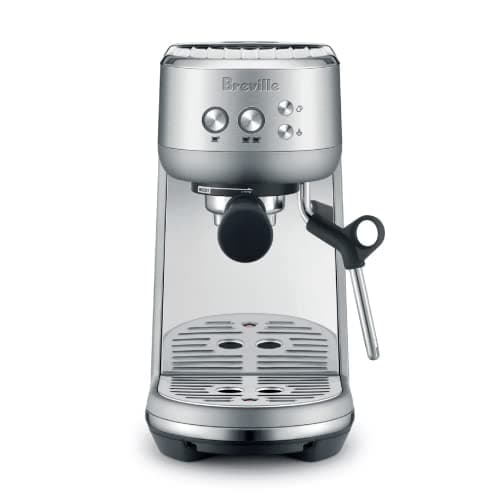 | Anyone who owns, or will buy, a capable espresso grinder | Choose this if you will buy a grinder | |
| 2 | 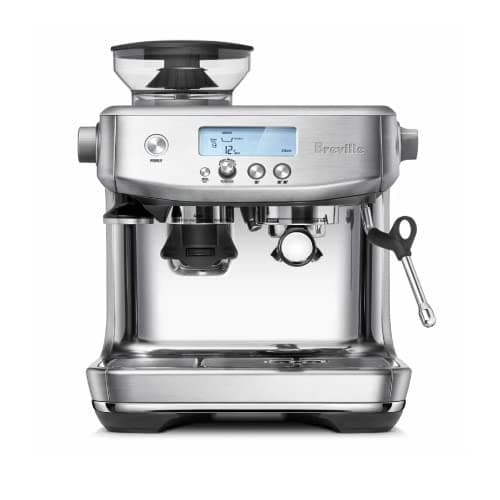 | A first espresso setup with nothing else to buy | Choose this for one box |
1. Choose this if you will buy a grinder
Breville Bambino
Entry tier · A compact 54 mm espresso machine with a manual steam wand and no grinder.
All the money in the brew path, and a grinder you can upgrade separately.
The Bambino is the smallest machine in Breville's range at 11.9 x 6.1 x 13.5 inches, and it has no grinder at all. That absence is the point: the whole machine is a 54 mm brew group, an 18 g basket and a ThermoJet heater that is ready in about three seconds.
Its extraction is the modern Breville recipe - low-pressure pre-infusion, then 9 bar - and on the heating side it gives up nothing to the Barista Pro. Both use the same heating system and the same 54 mm portafilter size.
The steam wand is manual. You hold the pitcher and decide how much air goes in, which is harder on day one and the reason latte art is possible at all.
The catch is the one this site repeats on every Bambino page: without a capable grinder it is the wrong machine. The grinder is not an accessory here; it is the other half of the purchase.
Specification
- Portafilter
- 54 mm, 18 g dose
- Heating
- ThermoJet, ready in 3 seconds
- Extraction
- Low-pressure pre-infusion, then 9 bar
- Footprint
- 11.9 x 6.1 x 13.5 in
- Grinder
- None - buy separately
What it does well
- Three-second heat-up means it is genuinely usable on a weekday
- The narrowest footprint of any machine here
- Real steam wand you control yourself
Where it gives ground
- No grinder, so the real budget is machine plus grinder
- Manual milk texturing has a learning curve
- Small tank means frequent refills if you pull several drinks
Skip it if
Skip it if you do not want a second appliance on the counter. Without a separate grinder the Bambino cannot make good espresso, and the Barista Pro can.
2. Choose this for one box
Breville Barista Pro
Mid tier · All-in-one with the fast ThermoJet heater and finer grind adjustment than the Express.
The same heater with a 30-setting grinder built in, so it works from beans on day one.
The Barista Pro puts a grinder - listed with 30 settings - into the same body as a ThermoJet heater with a three-second heat-up. That combination is the reason to buy it: fast like the Bambino, complete like the Barista Express.
Being complete matters more than it sounds. The most common way a first espresso machine disappoints is pre-ground coffee, and a built-in grinder removes that failure entirely.
The cost is footprint and flexibility. At 16.1 x 13.8 x 13.1 inches it takes considerably more counter than the Bambino, and the grinder inside can never be upgraded - when you outgrow it, you outgrow the machine.
It also cannot serve a pour-over habit well. An integrated espresso grinder is set up for espresso, and moving it back and forth between brew methods is impractical.
Specification
- Grinder
- Baratza European precision burrs, 30 settings
- Heating
- ThermoJet, 3-second heat-up
- Footprint
- 16.1 x 13.8 x 13.1 in
What it does well
- 30 grind settings - nearly double the Barista Express
- Three-second heat-up in an all-in-one body
- Burrs sourced from Baratza rather than a generic set
Where it gives ground
- Still a single thermoblock: no simultaneous brew and steam
- Large footprint
- Grinder is fixed to the machine lifespan
Skip it if
Skip it if you already own a good grinder. You would be paying for a second, lesser one - see the full Breville range.
The grinder is the real purchase
An espresso machine without a good grinder is a machine waiting for one. The Bambino's price only makes sense once a capable grinder is added to it, so the honest comparison is Bambino plus grinder against Barista Pro, not Bambino against Barista Pro.
Made that way, the split setup usually produces the better cup, because a standalone grinder at the same total spend outperforms an integrated one. The Barista Pro's answer is convenience, a single footprint and nothing to research beyond the machine itself - see espresso grinders under $300 for the other half of the split setup.
Counter space and the upgrade path
- The Bambino is the smaller object, but with a grinder beside it the pair usually takes more width than the Barista Pro alone.
- The Barista Pro is one footprint and one socket, which matters in a small kitchen.
- Upgrading the Bambino setup means replacing whichever half is holding you back.
- Upgrading the Barista Pro means replacing the whole machine, grinder and all.