The short answer
Buy the Barista Express if you want one box that does everything. Buy the Bambino if you are buying a grinder separately. Buy the Impress if you want an integrated grinder and consistent tamping. Buy the Barista Pro for speed, and the Dual Boiler if you make milk drinks for a household.
The range, decoded
Breville's naming does not make the differences obvious, and the models overlap heavily on price. In practice there are only three questions: does it grind, how fast does it heat, and can it brew and steam at once.
Scroll the table sideways to see every column.
Quick picks
The answer first. Tap any row to jump to the full reasoning for that pick.
Prices shown are checked daily against the retailer, as of October 25, 2026. We never write a price into the text of a page.
| # | Product | Best for | Award | Price |
|---|---|---|---|---|
| 1 | 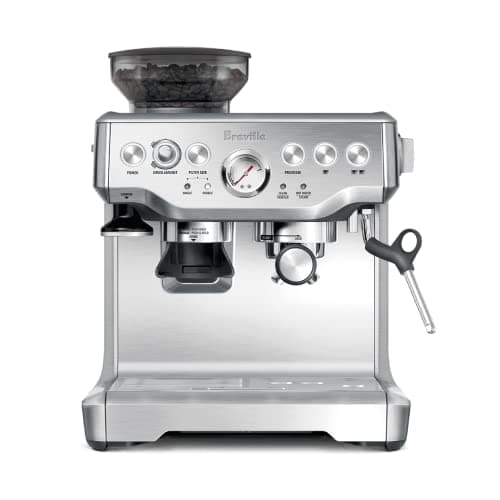 | A first real espresso setup with no second purchase | Top pick | |
| 2 | 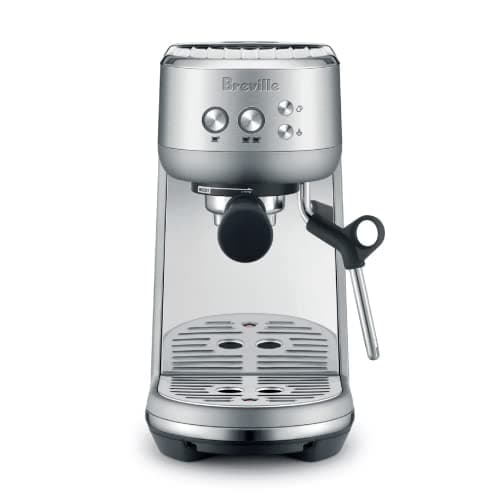 | Anyone who already owns a grinder, or is buying one separately | Best value | |
| 3 | 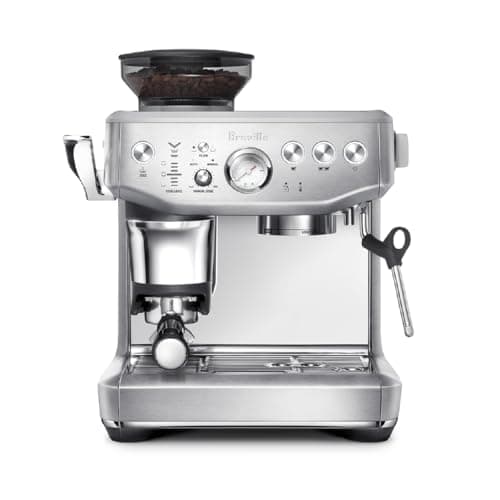 | Someone who wants an integrated grinder without learning to tamp | Best for consistency | |
| 4 | 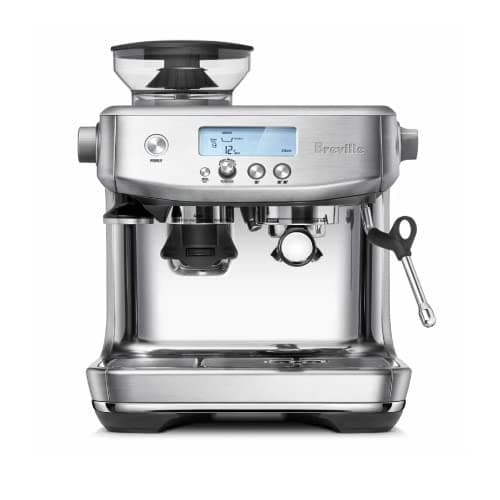 | Daily milk drinks from an integrated-grinder machine | Best all-rounder | |
| 5 | 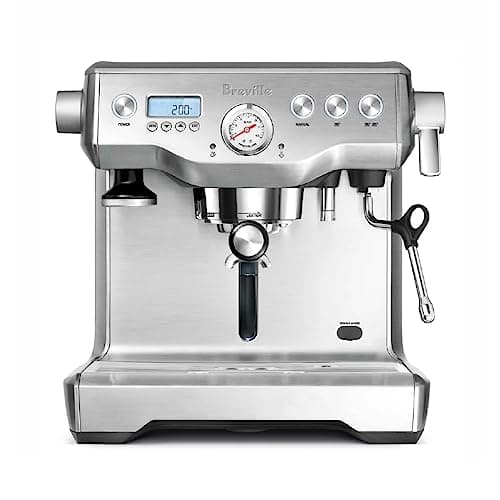 | Milk drinks for several people, or someone who has outgrown a single boiler | Best if money is not the constraint | |
| 6 | 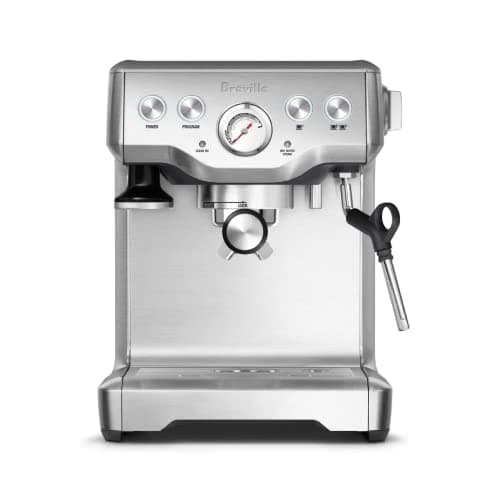 | Almost nobody, at current prices | Skip this |
1. Top pick
Breville Barista Express
Mid tier · The all-in-one: espresso machine with a conical burr grinder built into the case.
One box, one price, and everything you need to make espresso from beans on day one.
The Barista Express is the machine that made this category mainstream, and the reason is that it removes the decision that stops most people: it has a conical burr grinder built in.
That matters more than any specification on it. The most common way a home espresso project fails is that someone buys a machine, uses pre-ground coffee, gets sour shots, and concludes espresso is hard. With an integrated grinder that failure mode is gone.
You still pull the shot yourself. You dose into a portafilter, tamp it with the supplied tamper, lock it in and time the extraction. The machine gives you the inputs; you make the decisions.
Its limitations are real and worth knowing before you buy. The tamping is manual and inconsistent tamping is the most common beginner error, and it uses a thermocoil rather than a dual boiler, so you brew and then steam rather than doing both at once.
Specification
- Portafilter
- 54 mm stainless
- Grinder
- Integrated conical burr, 16 settings
- Heating
- Thermocoil, 200 F, PID controlled
- Footprint
- 15.9 x 13.1 x 12.4 in
What it does well
- One box, one price, one plug - nothing else to buy
- PID temperature control at this level is not a given
- Enormous owner base, so parts and answers are easy to find
Where it gives ground
- 16 grind settings is coarse resolution for espresso dialing
- The built-in grinder is the weakest component and cannot be upgraded
- Wide footprint for a single-boiler machine
Skip it if
Skip it if you already own a good grinder. You would be paying for a second one, and a grinderless machine puts that money into the brew group instead.
2. Best value
Breville Bambino
Entry tier · A compact 54 mm espresso machine with a manual steam wand and no grinder.
Three-second heat-up and a manual steam wand, with the grinder budget left in your pocket.
The Bambino is the argument against integrated grinders, and it is a strong one. It is small, it heats in about three seconds, and its manual steam wand leaves milk texture in your hands - harder at first, and the route to latte art.
Because there is no grinder inside, all of the money went into the brew and steam systems - and the money you did not spend can buy a standalone grinder that is better than any built-in unit.
That combination is the enthusiast's standard recommendation for a reason. A separate grinder can be upgraded independently, serviced independently, and used for pour-over as well.
The three-second heat-up is not marketing. It changes whether you make espresso on a weekday morning, which is ultimately what determines whether the machine was worth buying.
Specification
- Portafilter
- 54 mm, 18 g dose
- Heating
- ThermoJet, ready in 3 seconds
- Extraction
- Low-pressure pre-infusion, then 9 bar
- Footprint
- 11.9 x 6.1 x 13.5 in
- Grinder
- None - buy separately
What it does well
- Three-second heat-up means it is genuinely usable on a weekday
- The narrowest footprint of any machine here
- Real steam wand you control yourself
Where it gives ground
- No grinder, so the real budget is machine plus grinder
- Manual milk texturing has a learning curve
- Small tank means frequent refills if you pull several drinks
Skip it if
Skip it if you will not buy a grinder. Without one this is the wrong machine, and the Barista Express is the right one.
3. Best for consistency
Breville Barista Express Impress
Mid tier · The Barista Express with assisted tamping and dose correction added.
The assisted tamping mechanism removes the single most common beginner error.
The Impress addresses the Barista Express's weakest point directly. Instead of you pressing a tamper into the basket by hand and hoping for a level, repeatable result, a lever mechanism does it with consistent force.
Inconsistent tamping is the reason a lot of beginners get one good shot and one bad shot from the same beans on the same setting. Removing that variable removes most of the confusion in the first month.
It also handles dosing more intelligently, adjusting the grind time based on what went in, which reduces the retained-grounds drift that affects every integrated grinder.
It costs meaningfully more than the standard Barista Express for what is, functionally, a better tamping arm. Whether that is worth it depends on whether you would enjoy learning to tamp or would rather never think about it - our review of the Impress settles it against Breville's own published figures for both machines.
Specification
- Grinder
- Conical burr, 25 settings
- Basket
- Double basket, up to 19 g
- Tamping
- Assisted lever, 10 kg / 22 lb, 7-degree twist
- Dosing
- Adjusts grind time from the previous shot puck depth
What it does well
- Removes tamp pressure as a variable, which is the hardest one to keep consistent
- 25 grind settings against the Barista Express 16
- Dose feedback on the front panel tells you when you are out of range
Where it gives ground
- Solves a problem a calibrated tamper also solves, for far less
- Same integrated-grinder ceiling as the Barista Express
- The automation is the product; the espresso hardware is unchanged
Skip it if
Skip it if you find the process interesting. Learning to tamp takes about a week and the standard Barista Express saves you real money.
4. Best all-rounder
Breville Barista Pro
Mid tier · All-in-one with the fast ThermoJet heater and finer grind adjustment than the Express.
A thermojet heater and a digital display - the Barista Express with its two real annoyances fixed.
The Barista Pro is what you buy when the Barista Express's waiting bothers you. It uses a thermojet heating system that reaches temperature in seconds rather than tens of seconds, and the transition between brewing and steaming is dramatically shorter.
If you make one drink a day, this matters little. If you make three on a weekend morning, the difference between the two machines is most of the experience.
It also adds a digital display showing shot timing and grind settings, which sounds cosmetic and is not - having the shot timer in front of you is how you learn to read an extraction.
It has the same manual tamping as the Barista Express, so if tamping consistency is your concern rather than speed, the Impress addresses that instead. For the full specification, including the one figure Breville does not publish for it, see our Barista Pro review.
Specification
- Grinder
- Baratza European precision burrs, 30 settings
- Heating
- ThermoJet, 3-second heat-up
- Footprint
- 16.1 x 13.8 x 13.1 in
What it does well
- 30 grind settings - nearly double the Barista Express
- Three-second heat-up in an all-in-one body
- Burrs sourced from Baratza rather than a generic set
Where it gives ground
- Still a single thermoblock: no simultaneous brew and steam
- Large footprint
- Grinder is fixed to the machine lifespan
Skip it if
Skip it if you make one drink a day. The Barista Express makes the same coffee and the waiting will not bother you.
5. Best if money is not the constraint
Breville Dual Boiler
Prosumer tier · A true dual-boiler 58 mm machine: brew and steam at once, PID on the brew boiler.
Separate brew and steam boilers, so both happen at once and both hold temperature properly.
Every other Breville here heats one water path and switches it between brewing and steaming. The Dual Boiler has two independent boilers, each held at its own temperature, so you can brew and steam simultaneously.
For one person making one drink, that is a luxury. For someone making four flat whites for guests, it is the difference between a smooth ten minutes and a frustrating twenty.
The second benefit is thermal stability. A dedicated brew boiler held at a controlled temperature does not sag during a shot the way a shared heater can, and shot-to-shot consistency improves visibly.
It is large, heavy, and by some distance the most expensive machine on this page. It is also the last espresso machine a lot of people buy.
Specification
- Portafilter
- 58 mm stainless, 22 g dose
- Boilers
- Dual stainless steel, separate espresso and steam
- Control
- PID on the espresso boiler
- Extraction
- Low-pressure pre-infusion, then 9 bar
- Footprint
- 37.9 x 40.3 x 37.1 cm
What it does well
- Brew and steam simultaneously - the actual reason to buy dual boiler
- 58 mm commercial basket size opens the whole accessory market
- PID plus programmable pre-infusion
Where it gives ground
- Big, heavy and power-hungry
- Overkill if you drink one straight espresso a day
- Still needs a grinder at a matching level to be worth it
Skip it if
Skip it if you drink espresso without milk. Nearly all of the extra money buys steam capability you would never use - see the dual boiler roundup.
6. Skip this
Breville Infuser
Mid tier · A grinder-less 54 mm machine with PID and a larger tank than the Bambino line.
Superseded from both directions - the Bambino does its job smaller, faster and cheaper.
The Infuser was a good machine and the range has moved around it. It has no grinder, which puts it against the Bambino, and the Bambino is smaller, heats far faster and generally costs less.
Its remaining argument is a manual steam wand rather than the Bambino Plus's automatic one, which some people genuinely prefer because it gives full control over milk texture. The standard Bambino has a manual wand too, though, so the argument is narrower than it first looks.
Against machines with integrated grinders it loses on completeness, and against the Bambino it loses on speed and footprint. It sits in a gap that the current range has closed from both sides.
If you find one heavily discounted it is not a bad machine. At normal prices there is a better Breville for whatever you were going to use it for.
Specification
- Portafilter
- 54 mm stainless, commercial-style spouts
- Heating
- 1650 W thermocoil with electronic PID
- Water tank
- 61 fl oz / 1.8 L, removable, filtered
- Extraction
- Low-pressure pre-infusion
What it does well
- PID plus a big tank at a grinder-less price
- Auto-purge resets brew temperature after steaming
- Pairs well with a serious standalone grinder
Where it gives ground
- Slower to heat than the ThermoJet machines
- Older design; the Bambino line gets more attention
- Manual steam wand only
Skip it if
Skip it unless you specifically want a manual wand on a grinderless Breville and found a genuine discount.
Integrated grinder or not
This is the decision the whole range hangs on, and it is not primarily about money. An integrated grinder is convenient and cannot be upgraded; a separate grinder costs counter space and can.
The enthusiast answer is a Bambino plus a good standalone grinder, and it is genuinely the better coffee. The honest counter-argument is that two appliances is two appliances, and a lot of people who buy the split setup wish they had bought one box - see our built-in grinder roundup for that comparison in full.
Thermocoil against thermojet
Both are heat-on-demand systems rather than tanks of hot water, which is why no Breville here takes twenty minutes to warm up the way a traditional machine does. The thermojet is the newer design and reaches temperature in seconds.
The practical difference shows up between brewing and steaming. On a thermocoil machine you wait for the heater to change temperature; on a thermojet the wait is short enough not to interrupt what you are doing.
What none of them do
No machine on this page profiles pressure. A vibration pump delivers essentially one pressure through the shot, and the pre-infusion on these machines is a low-pressure phase rather than a curve you control.
If pressure control is what you are after, a manual lever gives you more of it than any Breville, for a fraction of the money and none of the convenience.