
The short answer
Both are immersion brewers, so both are forgiving of grind inconsistency. The AeroPress filters through paper and finishes with a plunge: clean, no sediment, one or two cups, two minutes. The French press filters through steel mesh and finishes by gravity: heavier body, some sediment, three or four cups, four minutes and a real clean-up.
Side by side
Scroll the table sideways to see every column.
Quick picks
The answer first. Tap any row to jump to the full reasoning for that pick.
Prices shown are checked daily against the retailer, as of October 23, 2026. We never write a price into the text of a page.
| # | Product | Best for | Award | Price |
|---|---|---|---|---|
| 1 | 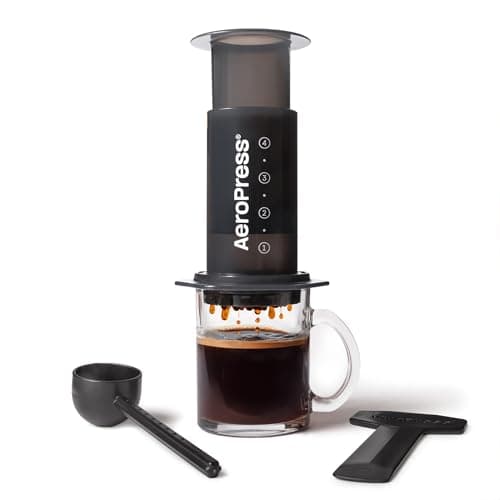 | One or two cups, quickly, with minimal cleanup | Choose this for a clean cup, fast | |
| 2 | 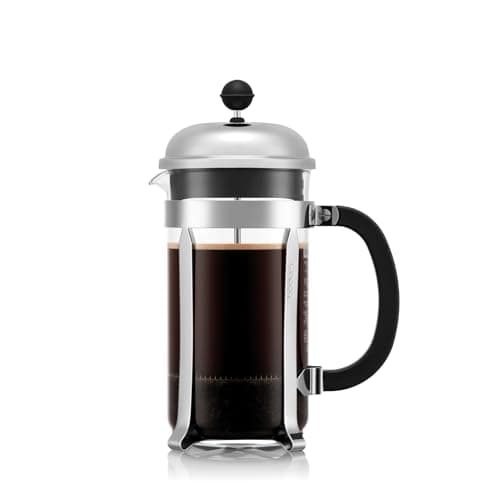 | Three or four cups with the fullest possible texture | Choose this for body and volume |
1. Choose this for a clean cup, fast
AeroPress Original
Manual tier · A hand-pressed immersion brewer using a paper or metal filter.
Immersion forgiveness with a paper filter and a two-minute total time.
The AeroPress brews up to 10 oz, makes 1 to 3 cups and weighs about 6.5 oz. Coffee steeps in the chamber and is then pressed through a paper or metal filter by hand.
The paper filter is the key difference from a French press: it traps oils and fines, so the cup is clean and has no sediment. If gritty coffee at the bottom of the mug bothers you, this removes the problem entirely.
It is also fast. Brew time is typically under two minutes, and cleanup is pushing the puck into the bin and rinsing - about ten seconds.
Because it is immersion, it is far more forgiving of grinder inconsistency than any pour-over method. That makes it the single best brewer to pair with an entry-level grinder.
Specification
- Capacity
- 10 oz, 1-3 cups
- Weight
- About 6.5 oz
- Filters
- Paper or metal mesh
What it does well
- Almost impossible to brew a bad cup with
- Forgiving of grinder inconsistency in a way pour-over is not
- Cleans up in about ten seconds
Where it gives ground
- Not espresso, whatever the marketing around it says
- One or two cups at a time
- Plunging takes real hand pressure
Skip it if
Skip it if you need to brew for more than two people. The XL exists for that, and the original does not stretch.
2. Choose this for body and volume
Bodum Chambord French Press
Budget tier · The classic 34 oz French press: borosilicate carafe in a chrome-plated steel frame.
No consumables, more body, and it makes four cups without thinking.
The Chambord is a 34 oz borosilicate carafe in a chrome-plated steel frame with a stainless mesh plunger, made in Portugal, serving 3 to 4 cups.
Its mesh filter lets oils and fine particles through, which is what produces the heavy, textured cup a French press is known for. A paper filter cannot make that coffee, and that is the whole reason to own one.
There are no consumables at all - no papers, no capsules, no proprietary anything. Once bought, the running cost is coffee.
The mesh is also why sediment settles at the bottom of the cup, and why a grinder producing lots of fines turns the last mouthful to silt.
Specification
- Capacity
- 34 oz, 3-4 cups
- Carafe
- Borosilicate glass
- Filter
- Stainless steel mesh plunger
- Frame
- Chrome-plated steel, made in Portugal
What it does well
- No paper, no capsules, no consumables at all
- Full-bodied cup that no paper filter can produce
- Every part is replaceable and cheap
Where it gives ground
- Metal mesh lets fines and oils through - that is the trade, not a defect
- Punishes an inconsistent grinder harder than any other brewer
- Glass carafe in a household with a tile floor
Skip it if
Skip it if sediment bothers you, or if your grinder produces a lot of fines - a French press displays exactly what a paper filter would hide.
The filter decides the cup
Both brewers steep the coffee, so extraction is broadly similar. The difference arrives at separation. A paper filter traps the oils and the very fine particles; a steel mesh passes both.
Oils carry a lot of what we perceive as body and richness, and fines carry texture. That is why French press coffee feels heavier in the mouth and why AeroPress coffee tastes cleaner and more defined.
You can move an AeroPress toward the French press character by using its metal filter instead of paper, which is a genuinely useful thing to know before buying both.
Cleanup is a bigger difference than it sounds
The AeroPress ejects a compact, nearly dry puck straight into the bin, and the chamber rinses in seconds. A French press leaves wet grounds in a carafe that cannot go down the sink, so it means a spoon, a bin and a rinse - every time.
This is the reason many households own a French press that lives in a cupboard. It is not a flaw in the brewer, but it is the practical fact that decides which one gets used on a Tuesday.
How much does your grinder matter?
Less than for pour-over, for both - immersion gives every particle the same contact time, so a wide particle spread produces a slightly muddled cup rather than a channeled one.
But the French press is more exposed than the AeroPress, because its mesh passes the fines straight into the cup. If your grinder produces a lot of dust, an AeroPress with a paper filter hides it and a French press displays it. Our grinder picks cover what to look for.
Batch size
An AeroPress makes up to 10 oz and realistically one or two cups. A 34 oz Chambord serves three or four. For a household, this is often the whole decision - and the AeroPress XL at 20 oz narrows the gap without closing it.