The short answer
A distribution tool - a spinning leveler - flattens the surface of the coffee bed so the tamp compresses it evenly. It does not break up clumps below the surface, which is where channeling actually starts. Buy a WDT needle tool first, then add a leveler if you want the bed finished properly.
The three puck-prep problems, and which tool solves each
Scroll the table sideways to see every column.
Marketing routinely blurs the first two, because both tools are described as distributing. They are not doing the same thing, and buying the leveler for a clumping problem is the most common wasted purchase in this category.
Quick picks
The answer first. Tap any row to jump to the full reasoning for that pick.
Prices shown are checked daily against the retailer, as of October 23, 2026. We never write a price into the text of a page.
| # | Product | Best for | Award | Price |
|---|---|---|---|---|
| 1 | 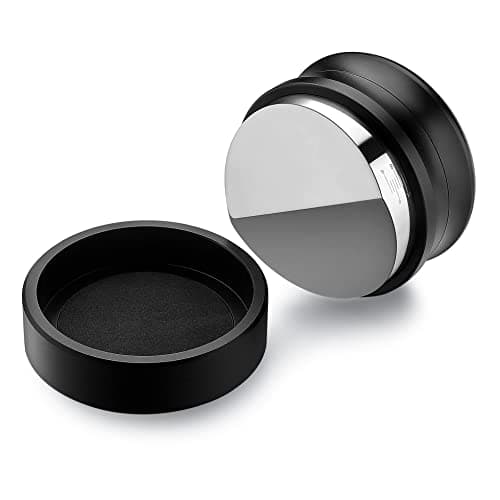 | 58 mm machines, after the grounds are in the basket | Top pick | |
| 2 | 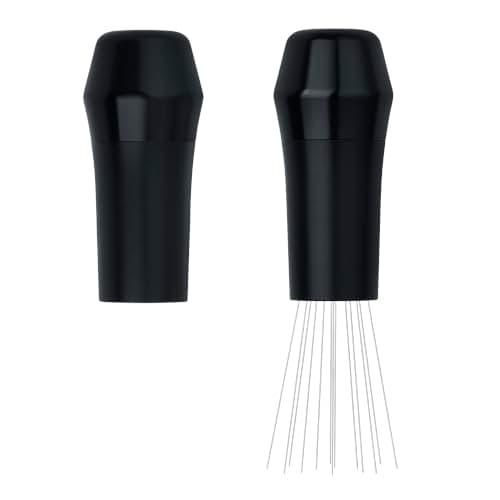 | Buying first, before any leveler | The more important tool | |
| 3 | 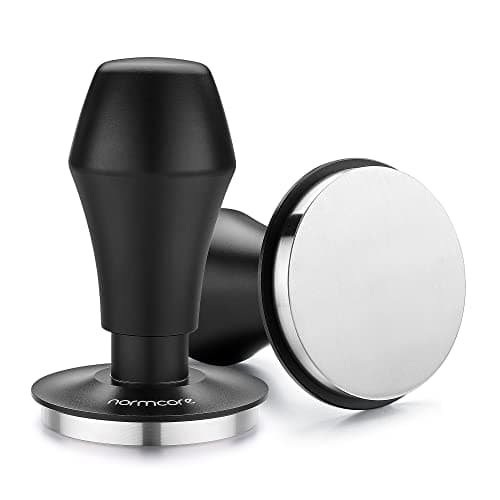 | Completing the puck-prep sequence | The third step | |
| 4 | 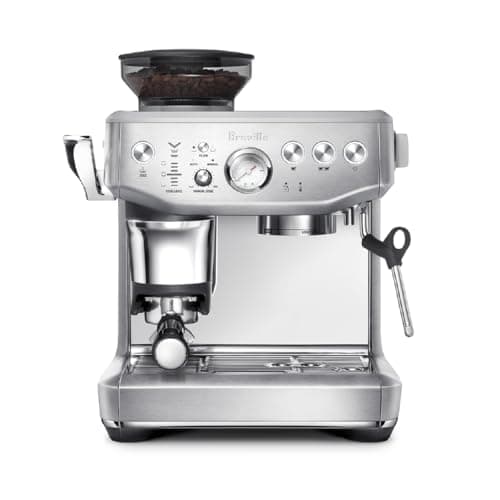 | Multi-user households | Skip this as a distribution fix |
1. Top pick
Normcore Coffee Distribution Tool
Entry tier · A depth-adjustable leveler that flattens the grounds before tamping.
Adjustable depth from 4 to 12 mm, which is the specification that makes a leveler usable.
The Normcore leveler is 58.5 mm, fitting standard 58 mm baskets, and covers a wide range of machines: Rancilio, Gaggia, La Pavoni, ECM, La Marzocco, Flair 58, Rocket, Breville, Astoria and E61 groups generally.
The adjustable depth from 4 mm to 12 mm is the feature that matters. Fixed-depth levelers only work at one dose, and if your dose changes with the coffee, the tool either does nothing or starts compressing the bed.
The base is food-grade 304 stainless with two angled planes and an anodized aluminum handle. In use it goes onto the un-tamped grounds straight from the grinder and gets twisted two or three times in either direction.
Set the depth so it just engages the surface at your normal dose. Too deep and it does nothing at all; too shallow and it pre-compresses unevenly. Both failures are invisible from above.
Specification
- Size
- 58.5 mm, fits standard 58 mm baskets
- Depth
- Adjustable 4 mm to 12 mm
- Base
- Food-grade 304 stainless, two angled planes
- Handle
- Anodized aluminum
What it does well
- Levels the bed in two or three twists with no technique to learn
- Adjustable depth means it works with your dose, not a fixed one
- Fits essentially every 58 mm machine
Where it gives ground
- Levels the surface; it does not fix clumping underneath - that is the WDT tool job
- One more thing to clean
- Wrong depth setting makes it useless, and the failure is invisible
Skip it if
Skip it if your machine is 54 mm. Buy the matching size - a 58.5 mm tool does not work in a 54 mm basket.
2. The more important tool
Normcore WDT Tool V4
Entry tier · A retractable needle tool for breaking up clumps in the basket before tamping.
Fixes clumping through the bed, which a leveler cannot reach.
This is the tool a distribution tool is often sold as replacing, and it does not. A leveler flattens the surface; the needles break up clumps through the full depth of the bed.
Clumps below the surface are where channeling starts. A perfectly flat, perfectly tamped bed with a dense clump 4 mm down will still send water around that clump.
The Normcore WDT V4 has nine needles with 0.3 mm and 0.4 mm sets included, 304 stainless needles in an anodized aluminum handle, in 54 mm and 58 mm. The needles retract with a twist so they store without bending.
If you can only buy one of the two, buy this one, and use it properly - stirring through the whole depth rather than skimming the top.
Specification
- Needles
- 9 needles; 0.3 mm and 0.4 mm sets included
- Material
- 304 stainless needles, anodized aluminum handle
- Mechanism
- Twist to extend or retract
- Sizes
- 54 mm and 58 mm
What it does well
- The cheapest meaningful improvement to an espresso shot, by some distance
- Retracting needles means it lives in a drawer without bending
- Two needle gauges cover fine and coarser grinds
Where it gives ground
- Adds a step to every single shot
- Needles will eventually bend whatever you do
- Does nothing at all for filter coffee
Skip it if
Skip it only if you already own one. There is no espresso setup that does not benefit.
3. The third step
Normcore Spring-Loaded Tamper V4
Mid tier · A calibrated tamper with interchangeable springs and a self-leveling plate.
Leveling then tamping square is the sequence; this handles the second half.
Once the bed is de-clumped and leveled, the tamp needs to be square and consistent. The Normcore V4 handles both with a leveling plate that rests on the basket rim and interchangeable 15 lb, 25 lb and 30 lb springs.
It comes in 51 mm, 53.3 mm, 58 mm and 58.5 mm with a 304 stainless base in flat or ripple.
Together with a needle tool and a leveler, this makes puck preparation a fixed procedure rather than a variable one - which is the whole point of buying any of these.
It is heavier and clunkier than a plain tamper, and the calibration click takes getting used to.
Specification
- Sizes
- 51 mm, 53.3 mm, 58 mm, 58.5 mm
- Springs
- 15 lb, 25 lb and 30 lb included
- Base
- 304 stainless, flat or ripple
- Leveling
- Plate rests on the basket rim as you press
What it does well
- Removes tamp pressure and tamp angle as variables in one purchase
- Three springs let you find the pressure your machine likes
- Costs a fraction of the machines that automate the same thing
Where it gives ground
- Heavier and clunkier than a plain tamper
- The click can be mistaken for the end of the stroke
- You must buy the size that matches your basket exactly
Skip it if
Skip it if you already tamp level and consistently. This is a fix for a specific problem, not a universal upgrade.
4. Skip this as a distribution fix
Breville Barista Express Impress
Mid tier · The Barista Express with assisted tamping and dose correction added.
It automates tamping, not distribution - and it costs the price of a machine.
The Impress is often suggested to people looking at distribution tools, and it is worth being precise about what it does.
It automates tamping - a lever applying a consistent 10 kg with a 7-degree twist - and dosing, adjusting grind time from the previous shot's puck depth. It has 25 grind settings and takes up to 19 g in a double basket.
What it does not do is distribute. Nothing in that mechanism breaks up clumps or levels the bed before the tamp arrives.
So it solves consistency across people rather than channeling within a puck, and it does so for the price of an espresso machine rather than the price of a hand tool.
Specification
- Grinder
- Conical burr, 25 settings
- Basket
- Double basket, up to 19 g
- Tamping
- Assisted lever, 10 kg / 22 lb, 7-degree twist
- Dosing
- Adjusts grind time from the previous shot puck depth
What it does well
- Removes tamp pressure as a variable, which is the hardest one to keep consistent
- 25 grind settings against the Barista Express 16
- Dose feedback on the front panel tells you when you are out of range
Where it gives ground
- Solves a problem a calibrated tamper also solves, for far less
- Same integrated-grinder ceiling as the Barista Express
- The automation is the product; the espresso hardware is unchanged
Skip it if
Skip it if distribution is the problem you are trying to solve. Two hand tools do more for a small fraction of the cost.
Depth adjustment is the specification
A leveler works by resting on the rim of the basket and sweeping at a fixed height above the bottom. That height needs to match your dose: too high and the blades never touch the coffee, too low and they compress it rather than leveling it.
A fixed-depth tool only works at one dose. If you use 18 g with one coffee and 20 g with another - which is normal, because different roasts want different doses - the tool is wrong for one of them.
That is why adjustable depth is worth insisting on rather than treating as a bonus feature.
How to set it
- 1Dose your normal amount into the basket and level it roughly by tapping.
- 2Rest the tool on the basket rim and check where the blades sit relative to the coffee.
- 3Adjust until the blades just engage the surface - you should feel light resistance, not compression.
- 4Twist two or three times in each direction. The surface should end flat, with the coffee still loose underneath.
- 5Tamp. If you feel the tool compressing rather than sweeping, it is set too deep.
Is it worth buying at all?
Honestly: it is the third most useful tool in this category, and its effect is smaller than the first two. If you have a needle tool and a decent tamper and your extractions still look uneven through a bottomless portafilter, a leveler is a reasonable next step.
If you do not yet own a needle tool, buy that instead. It costs less and it addresses the bigger problem.