The short answer
WDT stands for Weiss Distribution Technique: stirring the ground coffee in the basket with fine needles before tamping, to break up clumps. Clumps create low-resistance paths that water rushes through instead of extracting evenly, and no amount of careful tamping removes them. It is the cheapest meaningful improvement in espresso.
What clumping actually does
Ground coffee leaving a grinder does not arrive as loose powder. Static and the geometry of the chute make it clump, and those clumps land in the basket as dense pockets surrounded by looser coffee.
Water under nine bars of pressure takes the easiest route available. It goes around a dense clump rather than through it, which means the coffee in that clump is barely extracted while the coffee along the channel is over-extracted.
The result tastes bitter and sour simultaneously, which is the flavor signature that confuses people most - because the instinctive fixes for each pull in opposite directions.
Quick picks
The answer first. Tap any row to jump to the full reasoning for that pick.
Prices shown are checked daily against the retailer, as of October 23, 2026. We never write a price into the text of a page.
| # | Product | Best for | Award | Price |
|---|---|---|---|---|
| 1 | 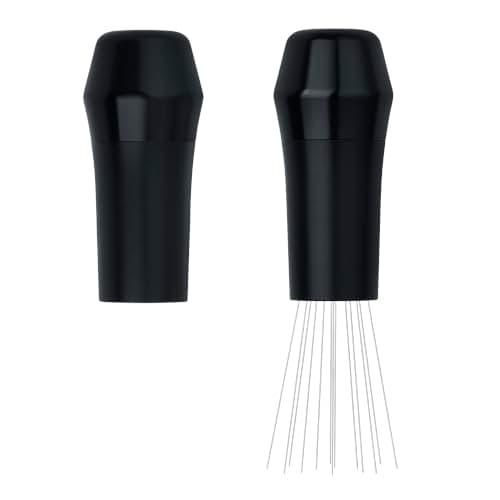 | Almost everyone making espresso | Top pick | |
| 2 | 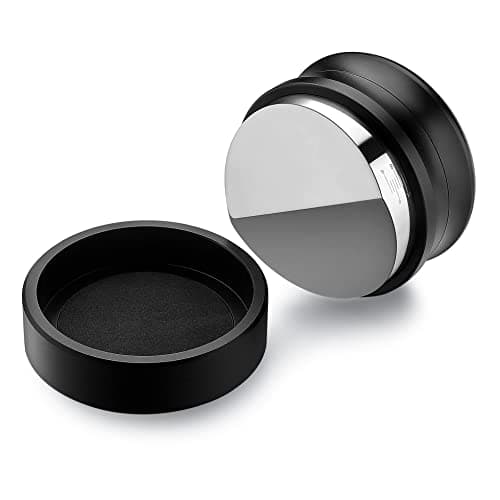 | Finishing the bed before tamping | The companion tool | |
| 3 | 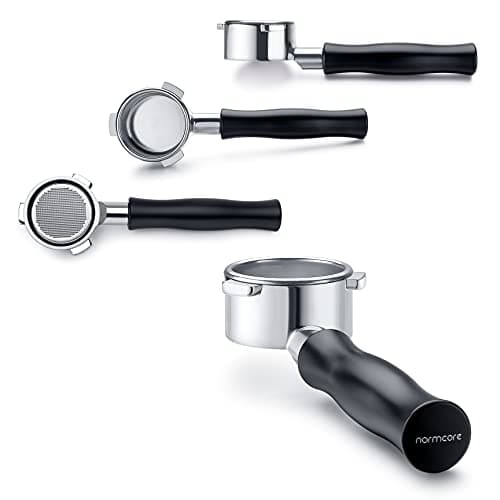 | Breville 54 mm owners diagnosing their puck prep | How you find out whether it worked | |
| 4 | 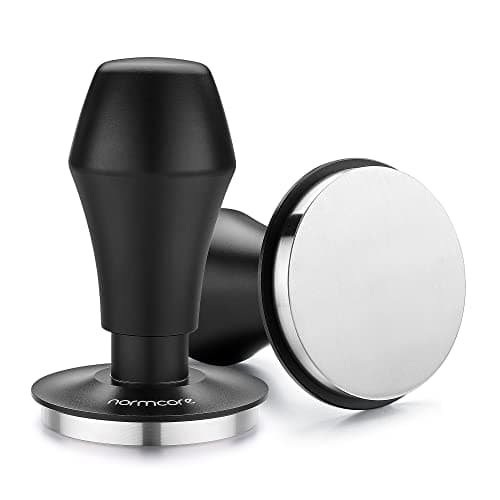 | After the needle tool | Skip this first |
1. Top pick
Normcore WDT Tool V4
Entry tier · A retractable needle tool for breaking up clumps in the basket before tamping.
Two needle gauges, retractable, and built to survive a drawer.
The Normcore WDT V4 has nine needles and ships with both 0.3 mm and 0.4 mm sets, in 304 stainless with an anodized aluminum CNC handle, in 54 mm and 58 mm versions.
The retractable mechanism is the design decision that matters practically. A twist extends or retracts the needles, so the tool stores safely and does not arrive back from the drawer with three needles bent sideways. Fine needles bend easily and a bent needle scratches the basket.
Two gauges is a genuine distinction rather than packaging. Finer 0.3 mm needles pass more easily through a very fine espresso grind; 0.4 mm is stiffer and better for coarser doses.
The needles are soft enough not to scratch the bottom of the basket, which matters because you are stirring against it every shot.
Specification
- Needles
- 9 needles; 0.3 mm and 0.4 mm sets included
- Material
- 304 stainless needles, anodized aluminum handle
- Mechanism
- Twist to extend or retract
- Sizes
- 54 mm and 58 mm
What it does well
- The cheapest meaningful improvement to an espresso shot, by some distance
- Retracting needles means it lives in a drawer without bending
- Two needle gauges cover fine and coarser grinds
Where it gives ground
- Adds a step to every single shot
- Needles will eventually bend whatever you do
- Does nothing at all for filter coffee
Skip it if
Skip it if you only brew filter coffee. WDT addresses clumping in a compacted espresso puck and does nothing elsewhere.
2. The companion tool
Normcore Coffee Distribution Tool
Entry tier · A depth-adjustable leveler that flattens the grounds before tamping.
Levels the surface after the needles have broken up the depth.
A needle tool breaks up clumps through the depth of the bed and leaves the surface uneven. A distribution tool flattens that surface so the tamp compresses evenly.
The Normcore leveler is 58.5 mm and fits standard 58 mm baskets, with an adjustable depth from 4 mm to 12 mm so it can be set for your actual dose.
The base is food-grade 304 stainless with two angled planes: rest it on the un-tamped grounds and twist two or three times.
Set the depth so it just engages the surface at your normal dose. Set too deep it does nothing; set too shallow it compresses rather than levels, and neither failure is visible.
Specification
- Size
- 58.5 mm, fits standard 58 mm baskets
- Depth
- Adjustable 4 mm to 12 mm
- Base
- Food-grade 304 stainless, two angled planes
- Handle
- Anodized aluminum
What it does well
- Levels the bed in two or three twists with no technique to learn
- Adjustable depth means it works with your dose, not a fixed one
- Fits essentially every 58 mm machine
Where it gives ground
- Levels the surface; it does not fix clumping underneath - that is the WDT tool job
- One more thing to clean
- Wrong depth setting makes it useless, and the failure is invisible
Skip it if
Skip it if you are buying one tool. The needles fix the bigger problem and this is the refinement.
3. How you find out whether it worked
Normcore 54 mm Bottomless Portafilter
Entry tier · A naked portafilter for 54 mm Breville machines, with a basket included.
The only way to see channeling rather than guess at it.
WDT is a technique whose whole purpose is preventing channeling, and channeling is invisible through a spouted portafilter. A bottomless portafilter is how you check.
This one fits 54 mm Breville machines - Barista Express, Barista Pro, Infuser, Duo-Temp - in 304 stainless with an anodized aluminum or walnut handle, and includes a 16-18 g basket.
An even extraction looks like a single dark stream forming and dripping evenly from the basket. Channeling looks like a jet spraying sideways from one point, and it is unmistakable once you have seen it.
That feedback is what makes the needle tool worth using properly rather than performatively. Without it you are stirring the coffee and hoping.
Specification
- Fits
- Breville 54 mm: Barista Express, Barista Pro, Infuser, Duo-Temp
- Material
- 304 stainless; anodized aluminum or walnut handle
- Basket
- 16-18 g included
What it does well
- Shows you exactly where the extraction is going wrong - nothing else does that
- Comes with a non-pressurized basket, which is the actual upgrade
- Fits the most common home machine platform in the US
Where it gives ground
- It will spray your kitchen while you learn
- Diagnoses problems; it does not fix them
- Useless without a grinder that can respond to what you see
Skip it if
Skip it if your machine is 58 mm - buy the 58 mm version instead. Fitment is not optional.
4. Skip this first
Normcore Spring-Loaded Tamper V4
Mid tier · A calibrated tamper with interchangeable springs and a self-leveling plate.
A good tamper, and the second purchase rather than the first.
The Normcore V4 is a very good calibrated tamper - 51 mm through 58.5 mm, with 15 lb, 25 lb and 30 lb springs and a leveling plate that rests on the basket rim.
It is here as the purchase to make second rather than first, because a tamper cannot fix the problem a needle tool addresses.
Tamping compresses whatever bed you present it with. If that bed contains clumps, tamping compacts the clumps too - the low-resistance path around them survives the tamp intact.
So a perfectly level, perfectly pressured tamp on a clumped bed still channels. That is why the needle tool goes first even though the tamper looks like the more serious tool.
Specification
- Sizes
- 51 mm, 53.3 mm, 58 mm, 58.5 mm
- Springs
- 15 lb, 25 lb and 30 lb included
- Base
- 304 stainless, flat or ripple
- Leveling
- Plate rests on the basket rim as you press
What it does well
- Removes tamp pressure and tamp angle as variables in one purchase
- Three springs let you find the pressure your machine likes
- Costs a fraction of the machines that automate the same thing
Where it gives ground
- Heavier and clunkier than a plain tamper
- The click can be mistaken for the end of the stroke
- You must buy the size that matches your basket exactly
Skip it if
Skip it as your first purchase. Buy the needle tool, use it for a month, then buy this.
How to actually do it
- 1Grind directly into the basket, or into a dosing cup and then into the basket.
- 2Insert the needles and stir through the full depth of the coffee, not just the surface. Work around the basket for about ten seconds.
- 3Keep the needles moving to the bottom - the point is to break up the whole bed, and clumps at the base are the ones that channel worst.
- 4Level the surface, either by tapping or with a distribution tool.
- 5Tamp level and consistently.
Needle gauge
Finer needles - around 0.3 mm - pass through a fine espresso grind more easily and disturb the bed less. Slightly thicker needles - around 0.4 mm - are stiffer, less prone to bending, and better on coarser doses.
A tool that ships with both is the sensible purchase, because you can try each with your grinder rather than guessing. The difference is real but small; the difference between using WDT and not using it is large.
Sizing
WDT tools are sold in 54 mm and 58 mm to match basket diameters. The size matters less than it does for a tamper - the needles do not need to reach the exact edge - but a 58 mm tool in a 54 mm basket is awkward to work with.
Does it actually work?
The mechanism is straightforward and the effect is visible through a bottomless portafilter, which is the honest way to say it: we have not run a controlled comparison, but the difference between a channeled extraction and an even one is something you can watch happen. Break up the clumps and the sideways jets stop.
It is also worth knowing what it does not fix. A grinder producing enormous quantities of fines will still choke a bed. A dose too large for the basket will still tunnel. WDT addresses clumping, and clumping is one problem among several.