The short answer
Buy both. Cafiza removes coffee oils from the group head and portafilter; Dezcal removes limescale from the boiler and lines. They fix different problems and neither substitutes for the other.
Cleaner and descaler are not interchangeable
This is the most common confusion in espresso maintenance, and it leads to people descaling a machine that needed cleaning and getting no improvement at all.
Scroll the table sideways to see every column.
Quick picks
The answer first. Tap any row to jump to the full reasoning for that pick.
Prices shown are checked daily against the retailer, as of October 25, 2026. We never write a price into the text of a page.
| # | Product | Best for | Award | Price |
|---|---|---|---|---|
| 1 | 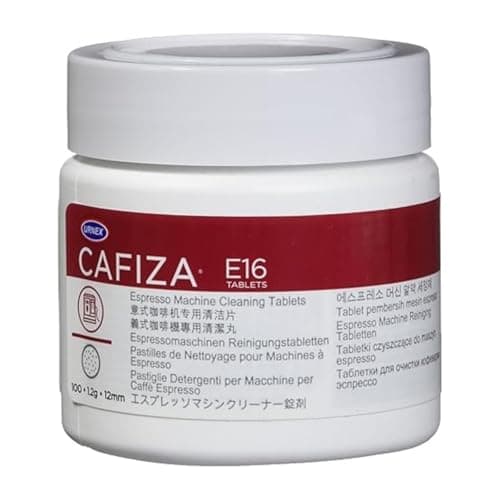 | Any machine with a group head, portafilter or baskets | Top pick | |
| 2 | 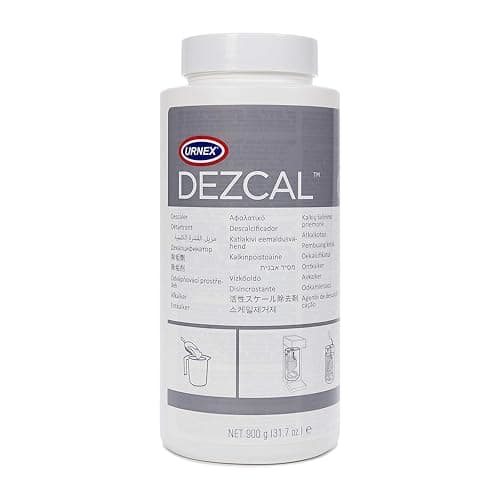 | Every machine that heats water, on a schedule set by your water | The other half | |
| 3 | 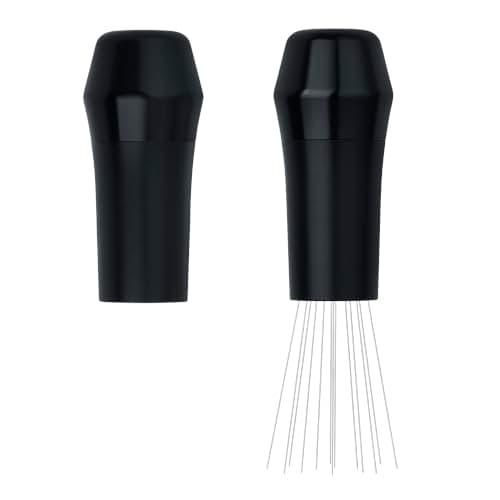 | Diagnosing whether your problem is dirt or distribution | Worth having alongside |
1. Top pick
Urnex Cafiza Cleaning Tablets
Entry tier · The industry-standard backflush detergent for stripping coffee oils from a group head.
The cafe standard for coffee oils, and the thing most home machines have never had.
Every shot leaves oil behind in the group head, the shower screen and the basket. Those oils go rancid within days, and rancid oil in the water path taints every subsequent shot with a stale, sour edge that people usually blame on their beans.
Cafiza is the detergent that removes them. Its active ingredient is tri-sodium phosphate, and it does what rinsing cannot - dissolving the oil film rather than moving it around.
If your machine has a three-way solenoid valve, you backflush: fit a blind basket, add the tablet or powder, and run the pump so the detergent is forced back through the group. That is the full treatment and it makes a noticeable difference on a neglected machine.
If your machine has no solenoid, you cannot backflush - but you can still soak the portafilter, the baskets and the shower screen, and those hold a large share of the residue anyway.
Specification
- Job
- Cleaning - removes coffee oils and residue
- Active ingredient
- Tri-sodium phosphate
- Used on
- Group heads, portafilters and baskets
- Requires
- A machine with a three-way solenoid valve to backflush
What it does well
- The cafe standard, and it removes oils nothing else touches
- Every shot leaves oil that goes rancid within days - this is the only fix
- Also soaks portafilters and baskets, which need it regardless of machine type
Where it gives ground
- You cannot backflush a machine without a three-way solenoid valve
- Phosphate-based, so it needs rinsing thoroughly
- Does nothing about limescale - that is a descaler's job
Skip it if
Skip the backflushing if your machine lacks a three-way solenoid valve. Forcing it can push water where the design did not intend - soak the removable parts instead.
2. The other half
Urnex Dezcal Descaler
Entry tier · A citric-acid descaling powder for removing limescale from boilers and water lines.
Removes limescale from boilers and lines, which no detergent will touch.
Scale is the second problem and it is entirely separate. Heating water deposits dissolved minerals on the heating element, inside the boiler and along the water lines, and that deposit insulates the element and narrows the passages.
The symptoms are gradual: slower heating, reduced flow, a machine that no longer reaches temperature properly. Left long enough it kills machines outright, and descaling neglect is one of the most common causes of an espresso machine's death.
Dezcal is phosphate-free, using citric acid, sulfamic acid and aluminum sulfate, and it is formulated to be safe on the brass, stainless and aluminum used inside home machines.
That safety point matters because the common home remedy is vinegar. Vinegar is a weak descaler, it smells for days afterwards, and it is harsher on seals and gaskets than a purpose-made product. It is a false economy.
Specification
- Job
- Descaling - removes mineral scale
- Composition
- Citric acid, sulfamic acid, aluminum sulfate; phosphate-free
- Safe on
- Brass, stainless and aluminum internals
- Applies to
- Any machine that heats water
What it does well
- Does the job vinegar is wrongly used for, without attacking seals or leaving a smell
- Phosphate-free and safe across the metals used in home machines
- Every machine that heats water needs this eventually - it is not optional
Where it gives ground
- Descaling frequency depends on your water, so the pack size you need varies
- Requires a thorough rinse afterwards or the next few drinks taste of it
- Does nothing about coffee oils - that is a different product
Skip it if
Skip a fixed schedule and set one from your water. Soft water areas need descaling far less often than hard water areas, and the label's interval is a generic guess.
3. Worth having alongside
Normcore WDT Tool V4
Entry tier · A retractable needle tool for breaking up clumps in the basket before tamping.
Not a cleaner, but the tool that stops you blaming the machine for a bad shot.
This is on a cleaning page for a diagnostic reason. When shots start running badly, people reach for cleaning products - and roughly as often the cause is the coffee bed rather than the machine.
A WDT tool breaks up clumps in the basket with fine needles before tamping. Clumped coffee leaves dense and loose regions in the puck, and water routes through the loose ones, which produces the fast, sour, uneven shots that also look like a machine problem.
Using one removes that variable. If your shots improve with a WDT tool, the machine was never dirty; if they do not, cleaning is the next thing to try.
It is a cheap tool that eliminates one of the two most common causes of a bad shot, which is why it belongs in the same drawer as the cleaning products.
Specification
- Needles
- 9 needles; 0.3 mm and 0.4 mm sets included
- Material
- 304 stainless needles, anodized aluminum handle
- Mechanism
- Twist to extend or retract
- Sizes
- 54 mm and 58 mm
What it does well
- The cheapest meaningful improvement to an espresso shot, by some distance
- Retracting needles means it lives in a drawer without bending
- Two needle gauges cover fine and coarser grinds
Where it gives ground
- Adds a step to every single shot
- Needles will eventually bend whatever you do
- Does nothing at all for filter coffee
Skip it if
Skip it if you use a pressurized basket. Distribution matters far less when the basket is manufacturing crema downstream anyway.
How often to do each
Cleaning frequency follows how much coffee you make. A machine pulling several shots a day accumulates oils quickly and benefits from a weekly backflush; a weekend-only machine can go considerably longer.
Descaling frequency follows your water, not your usage. Hard water areas deposit scale several times faster than soft water areas, so a published interval of 'every three months' is a generic guess rather than advice about your kitchen.
What backflushing actually does
On a machine with a three-way solenoid valve, water can be released back out of the group when the pump stops. Fitting a blind basket - one with no holes - means the pump has nowhere to push water except back through the group and out through that valve.
Adding detergent to the blind basket puts it into that reverse flow, so it reaches the parts of the group head that forward flow never cleans. That is why backflushing removes residue that no amount of wiping will.
Step 1
Check for a solenoid
If your machine dries the puck after a shot, it has one. If the puck comes out soupy, it usually does not - soak the parts instead.
Step 2
Backflush with water first
Run a few cycles with a blind basket and no detergent to clear the loose material.
Step 3
Add the detergent
A small measure in the blind basket. More is not better and needs more rinsing.
Step 4
Run short cycles
Several short bursts rather than one long one, pausing between so the valve releases.
Step 5
Rinse thoroughly
Repeat with clean water until there is no trace. Detergent left in the group taints the next few shots.
Step 6
Soak the removable parts
Portafilter, baskets and shower screen in a solution while you wait. This is where much of the residue lives.
The parts people forget
- The shower screen. It unscrews on most machines and it is filthy underneath. This is the single most neglected part.
- The steam wand. Milk residue inside the tip hardens. Purge after every use and soak the tip periodically.
- The drip tray. Standing coffee water ferments, and the smell reaches the drinks.
- The grinder chute. Old grounds sit in it and go stale, tainting the first shot after a bean change.
A machine that seems to have declined has usually accumulated several of these rather than developed a fault. Working through the list is free and fixes most of it.