The published specification
Scroll the table sideways to see every column.
Quick picks
The answer first. Tap any row to jump to the full reasoning for that pick.
Prices shown are checked daily against the retailer, as of October 23, 2026. We never write a price into the text of a page.
| # | Product | Best for | Award | Price |
|---|---|---|---|---|
| 1 | 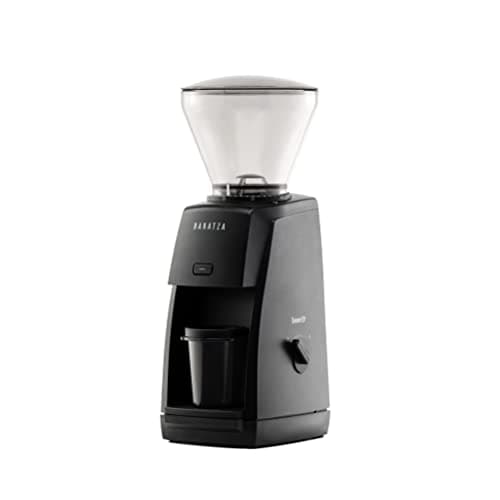 | A first real espresso grinder, or espresso plus filter | The grinder reviewed | |
| 2 | 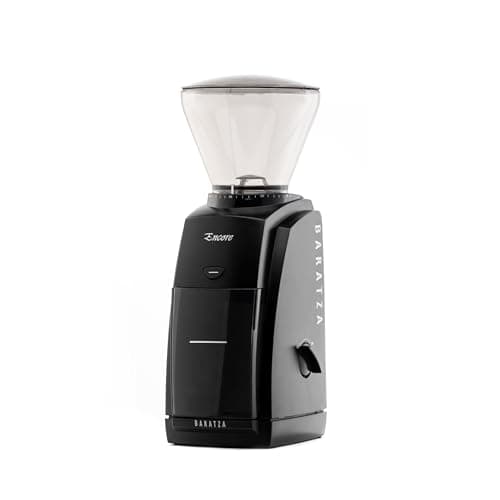 | Pour-over, drip and French press | The cheaper alternative | |
| 3 | 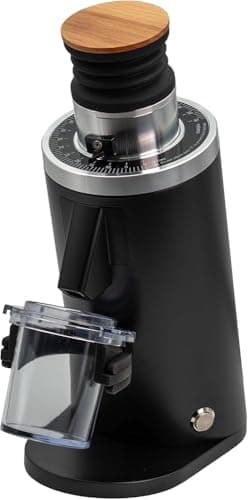 | The next grinder, in a year or two | The upgrade path |
1. The grinder reviewed
Baratza Encore ESP
Entry tier · The Encore re-geared for espresso: the same 40 mm burrs on a dual-resolution collar.
The cheapest grinder with genuinely published espresso resolution, and it is not close.
The Encore ESP uses 40 mm M2 hardened alloy steel conical burrs manufactured by Etzinger in Liechtenstein, on a dual-resolution adjustment collar. Steps 1 to 20 move the burrs approximately 20 microns per click; steps 21 to 40 move approximately 90 microns per click. A high-torque DC motor holds the burrs at 550 rpm.
That dual-resolution design is the entire product. It solves a problem that is usually solved with a bigger, more expensive burr set, and it solves it with gearing.
The burr housing was redesigned specifically to make burr removal easy - for cleaning, and for adding the shims that come in the box to shift the range.
Five hundred and fifty rpm is a deliberately low burr speed. Slower burrs transfer less heat into the grounds and generate less static, both of which matter more on a grinder used every day than the specification suggests.
Specification
- Burrs
- 40 mm M2 steel conical (Etzinger)
- Settings
- 40 stepped, dual resolution
- Espresso range
- Steps 1-20, 20 microns per click
- Filter range
- Steps 21-40, 90 microns per click
- Burr speed
- 550 rpm
What it does well
- 20 microns per click in the espresso range is real dialing resolution
- Redesigned burr housing makes cleaning and shimming easy
- Shims included in the box
Where it gives ground
- Still a stepped grinder - you cannot land between clicks
- Retention is normal-for-the-class, not low
- Same plastic body and noise as the Encore
Skip it if
Skip it if you never make espresso - the standard Encore does filter for less - or if you have outgrown stepped adjustment.
2. The cheaper alternative
Baratza Encore
Entry tier · The standard entry burr grinder for filter brewing.
Same burr platform, filter-only range, and less money.
If espresso genuinely is not in your plans, the standard Encore uses the same 40 mm conical burr platform with 40 stepped settings across a published range of 250 to 1200 microns.
That coarse end handles French press and cold brew properly, which espresso-oriented grinders often do poorly.
Burr speed sits at roughly 450 to 550 rpm, again to limit heat and static.
It is the same grinder in every way that affects filter coffee, and it does not reach espresso. The comparison is here.
Specification
- Burrs
- 40 mm conical, made in Europe
- Settings
- 40 stepped
- Grind range
- 250-1200 microns
- Burr speed
- Roughly 450-550 rpm to limit heat and static
What it does well
- The reference answer for pour-over, drip and French press
- Fully serviceable, with parts sold individually for years
- Low burr speed keeps static and heat down
Where it gives ground
- Bottom of its range is too coarse for espresso - that is the ESP model job
- Stepped settings only
- Plastic body and a loud motor
Skip it if
Skip it if espresso is even a possibility. The upgrade later costs more than the difference now.
3. The upgrade path
DF54
Upper-mid tier · A single-dose grinder with 54 mm flat burrs and stepless adjustment.
Where you go when stepped adjustment becomes the limit.
Worth knowing about now, because it is where Encore ESP owners tend to go next. The DF54 is a single-dose grinder with 54 mm flat burrs, stepless adjustment, retention under 0.1 g, a 150 W motor at 1400 rpm and a 25 g hopper.
The two things it fixes are exactly the two the ESP cannot: stepless adjustment means never being stuck between clicks, and sub-0.1 g retention means the dose you weigh is the dose you get.
Flat burrs also shift the cup toward clarity and separation rather than body, which is a preference rather than an improvement.
It costs meaningfully more, requires a single-dose workflow with bellows and dosing cup, and at 29.7 cm tall it needs vertical clearance the ESP does not.
Specification
- Burrs
- 54 mm flat
- Adjustment
- Stepless
- Retention
- Under 0.1 g
- Motor
- 150 W, 1400 rpm
- Hopper
- 25 g single-dose
- Anti-static
- Ionizer in the exit chute
What it does well
- Flat burrs and stepless adjustment at a price that used to buy neither
- Near-zero retention means the dose you weigh is the dose you get
- Small footprint for a flat-burr grinder
Where it gives ground
- Stepless with no reference marks is fiddly until you make your own
- Single-dose only - no hopper workflow for a busy household
- Bellows and a dosing cup are part of the routine, not optional extras
Skip it if
Skip it for now if you are buying your first espresso grinder. The ESP is where to start and this is where to arrive.
Why 20 microns per click is the number that matters
Espresso resistance is extremely sensitive to particle size. A shot that runs in 18 seconds and one that runs in 32 can be separated by a few dozen microns of burr gap. That is why grind adjustment resolution, not step count, decides whether a grinder can dial espresso.
Twenty microns per click means the smallest change you can make is genuinely small. On a conventional 40-step grinder spreading its whole range across those steps, the smallest change is large enough to skip past the setting you wanted.
It is worth noting how unusual it is that Baratza publishes this figure at all. Most manufacturers publish a step count and leave the micron question unanswered, which is exactly the information a buyer needs.
The dual-resolution collar, and its one cost
Splitting the collar means the fine half gets high resolution and the coarse half gets range. That is the right division for a household making espresso in the week and pour-over at the weekend.
The cost is at the very coarse end. Twenty of the forty steps are spent on espresso, so the filter range has half the positions the standard Encore gives it. For pour-over and drip that is ample; for French press and cold brew the standard Encore is slightly more comfortable.
What stepped adjustment still costs you
You cannot land between clicks. Most of the time 20 microns is fine enough that this is invisible. Occasionally - a light roast, a stale bag, a hot day - the shot you want sits between two settings, and the only way to get there is to change the dose instead.
That is a genuine limitation and it is the reason people eventually move to stepless grinders. It is not a reason to avoid this one; it is a reason to know what you are buying.
Retention, noise and build
- Retention is ordinary for the class rather than low. Expect grounds to stay in the chute between doses, and expect to purge when switching coffees.
- Noise is the Encore family's weakest point. This is not a quiet grinder.
- Build is plastic-bodied, which looks and feels like an entry grinder because it is one. What it buys back is serviceability.
- Parts are sold individually and have been for years, which is the reason Encores get repaired rather than replaced.
Verdict
If you are buying a first espresso grinder, this is the one to buy, and the published 20-micron figure is why rather than brand loyalty. If you already own a standard Encore and want espresso, this is the upgrade rather than a shim kit. If you have been dialing espresso for a couple of years and find yourself wishing for a setting between two clicks, you have outgrown it - go stepless.