The short answer
A gooseneck kettle matters for one reason: it delivers a thin, controllable stream you can place precisely. That control is most of pour-over technique. Temperature settings are useful for repeatability rather than for finding a magic number, and a hold function - keeping the water at temperature between pours - is the most underrated feature.
What the spout actually does
A standard kettle spout dumps water in a wide, fast stream that lands where the kettle throws it. On a cone dripper that digs into the bed, pushes grounds up the walls and creates channels for the water to run down.
A gooseneck delivers a narrow stream at a controllable rate, so you can wet the bed evenly, pour in circles, and keep the water level steady. On a V60, where flow is set by your pour, that is the difference between an even extraction and a lottery.
Quick picks
The answer first. Tap any row to jump to the full reasoning for that pick.
Prices shown are checked daily against the retailer, as of October 23, 2026. We never write a price into the text of a page.
| # | Product | Best for | Award | Price |
|---|---|---|---|---|
| 1 | 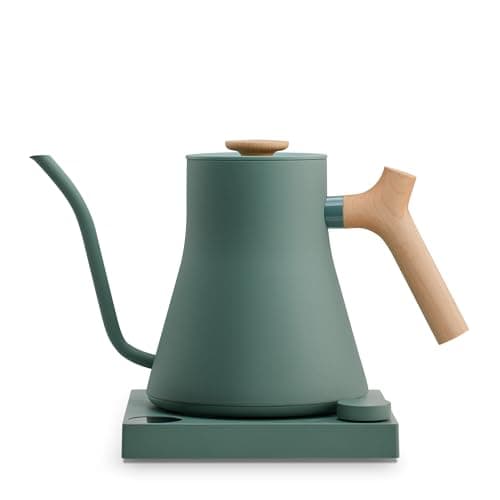 | Anyone brewing cone drippers regularly | Top pick | |
| 2 | 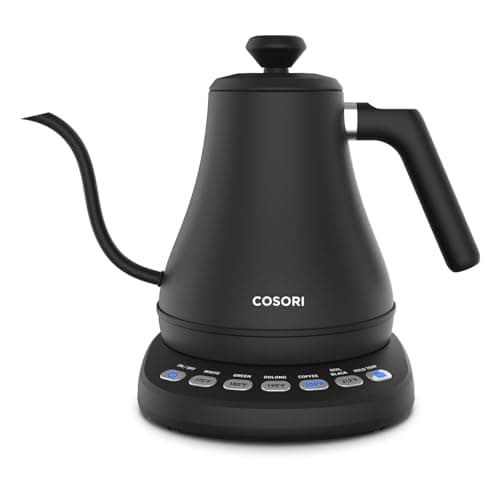 | Getting the control without the premium | Best value | |
| 3 | 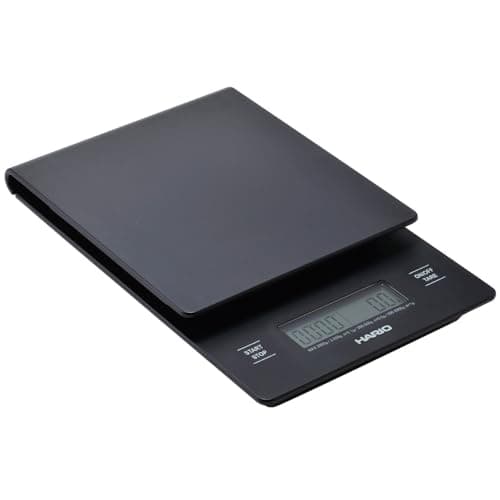 | Anyone weighing by eye | Buy this before a nicer kettle | |
| 4 | 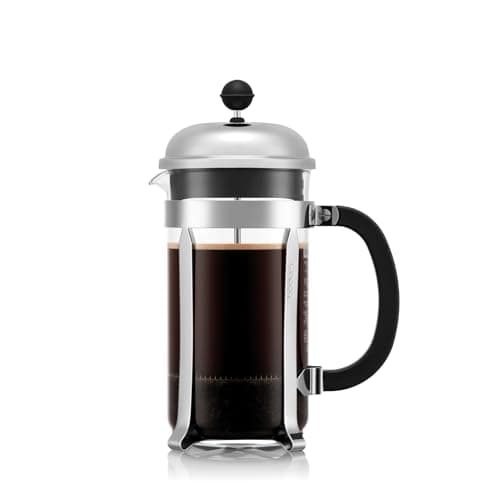 | Immersion brewing with any kettle you own | Skip this if you are here for pour-over |
1. Top pick
Fellow Stagg EKG
Upper-mid tier · A variable-temperature electric gooseneck kettle with a hold function.
The best-balanced pour of any kettle in common use, with a hold that matters more than the range.
The Stagg EKG is the kettle other gooseneck kettles are compared against, and the reason is the spout rather than the electronics. The stream is thin, stable and starts and stops where you want it, which is the entire job.
The published specification is a 0.9 L capacity, variable temperature from 104 to 212 F, and a 1200 W heating element.
The hold function is the underrated feature: 15, 30, 45 or 60 minutes at your chosen temperature. On a pour-over with a bloom and two or three pours, that means the last pour is the same temperature as the first, which is a real variable removed.
There is a built-in stopwatch for bloom timing, which sounds gimmicky and turns out to be the thing you use every brew.
Specification
- Capacity
- 0.9 L (30 oz)
- Temperature
- 104-212 F variable
- Hold
- 15, 30, 45 or 60 minutes
- Power
- 1200 W
What it does well
- The spout is the best-balanced pour of any kettle in common use
- Hold mode means the second pour is at the same temperature as the first
- Built-in stopwatch for bloom timing
Where it gives ground
- Costs more than some grinders
- 0.9 L is small for making coffee and tea in the same session
- The counterweighted handle is polarizing
Skip it if
Skip it if you also make tea for several people. At 0.9 L it will not do both in one boil.
2. Best value
COSORI Electric Gooseneck Kettle
Budget tier · A stainless gooseneck kettle with five temperature presets and a keep-warm hold.
Stainless water path and five sensible presets, for a fraction of the Stagg.
The COSORI is the kettle to buy if you want the function and not the price. Published specification: 0.8 L capacity, 1200 W, boiling a full kettle in 3 to 5 minutes, with five temperature presets - 170, 180, 195, 205 and 212 F.
The five presets are well chosen: 195 and 205 F bracket the useful coffee range, and the rest cover tea. In practice most people brew at one temperature anyway, so the absence of a free dial matters less than it sounds.
The kettle, lid and spout are all food-grade stainless, so no plastic touches the water - which is not a given at this price and is worth checking on any kettle you consider.
The Hold Temp function keeps water warm for up to 60 minutes, matching the Stagg on the feature that matters most.
Specification
- Capacity
- 0.8 L
- Presets
- 170 / 180 / 195 / 205 / 212 F
- Hold
- Up to 60 minutes
- Power
- 1200 W; boils full in 3-5 minutes
- Contact surfaces
- Food-grade stainless kettle, lid and spout
What it does well
- Every water-contact surface is stainless, not plastic
- Presets cover the temperatures coffee and tea actually use
- A fraction of the Stagg outlay for most of the function
Where it gives ground
- Presets rather than a free temperature dial
- Spout control is good, not Stagg-good
- No brew timer
Skip it if
Skip it if you want an exact temperature rather than the nearest preset, or if you want a brew timer built in.
3. Buy this before a nicer kettle
Hario V60 Drip Scale
Budget tier · A basic brewing scale with an integrated count-up timer.
If you own any gooseneck kettle, a scale with a timer improves your coffee more than a better one will.
This is a scale, not a kettle, and it is on this page deliberately. If you have a working gooseneck kettle and are considering upgrading it, buy this first - the improvement is larger.
Pour-over is a ratio brewed over time. Without a scale you are estimating the dose, estimating the water, and estimating the duration, and any one of those explains a cup that is different from yesterday's.
The published specification is 2000 g capacity with 0.1 g resolution between 2 and 200 g, a count-up timer to 99:59, a platform of W120 x D190 x H29 mm, and auto power-off after five minutes.
It is not water resistant, which is a genuine consideration for something sitting under a pouring kettle. Keep a cloth nearby.
Specification
- Capacity
- 2000 g
- Resolution
- 0.1 g between 2 and 200 g
- Timer
- Count-up to 99:59
- Size
- W120 x D190 x H29 mm
- Water resistance
- None
What it does well
- Does the two things a brew scale must do, for very little money
- Long, narrow platform suits a dripper and server
- Auto power-off after five minutes
Where it gives ground
- Not water resistant, and it sits under a pouring kettle
- Slower response than the premium scales
- No flow-rate display
Skip it if
Skip it if you already brew on a scale. This is aimed at people brewing by eye and wondering why the cup varies.
4. Skip this if you are here for pour-over
Bodum Chambord French Press
Budget tier · The classic 34 oz French press: borosilicate carafe in a chrome-plated steel frame.
It does not need a gooseneck kettle, which is the point of mentioning it.
This entry exists to save someone money. If you are shopping for a gooseneck kettle and you are not certain you want to brew pour-over, consider whether immersion suits you better - because a French press needs no gooseneck at all.
The Chambord is 34 oz of borosilicate glass in a chrome-plated steel frame with a stainless mesh plunger, made in Portugal. You pour boiling water in from any kettle, wait, and plunge.
The cup is heavier and more textured than pour-over, because the mesh lets oils and fines through rather than trapping them in paper.
If what you actually want is good coffee with minimal equipment and no technique, this plus a decent grinder is a complete setup - and the gooseneck kettle budget goes to the grinder instead.
Specification
- Capacity
- 34 oz, 3-4 cups
- Carafe
- Borosilicate glass
- Filter
- Stainless steel mesh plunger
- Frame
- Chrome-plated steel, made in Portugal
What it does well
- No paper, no capsules, no consumables at all
- Full-bodied cup that no paper filter can produce
- Every part is replaceable and cheap
Where it gives ground
- Metal mesh lets fines and oils through - that is the trade, not a defect
- Punishes an inconsistent grinder harder than any other brewer
- Glass carafe in a household with a tile floor
Skip it if
Skip it if you specifically want pour-over. A French press cannot do what a cone dripper does, and vice versa.
Temperature: less magic than advertised
The useful brewing range for most coffee sits between roughly 195 and 205 F, and the practical benefit of a variable kettle is being able to return to the same number rather than to find a special one. Lighter roasts generally want the top of that range because they are denser and harder to extract; darker roasts often taste better slightly cooler because they extract easily and turn bitter.
That is the whole of it. A kettle with five sensible presets covers it as well as one with a free dial, for most people.
The hold function is the feature to look for
A pour-over is not one pour. It is a bloom, a pause, and then two or three further pours over two to three minutes. Without a hold function, the water in the kettle is cooling throughout, so your last pour is meaningfully cooler than your first.
Both kettles here offer a 60-minute hold, and it is the specification that makes the biggest practical difference to a repeatable brew.
Stovetop or electric
A stovetop gooseneck is cheaper and gives you the spout, which is the important half. What it cannot do is hold a temperature, and boiling water then waiting an arbitrary time to cool is exactly the kind of unmeasured variable that makes cups differ. If the budget is tight, a stovetop gooseneck plus a scale with a timer beats an electric kettle and no scale.
What to check before buying any kettle
- No plastic in the water path. Check the lid and the spout, not just the body.
- Hold function, ideally with a duration you choose.
- Capacity that matches your use. 0.8 to 0.9 L is a coffee kettle, not a household one.
- A handle that balances. Pouring precisely with a badly balanced kettle is unnecessarily hard.