The short answer
Choose the Able Kone if you own a Chemex and want body rather than clarity. Choose CoffeeSock if you want to stop buying paper without changing the cup much. Choose the Hario metal dripper for a no-consumables V60, and the Prismo for an AeroPress.
The filter changes the cup more than the brewer does
People choose drippers carefully and then treat the filter as a consumable detail. It is the other way around: filter material is one of the largest variables in the whole brew, because it decides which parts of the coffee reach your cup.
Scroll the table sideways to see every column.
Quick picks
The answer first. Tap any row to jump to the full reasoning for that pick.
Prices shown are checked daily against the retailer, as of October 24, 2026. We never write a price into the text of a page.
| # | Product | Best for | Award | Price |
|---|---|---|---|---|
| 1 | 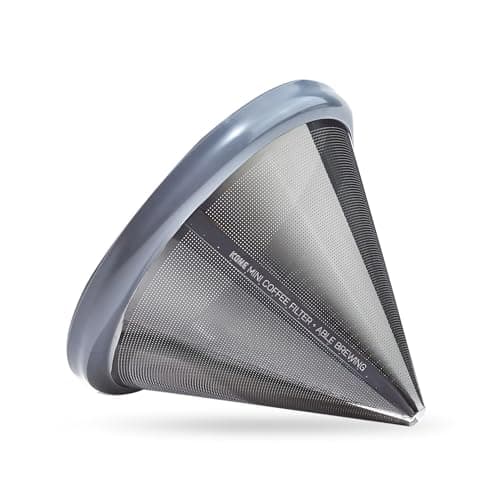 | Chemex owners who want body instead of clarity | Top pick | |
| 2 | 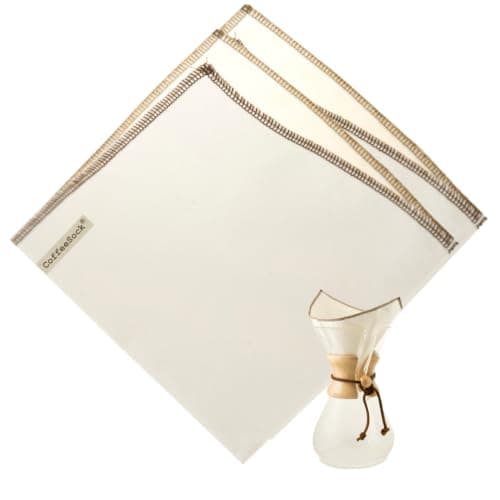 | Anyone who wants to stop buying paper without changing the cup much | Best compromise | |
| 3 | 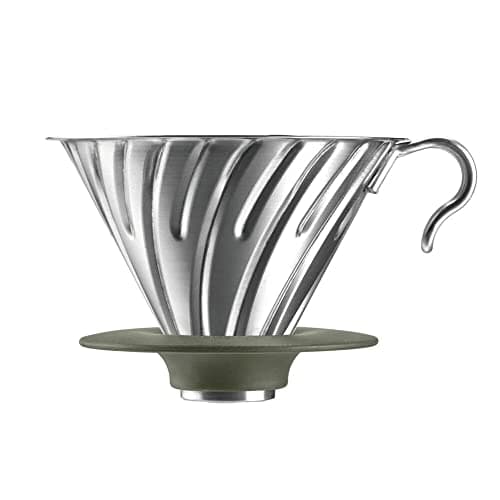 | V60 brewing with no consumables at all | Best all-in-one | |
| 4 | 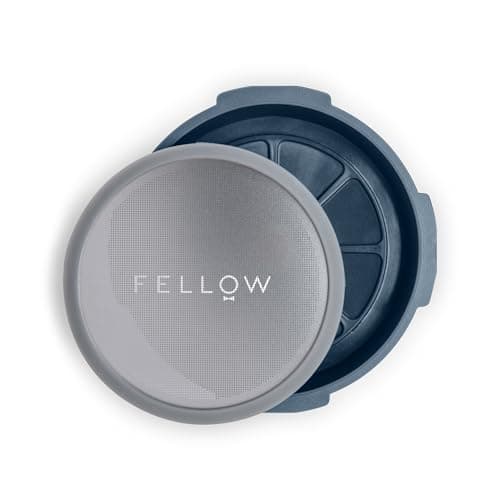 | AeroPress owners who want concentrate and no paper | Best for AeroPress | |
| 5 | 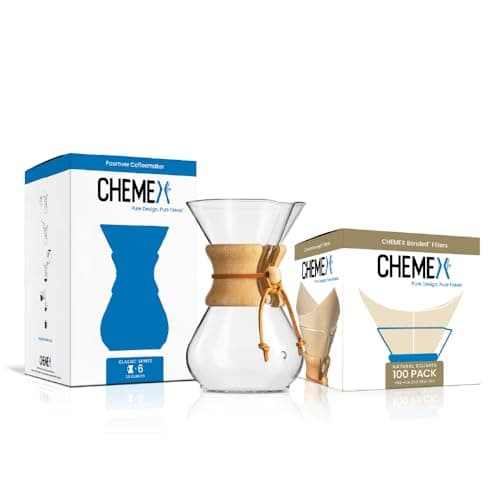 | Anyone whose favorite thing about their brewer is how clean it tastes | Skip this - the paper is the point |
1. Top pick
Able Kone Reusable Filter
Mid tier · A laser-cut stainless cone filter that replaces Chemex paper permanently.
Laser-cut surgical stainless that owners keep for a decade, and it transforms a Chemex.
The Kone is a cone of surgical-grade stainless steel with laser-cut holes, made to sit in a Chemex in place of its bonded paper. It fits the 6, 8 and 10 cup models, at 5 1/8 inches in diameter and 4 inches tall.
What it does to the cup is dramatic rather than subtle. A Chemex bonded filter is unusually thick and removes most oils and fines, which is exactly why a Chemex tastes clean and tea-like. The Kone passes those oils straight through.
The result is a heavier, rounder, more textured cup - closer to a French press than to a paper pour-over, while keeping the Chemex's percolation. Whether that is an improvement depends entirely on what you wanted from the brewer.
Durability is the other argument. Laser-cut holes do not stretch or tear, and owners routinely report ten years or more of service. After the purchase there is no running cost at all.
Specification
- Material
- Surgical-grade stainless steel, laser-cut holes
- Fits
- 6, 8 and 10 cup Chemex
- Size
- 5 1/8" diameter x 4" height
- Life
- Many owners report 10+ years of use
What it does well
- Buy once - owners routinely report a decade of service
- Passes the oils that paper traps, giving a much fuller body
- No consumable cost at all after the purchase
Where it gives ground
- It undoes the clarity a Chemex is bought for - that is the trade, not a defect
- Fines pass through, so a grinder producing dust will show it
- Needs proper cleaning or the perforations clog with oils
Skip it if
Skip it if you bought a Chemex for its clarity. This removes the exact quality that makes a Chemex a Chemex, and there is no way to have both.
2. Best compromise
CoffeeSock Reusable Cotton Filter
Budget tier · A cloth filter in certified organic cotton, sitting between paper and metal.
Cloth sits between paper and metal - most of the clarity, some of the body.
Cloth is the oldest filter material and the most underrated. Its weave catches fines the way paper does while letting more of the oils through than paper allows, which puts the cup somewhere between a paper pour-over and a metal one.
For most people switching away from paper, this is the outcome they actually wanted. Metal filters change the cup considerably; cloth changes it a little.
It is made from 100% GOTS-certified organic cotton with non-toxic dyes. The Chemex version is a half-moon shape for the 6 to 13 cup models, 9 inches wide by 6.25 inches tall, and cone versions are made for other drippers.
The catch is care. It needs rinsing after every brew and hanging to dry properly, and a cloth filter left damp in a cupboard sours. Kept properly it lasts six to twelve months, so it is a consumable rather than a lifetime purchase.
Specification
- Material
- 100% GOTS-certified organic cotton, non-toxic dyes
- Chemex size
- Half-moon, 6-13 cup: 9" W x 6.25" H
- Life
- 6-12 months with rinsing and hang drying
- Also made for
- Cone drippers and other brewers
What it does well
- Cleaner and brighter than a metal filter while still passing some oils
- The closest reusable option to paper clarity
- Cheap, compostable at end of life, and made from a certified organic fiber
Where it gives ground
- Needs rinsing after every brew and hang drying, or it sours
- 6-12 months, so it is a consumable rather than a lifetime purchase
- Stains permanently, which bothers some people
Skip it if
Skip it if you will not maintain it. A neglected cloth filter tastes worse than any paper, and 'rinse and hang after every brew' is a real commitment.
3. Best all-in-one
Hario V60 Metal Dripper 02
Mid tier · The V60 cast in double-mesh stainless steel, so the dripper is the filter.
The dripper and the filter are the same object, so there is nothing to run out of.
Rather than putting a metal filter inside a dripper, this is a dripper made entirely of double-walled stainless mesh. It has the same 60-degree cone, the same spiral ribs and the same unrestricted flow as any other V60.
At W145 x D120 x H90 mm it brews 1 to 4 cups, or 300 to 500 ml, and it has a removable silicone base for cleaning. There is no paper involved anywhere.
Thin metal is thermally different from ceramic in a useful way: it warms through almost immediately rather than needing preheating, though it also sheds heat faster once the brew is running.
The cup is the metal-filter cup - oils and fines pass through, giving a silky mouthfeel and a medium body rather than the clarity a paper V60 produces. If your grinder produces a lot of dust, you will taste it.
Specification
- Material
- Heat-resistant stainless steel, double-walled mesh
- Dimensions
- W145 x D120 x H90 mm
- Capacity
- 1 to 4 cups, 300-500 ml
- Base
- Removable silicone
- Paper
- None needed
What it does well
- Same 60-degree cone, spiral ribs and unrestricted flow as any other V60
- No paper at all, and nothing to run out of
- Thin metal warms through quickly rather than stealing heat like cold ceramic
Where it gives ground
- Mesh passes oils and fines, so it loses the clarity a V60 is usually bought for
- The mesh clogs with oils and needs proper cleaning, not just a rinse
- Sheds heat faster than ceramic once brewing is underway
Skip it if
Skip it if you already own a V60. A cloth filter in the dripper you have costs far less than buying a second dripper.
4. Best for AeroPress
Fellow Prismo
Mid tier · An AeroPress cap with a pressure valve and an etched steel filter instead of paper.
An etched steel filter and a pressure valve, so the AeroPress brews without inverting.
The Prismo replaces the AeroPress cap entirely. It carries an etched stainless steel filter instead of a paper disc, and adds a pressure-actuated valve that seals the chamber until you press.
That seal is the real feature. Normally an AeroPress drips as soon as you add water, which is why people invert it to get a full immersion brew. With the Prismo the chamber holds, so you brew upright and skip the flip entirely.
The valve also builds genuine pressure before releasing, which pushes the result closer to an espresso-style concentrate than a standard AeroPress cap manages. It is not espresso, but it is meaningfully more concentrated.
Etched steel rather than woven mesh means fewer fines than most metal filters pass, though still more than paper. At 2.75 inches across, 1 inch tall and 100 g, it adds very little to what you carry.
Specification
- Filter
- Etched stainless steel mesh
- Valve
- Pressure-actuated, seals until you press
- Size
- 2.75" diameter x 1" tall
- Weight
- 100 g
- Fits
- AeroPress Coffee Maker; not the AeroPress Go or 2005-2009 models
What it does well
- The no-drip seal makes full immersion possible without inverting the AeroPress
- Builds real pressure, so it gets closer to espresso-style concentrate than a plain cap
- Etched steel rather than woven mesh, so it passes fewer fines than most metal filters
Where it gives ground
- Does not fit the AeroPress Go, which is the one people travel with
- More sediment than paper, though less than a woven mesh disc
- Etched mesh needs careful cleaning or it blinds over with oils
Skip it if
Skip it if you own an AeroPress Go. The Prismo does not fit it, or any AeroPress made between 2005 and 2009.
5. Skip this - the paper is the point
Chemex Classic 6-Cup
Manual tier · A single-piece borosilicate brewer that uses very thick bonded filters.
A reminder that on some brewers the filter is the design, not a consumable.
The Chemex is worth singling out because it is the brewer people most often try to convert, and the one where conversion changes the most.
Its bonded filters are dramatically thicker than ordinary cone papers. That thickness is not incidental - it is the reason a Chemex produces the cleanest, most tea-like coffee of any common brewer, and it is what the vessel was designed around.
Fit a metal filter and you have a large, elegant glass carafe brewing something closer to a French press. That is a fine drink and it is not what the Chemex was built to make.
If your reason for switching is waste, Chemex papers are unbleached, compostable and made of paper. The environmental case for metal here is much weaker than it first appears.
Specification
- Capacity
- 30 oz
- Size
- 8.5 in H x 5.125 in diameter
- Material
- Borosilicate glass, wood collar and leather tie
- Filters
- Chemex Bonded (FP-1, FC-100, FS-100, FSU-100)
What it does well
- The thick bonded filter produces the cleanest cup of any common brewer
- Brews and serves in one vessel, which matters when guests are involved
- It looks like an object, not an appliance
Where it gives ground
- The proprietary filters are a permanent running cost
- Slow, and unforgiving if you grind too fine
- Glass, with a wood collar that should not be soaked
Skip it if
Skip the conversion if clarity is why you own it. Buy the Kone only if you specifically want body from the same vessel.
Fines are the reason metal filters divide people
Every grinder produces some very fine particles alongside the target size. A paper filter traps them. A metal filter does not, so they end up in the cup and continue extracting there.
That is why the same metal filter reads as 'silky and full-bodied' to one person and 'muddy and bitter' to another. The difference is usually the grinder rather than the filter - a burr grinder producing few fines makes metal filters much more pleasant than an entry-level one does.
The waste argument, honestly
It is a genuine reason to switch, but it is smaller than it is usually presented. Unbleached paper filters are compostable, and so are the grounds inside them - the two go into the same caddy.
The stronger arguments for reusable filters are that you never run out mid-brew, and that they change the cup in a direction you might prefer. If the cup is not the reason, be aware you may be trading a taste you like for a modest environmental gain.