The short answer
Conical burrs produce a wider spread of particle sizes, which the cup reads as body and sweetness. Flat burrs produce a narrower spread, which reads as clarity and flavor separation. Neither is better in the abstract: milk drinks and darker roasts often suit conical, while light-roast filter and straight espresso usually suit flat.
The mechanism, briefly
A conical burr set is a cone spinning inside a ring. Coffee falls in at the top, is drawn down through a narrowing gap by gravity and the burr's shape, and exits at the bottom. Because particles travel different paths through the gap, the resulting sizes vary more.
A flat burr set is two parallel rings, one spinning. Coffee is thrown outward between them and exits at the rim. Every particle passes through effectively the same gap on the way out, so the resulting sizes vary less.
That is the whole difference. Everything people say about how the two taste follows from it.
What the difference does to the cup
Scroll the table sideways to see every column.
Read that table with some skepticism about the last few rows. These are tendencies rather than laws, and a well-made conical grinder will beat a poorly made flat one at everything.
Quick picks
The answer first. Tap any row to jump to the full reasoning for that pick.
Prices shown are checked daily against the retailer, as of October 23, 2026. We never write a price into the text of a page.
| # | Product | Best for | Award | Price |
|---|---|---|---|---|
| 1 | 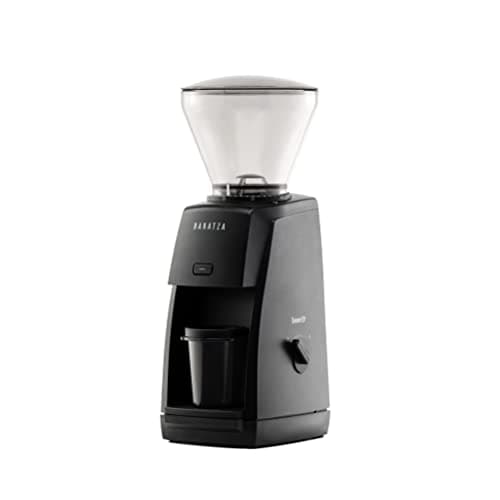 | Espresso with milk, and anyone wanting sweetness over separation | The conical case | |
| 2 | 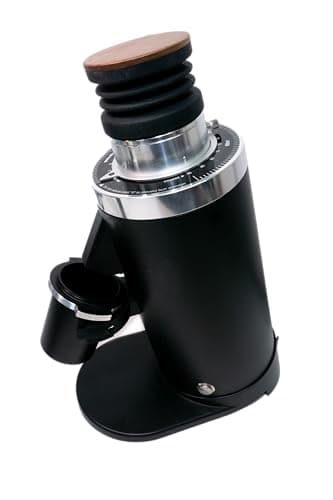 | Light roasts, straight espresso, and anyone chasing separation | The flat case | |
| 3 | 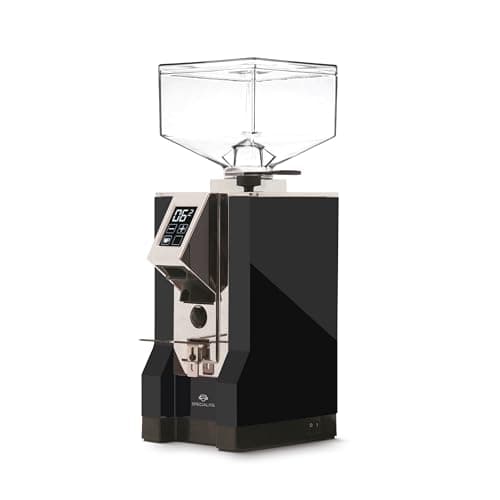 | Espresso-focused setups that want flats without a ritual | The middle ground |
1. The conical case
Baratza Encore ESP
Entry tier · The Encore re-geared for espresso: the same 40 mm burrs on a dual-resolution collar.
40 mm conical burrs, wider particle spread, and the body that comes with it.
The Encore ESP is a good example of the conical case because it is a well-specified conical grinder rather than a compromised one.
It publishes 40 mm M2 hardened alloy steel conical burrs made by Etzinger, 40 stepped settings with roughly 20 microns per click across the espresso range and about 90 microns across filter, and a burr speed of 550 rpm.
Conical geometry produces a wider distribution of particle sizes than a flat set, which reads in the cup as body and perceived sweetness rather than separation.
For espresso with milk that is often the more pleasant direction - a heavier shot stands up to milk where a very clean one can disappear into it.
Specification
- Burrs
- 40 mm M2 steel conical (Etzinger)
- Settings
- 40 stepped, dual resolution
- Espresso range
- Steps 1-20, 20 microns per click
- Filter range
- Steps 21-40, 90 microns per click
- Burr speed
- 550 rpm
What it does well
- 20 microns per click in the espresso range is real dialing resolution
- Redesigned burr housing makes cleaning and shimming easy
- Shims included in the box
Where it gives ground
- Still a stepped grinder - you cannot land between clicks
- Retention is normal-for-the-class, not low
- Same plastic body and noise as the Encore
Skip it if
Skip it if you drink light-roast filter and want origin character. Flats are the direction for that.
2. The flat case
DF64 Gen 2
Upper-mid tier · The 64 mm flat-burr single-dose grinder that made the format mainstream at home.
64 mm flat burrs, narrower particle spread, and the clarity that comes with it.
The DF64 is the clearest expression of the flat case at a home price: 64 mm stainless flat burrs with stepless adjustment, retention under 0.1 g, a 250 W motor at 1400 rpm and a 50 g hopper.
Flat burrs cut with a narrower distribution of particle sizes, which reads as clarity - individual flavors distinguishable rather than blended into a single impression.
Sixty-four millimeters is also the size the espresso world benchmarks against, and the extra cutting area means a dose grinds faster and cooler.
The burrs are swappable, which is the underrated part: different burr sets shift the character further toward clarity or body without replacing the grinder.
Specification
- Burrs
- 64 mm flat stainless; aftermarket sets available
- Adjustment
- Stepless
- Retention
- Under 0.1 g
- Motor
- 250 W, 1400 rpm at 110/120 V
- Hopper
- 50 g
- Size
- 13 cm W x 22.5 cm D x 30 cm H, 6.8 kg
What it does well
- 64 mm flats are the burr size the espresso world benchmarks against
- Burrs are swappable, so the grinder can be re-tuned rather than replaced
- Ionizer probes in the chute keep static manageable
Where it gives ground
- Heavy and tall for a home counter
- Stepless adjustment with no detents demands note-keeping
- Version numbering across sellers is genuinely confusing
Skip it if
Skip it if you want a simple workflow. Single dosing means weighing, loading and a bellows every time.
3. The middle ground
Eureka Mignon Specialita
Upper-mid tier · An Italian 55 mm flat-burr espresso grinder with stepless micrometric adjustment.
55 mm flats - flat-burr character in a hopper-fed grinder that is quiet and fast.
Fifty-five millimeter flats sit between the 40 mm conical entry tier and the 64 mm benchmark, and behave much more like the latter.
The Specialita publishes 55 mm flat hardened steel burrs made in Italy, with stepless micrometric adjustment on the lower burr, output up to 1.8 g per second, and digital timed dosing adjustable in tenths of a second.
It gets you flat-burr clarity without the single-dose workflow, because it is hopper-fed by design.
The micrometric mechanism holds its setting through a strip-down clean, which is a practical advantage over most stepless designs and matters more than the burr geometry on a day-to-day basis.
Specification
- Burrs
- 55 mm flat hardened steel, made in Italy
- Adjustment
- Stepless micrometric on the lower burr
- Output
- Up to 1.8 g per second
- Dosing
- Digital timed, adjustable in tenths of a second
What it does well
- Genuinely quiet - the sound insulation is not marketing
- Micrometric adjustment holds its setting through a strip-down clean
- Fast enough that an 18 g dose is a ten-second job
Where it gives ground
- Hopper-fed by design; single dosing it is a workaround
- No weight-based dosing
- Espresso-focused - the coarse end is not its strength
Skip it if
Skip it if you keep several coffees open. Hopper-fed grinders make switching a chore.
Why a wider distribution tastes like body
Different particle sizes extract at different rates. Very fine particles give up their soluble compounds quickly; larger ones give up different compounds more slowly.
A wider spread of sizes therefore produces a wider spread of extraction stages happening simultaneously, which lands as complexity and weight - a fuller, rounder impression rather than a precise one.
A narrower spread means the particles extract more uniformly, so what reaches the cup is more consistent - and consistency reads as clarity, because individual flavors are not overlaid on one another.
Where the difference stops mattering
Three situations where this whole question becomes academic:
- 1In milk. A cappuccino is mostly milk, and milk flattens the distinctions flat burrs are prized for. If you drink milk drinks exclusively, the burr geometry is one of the smaller variables in your setup.
- 2With dark roasts. Darker roasting reduces origin character, which is precisely what clarity would reveal. A dark blend through a 64 mm flat set does not taste dramatically different from the same blend through a good conical.
- 3When something upstream is the limit. If your machine has a pressurized basket, or your beans are three months past roasting, burr geometry is not what is holding you back.
Burr size is the other variable
Size and shape get conflated constantly. Bigger burrs cut more coffee per rotation, which means less time grinding and less heat transferred into the grounds. That is a separate benefit from geometry and it applies to both types.
A 64 mm flat set and a 40 mm conical set differ in both size and shape at once, which makes it hard to attribute a difference to either. When comparing, look at both numbers.
The honest recommendation
If you drink espresso with milk, or you like a heavy, syrupy shot, a good conical grinder is not a compromise - it may genuinely be what you prefer. If you drink light-roast filter and want to taste the difference between origins, flats are the direction.
And if you are choosing between a well-made conical and a poorly made flat at the same price, buy the conical. Execution beats geometry, every time.