The short answer
Light roasts are denser and extract more slowly than dark, so they need a finer, more even grind and precise adjustment. Flat burrs - and larger ones - narrow the particle distribution that clarity depends on: the Fellow Ode Gen 2 for filter, the DF64 Gen 2 or DF54 for espresso and filter, the Eureka Specialita for a fast espresso workflow. A blade grinder is worse here than anywhere else.
Why light roasts are harder on a grinder
Roasting breaks down cell structure and drives off moisture. A dark roast is brittle and soluble; a light roast is dense and hard, so the same grinder produces a coarser, less even result from it at the same setting.
Light roasts also extract more slowly, which is why they are usually ground finer and brewed hotter. Fine grinding is where a grinder's weaknesses show: heat, static, retention and an uneven distribution all get worse as you go finer.
The result is a narrow window. Slightly too coarse and a light roast is sour and thin; slightly too fine and the fines over-extract while the boulders stay under. That is why adjustment resolution matters here more than with any other coffee.
What to look for
- Flat burrs, ideally large ones. Narrower particle distribution is what clarity means in practice - see conical vs flat burr.
- Stepless or very fine adjustment. A narrow extraction window needs settings between the clicks.
- Low retention. An expensive single origin should not be diluted by the last bag.
- Enough motor to grind dense beans finely without stalling or heating the grounds.
- A workflow that suits changing beans often, because light-roast drinkers rarely stay on one bag.
Quick picks
The answer first. Tap any row to jump to the full reasoning for that pick.
| # | Product | Best for | Award | Price |
|---|---|---|---|---|
| 1 | 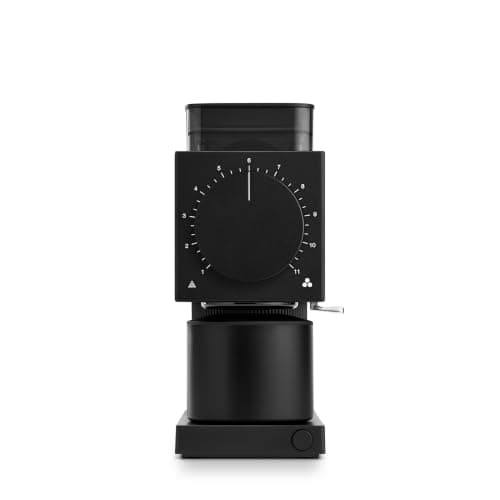 | Light-roast pour-over | Top pick for filter | |
| 2 | 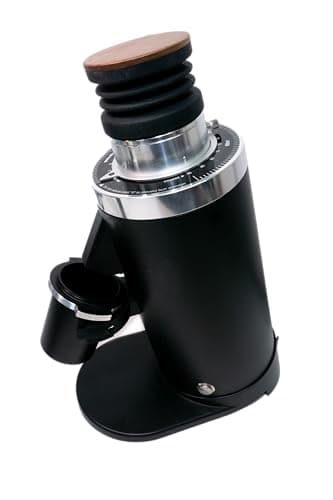 | Light-roast espresso, dialed precisely | Top pick for espresso | |
| 3 | 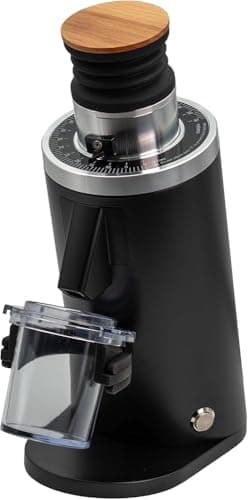 | Flat-burr clarity on a smaller budget | Best value flats | |
| 4 | 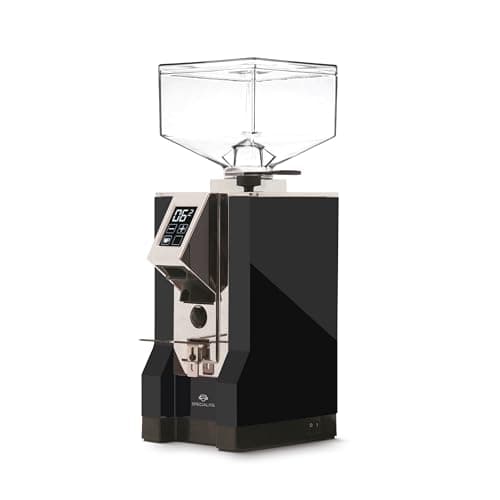 | Light-roast espresso every day, quickly | Best for espresso workflow | |
| 5 | 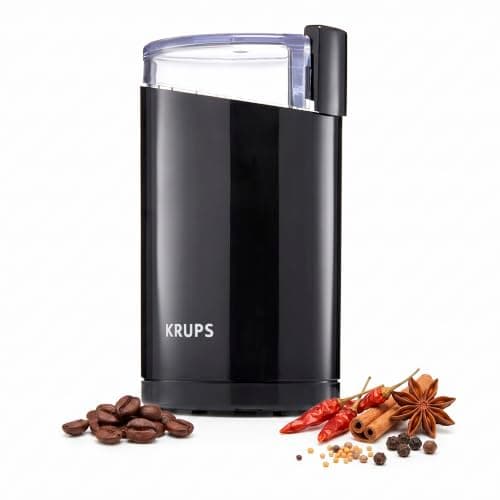 | Spices | Skip this |
1. Top pick for filter
Fellow Ode Brew Grinder Gen 2
Upper-mid tier · A 64 mm flat-burr grinder built only for filter coffee - it does not do espresso.
64 mm flat burrs aimed squarely at clarity, in a quiet single-dose body.
The Ode Gen 2's 64 mm uncoated stainless flat burrs are the largest here, and large flats are the tool for the job light roasts set: a narrow particle distribution so delicate flavors separate rather than blend.
It has 31 settings across the filter range, with a PID-held 1400 rpm motor that keeps grind speed - and therefore heat - consistent.
Single-dose loading up to 100 g with a knocker to clear the chamber means a light-roast bag is not diluted by whatever you ground yesterday.
It is one of the quietest electric grinders sold, which is a real bonus for a grinder you will use at 6 a.m.
Fellow states it does not grind espresso - it bottoms out around 250 to 300 microns - so this is a filter-only recommendation.
Specification
- Burrs
- 64 mm uncoated stainless flat
- Settings
- 31
- Load bin
- Single dose, up to 100 g
- Motor
- PID-held 1400 rpm
- Size
- 9.4 x 4.1 x 9.8 in
- Espresso
- No - bottoms out around 250-300 microns
What it does well
- 64 mm flats aimed squarely at clarity in filter brewing
- Single-dose bin, magnetic catch cup and a knocker to clear retention
- One of the quietest electric grinders you can buy
Where it gives ground
- Cannot grind fine enough for espresso, by design
- 31 settings is modest if you brew many methods
- Buying it and then wanting espresso means buying a second grinder
Skip it if
Skip it if you pull light-roast espresso. It cannot reach, and no modification changes that.
2. Top pick for espresso
DF64 Gen 2
Upper-mid tier · The 64 mm flat-burr single-dose grinder that made the format mainstream at home.
64 mm flats, stepless adjustment and under 0.1 g retention.
The DF64 Gen 2's 64 mm flat stainless burrs are the size the espresso world benchmarks against, and its burrs are swappable, so the grinder can be re-tuned for light roasts rather than replaced.
Adjustment is stepless, which matters more with light roasts than with any other coffee: their extraction window is narrow, and landing between two clicks is often exactly where the shot lives.
Retention is under 0.1 g with ionizer probes in the chute, so the expensive single-origin you just weighed is the coffee that reaches the basket.
Its 250 W motor turns at 1400 rpm and its 50 g hopper suits single dosing.
It is heavy and tall for a home counter at 13 x 22.5 x 30 cm and 6.8 kg, stepless adjustment demands note-keeping, and version numbering across sellers is genuinely confusing.
Specification
- Burrs
- 64 mm flat stainless; aftermarket sets available
- Adjustment
- Stepless
- Retention
- Under 0.1 g
- Motor
- 250 W, 1400 rpm at 110/120 V
- Hopper
- 50 g
- Size
- 13 cm W x 22.5 cm D x 30 cm H, 6.8 kg
What it does well
- 64 mm flats are the burr size the espresso world benchmarks against
- Burrs are swappable, so the grinder can be re-tuned rather than replaced
- Ionizer probes in the chute keep static manageable
Where it gives ground
- Heavy and tall for a home counter
- Stepless adjustment with no detents demands note-keeping
- Version numbering across sellers is genuinely confusing
Skip it if
Skip it if you only brew filter. The Ode's larger filter focus is the better buy.
3. Best value flats
DF54
Upper-mid tier · A single-dose grinder with 54 mm flat burrs and stepless adjustment.
54 mm flat burrs, stepless, under 0.1 g retention - and it does espresso.
The DF54 brings 54 mm flat burrs and stepless adjustment to a price that used to buy neither, which is the cheapest honest route into light-roast grinding.
Stepless plus near-zero retention is the combination light roasts want: precise adjustment, and no yesterday's coffee muddying a delicate cup.
Its 150 W motor runs at 1400 rpm with an ionizer in the exit chute, and the 25 g single-dose hopper matches one brew or one double shot.
It grinds fine enough for espresso as well as filter, so one grinder covers a light-roast bag both ways.
Stepless with no reference marks is fiddly until you mark your own, and bellows and a dosing cup are part of the routine rather than optional extras.
Specification
- Burrs
- 54 mm flat
- Adjustment
- Stepless
- Retention
- Under 0.1 g
- Motor
- 150 W, 1400 rpm
- Hopper
- 25 g single-dose
- Anti-static
- Ionizer in the exit chute
What it does well
- Flat burrs and stepless adjustment at a price that used to buy neither
- Near-zero retention means the dose you weigh is the dose you get
- Small footprint for a flat-burr grinder
Where it gives ground
- Stepless with no reference marks is fiddly until you make your own
- Single-dose only - no hopper workflow for a busy household
- Bellows and a dosing cup are part of the routine, not optional extras
Skip it if
Skip it if you want a hopper-and-button workflow. It is a single-dose grinder by design.
4. Best for espresso workflow
Eureka Mignon Specialita
Upper-mid tier · An Italian 55 mm flat-burr espresso grinder with stepless micrometric adjustment.
55 mm Italian flats with stepless micrometric adjustment, and genuinely quiet.
The Specialita's 55 mm flat hardened steel burrs are made in Italy, with stepless micrometric adjustment on the lower burr - a mechanism that holds its setting through a strip-down clean.
Output is up to 1.8 g per second, so an 18 g light-roast dose is about a ten-second job. Speed matters when light roasts already demand fine grinding.
Digital timed dosing adjustable in tenths of a second makes a repeatable workflow, and the sound insulation is not marketing - it is one of the quietest espresso grinders sold.
It is hopper-fed by design, so single dosing it is a workaround rather than a feature.
There is no weight-based dosing, and its coarse end is not its strength - this is an espresso grinder that tolerates filter.
Specification
- Burrs
- 55 mm flat hardened steel, made in Italy
- Adjustment
- Stepless micrometric on the lower burr
- Output
- Up to 1.8 g per second
- Dosing
- Digital timed, adjustable in tenths of a second
What it does well
- Genuinely quiet - the sound insulation is not marketing
- Micrometric adjustment holds its setting through a strip-down clean
- Fast enough that an 18 g dose is a ten-second job
Where it gives ground
- Hopper-fed by design; single dosing it is a workaround
- No weight-based dosing
- Espresso-focused - the coarse end is not its strength
Skip it if
Skip it if you single-dose different beans daily. A single-dose grinder suits that better.
5. Skip this
KRUPS F203 Blade Grinder
Budget tier · A 200 W blade grinder that chops rather than grinds - fine for spices, poor for coffee.
A blade grinder cannot produce an even grind at any setting, because it has none.
Light roasts are the least forgiving coffee there is: dense, hard, and with a narrow extraction window that punishes uneven particles immediately.
A blade grinder chops for as long as you hold the button, producing dust and boulders together. In a light roast that means sour and bitter in the same cup, every time.
No technique compensates. A longer brew over-extracts the dust before the boulders give up anything at all.
It is fine for spices, nuts and seeds, and it is cheap and compact - virtues for a different job.
If the budget is the constraint, a good hand grinder beats any blade grinder made - see burr grinder vs blade grinder.
Specification
- Type
- Blade, not burr
- Power
- 200 W
- Capacity
- 3 oz
- Blades
- Stainless steel
- Safety
- Lid-activated switch
What it does well
- Fast and inexpensive
- Handles spices, nuts and seeds as well as coffee
- Compact and simple to clean
Where it gives ground
- Chops beans into a mix of dust and chunks rather than an even grind
- No grind setting - particle size depends on how long you hold the button
- The dust it makes passes straight through a French press screen
Skip it if
Skip it for coffee, and especially for light roasts, where its output is most obvious.
Burr size and type, side by side
Scroll the table sideways to see every column.
Retention matters more with expensive coffee
Retention is the coffee a grinder keeps inside itself between doses. On a hopper grinder it can be several grams, which means the first part of today's brew is the tail of yesterday's bag.
With a supermarket dark roast, nobody notices. With a 250 g bag of a light single origin you paid a premium for, a few grams of last week's coffee in the cup is both a flavor problem and a waste - which is why every flat-burr grinder on this page quotes retention under 0.1 g.
Single dosing plus a bellows or a knocker is how that number stays low in practice - see single dose vs hopper grinders.
Grinding finer is harder work on dense beans
A dense light roast resists the burrs more than a brittle dark one. On a hand grinder that is felt directly; on an electric one it shows up as a slower grind, a hotter motor and, on weaker grinders, stalling.
That is the practical reason the picks here are electric flat-burr grinders with real motors - 150 W to 250 W at 1400 rpm - rather than budget grinders pushed to their fine end.
What a grinder cannot fix
Light roasts want hotter water and often a longer ratio. If a light-roast brew tastes sour on a good grinder, the next variables are temperature and time, not another grinder - see how to dial in espresso for the ordering of changes.
Freshness cuts both ways too. Light roasts often need a few more days of rest after roasting than dark ones before they behave predictably.
Water is the third thing outside the grinder's control. Very soft water under-extracts and very hard water mutes acidity, and light roasts - bought precisely for their acidity - show both effects more clearly than a dark roast ever will.