The short answer
Buy the Ode Gen 2 if you brew pour-over and want the clarity that 64 mm flat burrs give, plus single dosing and a very quiet motor. Buy the Virtuoso+ if you want a button that delivers the same dose every morning, a metal body and Baratza's repair path. Neither grinds espresso, so if that is coming, neither of these is your grinder.
Flat or conical, at the same job
These two make the burr-geometry argument unusually clean, because both are filter-only. Flats cut between parallel discs and narrow the particle distribution; conicals shear in a cone and widen it.
In a cup, narrow reads as clarity - individual flavors separating - and wide reads as body and blend. Neither is better in the abstract, and the Ode's 64 mm set is considerably larger than the Virtuoso+'s 40 mm, which compounds the difference. See conical vs flat burr.
Dose by time or dose by weight
The Virtuoso+'s timer is the practical feature here: set 22 seconds, get roughly the same dose every day, no scale in the loop.
The Ode has no timer. You weigh beans into the bin and grind them all, which is slower, exactly repeatable, and keeps yesterday's coffee out of today's brew.
Whether that is a feature or a chore is the honest fork in this comparison - see single dose vs hopper grinders.
Burr size, and what 64 mm actually changes
The Ode's burrs are 64 mm; the Virtuoso+'s are 40 mm. Bigger burrs cut a dose in fewer rotations, which keeps heat down, and they hold alignment better because the tolerances are proportionally tighter across a larger disc.
Sixty-four millimeters is a cafe-equipment size. Putting it in a home grinder is most of what the Ode's price buys, and it is the reason its output is more uniform than a 40 mm conical's at the same setting.
What it does not buy is range. Both grinders are filter-only, and the Ode's 31 settings across that range is fewer than the Virtuoso+'s 40 - fine for pour-over and drip, thin if you want cold brew and French press dialed separately.
Serviceability over a decade
Baratza's model is the strongest long-term argument here: parts sold individually, repair guides published, and a grinder platform that has been supported for years. A worn burr set or a stripped gear is a repair.
Fellow's documentation is thinner. The Ode is a newer design with fewer years of parts history behind it, which is a real consideration if you expect to own a grinder for ten years rather than three.
Noise, which nobody shops for
The Ode is one of the quietest electric grinders on sale. The Virtuoso+ is noticeably quieter than the Encore but not in the Ode's class.
In an apartment, or a house with somebody asleep past six, that turns out to matter more than most specifications - see best quiet coffee grinders.
Quick picks
The answer first. Tap any row to jump to the full reasoning for that pick.
| # | Product | Best for | Award | Price |
|---|---|---|---|---|
| 1 | 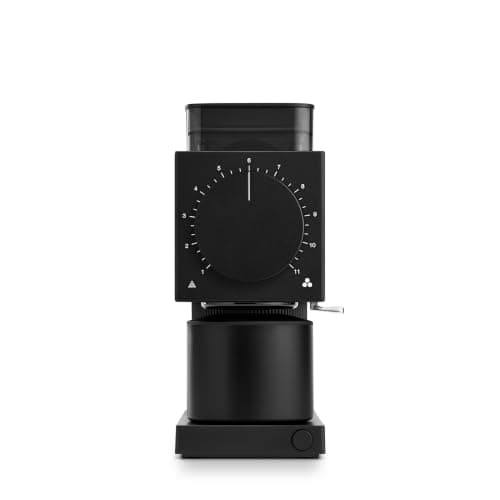 | Pour-over, especially light roasts | If clarity is the goal | |
| 2 | 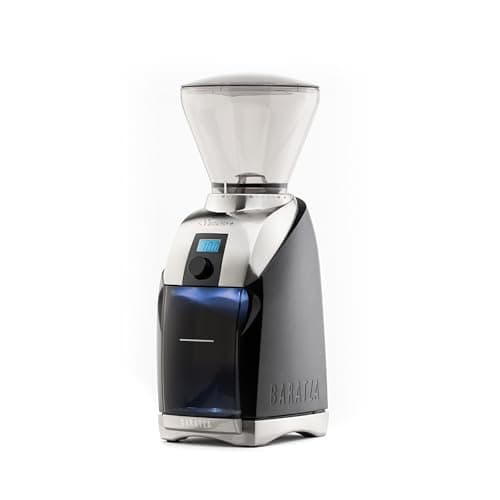 | The same dose every morning without a scale | If repeatable dosing matters |
1. If clarity is the goal
Fellow Ode Brew Grinder Gen 2
Upper-mid tier · A 64 mm flat-burr grinder built only for filter coffee - it does not do espresso.
64 mm flat burrs, single-dose loading, and one of the quietest grinders sold.
The Ode Gen 2 runs 64 mm uncoated stainless flat burrs - a cafe-sized burr set - across 31 settings, with a PID-held 1400 rpm motor.
Flat burrs tend toward a narrower particle distribution, which reads in the cup as clarity and separation rather than body. In a light-roast V60 that is the difference you are paying for.
Its workflow is single dose: load up to 100 g, grind it all, magnetic catch cup, knocker to clear the chamber.
It is one of the quietest electric grinders you can buy, which owners mention more often than any specification.
Fellow states plainly that it does not grind for espresso - the range bottoms out around 250 to 300 microns - and 31 settings is modest if you brew many methods. See the Ode Gen 2 review.
Specification
- Burrs
- 64 mm uncoated stainless flat
- Settings
- 31
- Load bin
- Single dose, up to 100 g
- Motor
- PID-held 1400 rpm
- Size
- 9.4 x 4.1 x 9.8 in
- Espresso
- No - bottoms out around 250-300 microns
What it does well
- 64 mm flats aimed squarely at clarity in filter brewing
- Single-dose bin, magnetic catch cup and a knocker to clear retention
- One of the quietest electric grinders you can buy
Where it gives ground
- Cannot grind fine enough for espresso, by design
- 31 settings is modest if you brew many methods
- Buying it and then wanting espresso means buying a second grinder
Skip it if
Skip it if espresso is even a maybe. No setting or modification makes it reach.
2. If repeatable dosing matters
Baratza Virtuoso+
Mid tier · The Encore chassis upgraded with a metal body and a digital dosing timer.
40 mm conicals across 200-1200 microns with a 40-second digital timer.
The Virtuoso+ keeps Baratza's 40 mm conical platform and 40 stepped settings, with a published range of 200 to 1200 microns - starting finer than the standard Encore's 250.
Its 40-second digital timer is adjustable in tenths of a second, so a household can press one button and get the same dose daily.
A metal body and a noticeably quieter run than the Encore are the differences you feel rather than read.
Burr speed is 550 rpm, and Baratza's parts-and-guides model applies here as it does across the range.
Timed dosing is not weight dosing - beans age and the dose drifts - and it is built for filter, not espresso, on the same 40 mm burr set as much cheaper grinders.
Specification
- Burrs
- 40 mm conical
- Settings
- 40 stepped, 200-1200 microns
- Timer
- 40-second digital, adjustable to 0.1 s
- Burr speed
- 550 rpm
What it does well
- Repeatable dosing without a scale in the loop
- Metal body and a noticeably quieter run than the Encore
- Grind range starts finer than the standard Encore
Where it gives ground
- Built for filter brewing, not espresso
- Timed dosing is not weight dosing - beans age and the dose drifts
- Same 40 mm burr set as grinders costing much less
Skip it if
Skip it if you weigh every dose anyway. The timer is most of what you are paying for.
Side by side
Scroll the table sideways to see every column.
Which one is yours
- Light-roast pour-over: the Ode, for the flats.
- A drip carafe every morning: the Virtuoso+, for the timer.
- You change beans weekly: the Ode's single-dose bin.
- Early mornings in a quiet house: the Ode.
- You want the cheapest good filter grinder: neither - that is the Baratza Encore.