The short answer
For espresso in a hand grinder, look for 48 mm burrs and 20 microns per click or finer. Burr size decides how much effort a dose takes; micron resolution decides whether you can dial the shot at all. Smaller burrs will grind espresso and will make it hard work.
Why hand grinders out-specify electric ones at the same price
A hand grinder has no motor, no gearbox, no electronics and no housing to accommodate them. The entire budget goes into burrs, bearings and an adjustment mechanism. That is why a manual grinder at $200 routinely publishes finer adjustment than an electric grinder at the same price - and why several of the picks on our under $300 list are manual.
Quick picks
The answer first. Tap any row to jump to the full reasoning for that pick.
Prices shown are checked daily against the retailer, as of October 23, 2026. We never write a price into the text of a page.
| # | Product | Best for | Award | Price |
|---|---|---|---|---|
| 1 | 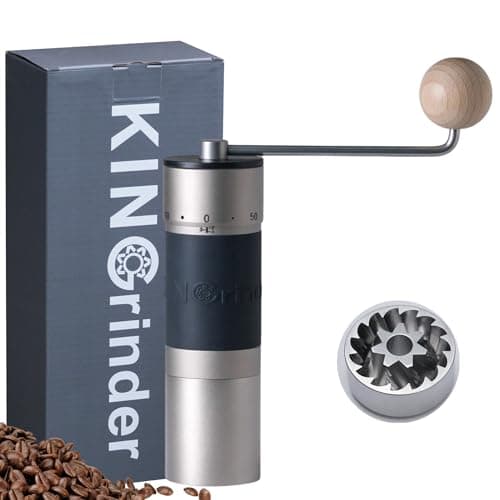 | Specification per dollar, with an escape route from cranking | Top pick for espresso | |
| 2 | 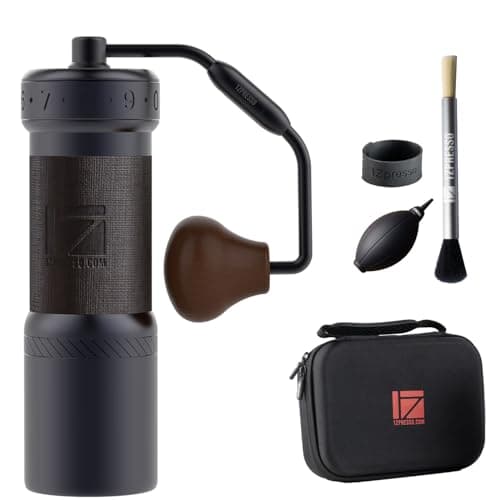 | Espresso plus filter, from one grinder | Best all-rounder | |
| 3 | 1Zpresso JX-Pro12.5 microns per click - the finest published resolution here, by a clear margin. | Espresso as the primary brew method | The finest resolution | |
| 4 | 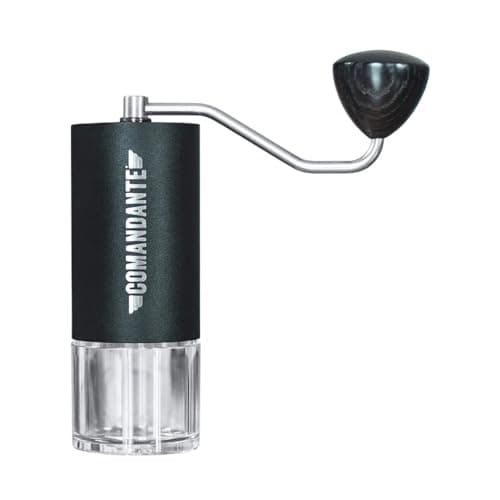 | Filter first, espresso occasionally | Best build, best for filter | |
| 5 | 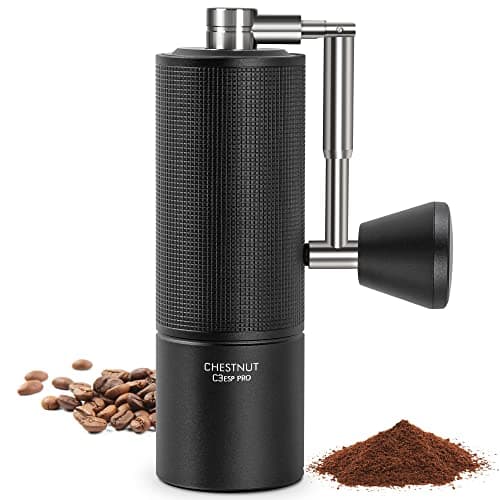 | Filter brewing and travel, where it is excellent | Skip this for espresso |
1. Top pick for espresso
Kingrinder K6
Manual tier · A 48 mm hand grinder with external adjustment and a hex shaft you can drive with a drill.
48 mm burrs, external adjustment and a drill shaft, for well under the premium options.
The K6 publishes 48 mm heptagonal stainless conical burrs with external adjustment at 60 clicks per rotation and 16 microns per click, in a 630 g aluminum body holding 30 to 35 g.
Those numbers are genuinely competitive with grinders costing considerably more, and the external adjustment removes the JX-Pro's main ergonomic annoyance.
The quarter-inch hex drive shaft is the feature that changes the argument. Drop a hex bit into a cordless drill and it grinds an espresso dose in seconds, which removes the single biggest objection to hand grinding for daily espresso.
Fit and finish is a step below 1Zpresso and Comandante, the aluminum marks with use, and parts support is thinner. Those are real trade-offs rather than snobbery.
Specification
- Burrs
- 48 mm heptagonal stainless conical
- Adjustment
- External, 60 clicks per rotation
- Resolution
- 16 microns per click
- Capacity
- 30-35 g
- Weight
- 630 g
- Shaft
- Quarter-inch hex drive
What it does well
- Big burrs and external adjustment for a fraction of the premium options
- The hex shaft turns it into an electric grinder with any cordless drill
- 16 microns per click is genuine espresso resolution
Where it gives ground
- Fit and finish is a step below the premium Taiwanese and German grinders
- Aluminum body picks up marks
- Support and spare parts are thinner than Comandante or 1Zpresso
Skip it if
Skip it if you want long-term parts support and service. The premium brands are meaningfully better on that specifically.
2. Best all-rounder
1Zpresso K-Ultra
Manual tier · A 48 mm hand grinder with external adjustment, built as an all-rounder.
External adjustment and seven cutting edges - the most pleasant to live with.
The K-Ultra's headline feature is ergonomic rather than metallurgical: the external adjustment ring lets you change grind without opening the grinder or removing the catch cup, at 100 clicks per rotation and 20 microns per click.
The burrs are 48 mm heptagonal conical stainless - seven cutting edges rather than the more common six, which gives faster throughput and, by 1Zpresso's account, a more uniform particle distribution.
It weighs 685 g and measures 19.5 x 18.5 x 6 cm, with a magnetic catch cup holding 35 to 40 g - a full espresso or filter dose.
Twenty microns per click is coarser than the JX-Pro's espresso resolution. If espresso is all you do, that model is more precise; if you move between espresso and V60 daily, the external ring is worth the trade.
Specification
- Burrs
- 48 mm heptagonal conical stainless (K burr)
- Adjustment
- External ring, 100 clicks per rotation
- Resolution
- 20 microns per click
- Weight
- 685 g
- Catch cup
- Magnetic, 35-40 g
What it does well
- External adjustment - you change grind without opening anything
- Seven cutting edges rather than six speeds the grind up noticeably
- Genuinely good across espresso, filter and French press
Where it gives ground
- 20 microns per click is coarser than the JX-Pro espresso resolution
- Heavier than a travel grinder should be
- Premium price for a hand grinder
Skip it if
Skip it if espresso resolution is the only thing you care about. The JX-Pro is finer at the fine end.
3. The finest resolution
1Zpresso JX-Pro
Manual tier · A 48 mm hand grinder with internal adjustment fine enough for espresso.
12.5 microns per click - the finest published resolution here, by a clear margin.
The JX-Pro is the hand grinder to buy if espresso is the reason you are buying one. Its published adjustment is 40 clicks per rotation at 12.5 microns per click, with each full rotation moving the burrs 0.5 mm.
That resolution genuinely matters when dialing in. A shot running four seconds too fast needs a small change, and on a grinder with 20 or 25 microns per click the smallest available change often overshoots. At 12.5 microns you can make the adjustment you actually want.
The burrs are 48 mm steel conicals, which is large enough that an 18 g espresso dose is a reasonable amount of cranking rather than an ordeal.
The main ergonomic cost is that the adjustment dial sits inside the hopper, so changing grind means lifting the lid - fine when dialed in, tedious while you are dialing.
Specification
- Burrs
- 48 mm steel conical
- Adjustment
- Internal, 40 clicks per rotation
- Resolution
- 12.5 microns per click
What it does well
- 12.5 microns per click is finer resolution than most electric grinders
- 48 mm burrs make short work of an espresso dose
- No power, no static, nothing to break
Where it gives ground
- The adjustment dial sits inside the hopper - you lift the lid to change it
- Grinding espresso by hand every morning gets old for some people
- No dosing aid: you weigh in, you weigh out
Skip it if
Skip it if you want one grinder for espresso and coarse filter. The external-adjustment models are far more pleasant to move across the range.
4. Best build, best for filter
Comandante C40 MK4
Manual tier · The reference hand grinder for filter brewing, built around a nitrogen-steel burr.
The clarity benchmark - and its click resolution is coarse for espresso.
The C40 is the grinder other hand grinders are measured against, and its reputation rests on filter rather than espresso. Thirty-nine millimeter conical burrs in high-nitrogen martensitic steel, with a stainless body, axle, crank and dual ball bearings.
The crank action is the thing owners describe first: effortless for the precision it delivers, and the reason people keep them for decades.
Adjustment is stepped at roughly 25 to 30 microns per click across about 40 clicks per rotation, with a 40 g bean container. Twenty-five to thirty microns is coarse for espresso - workable, but you will sometimes want to land between two clicks and cannot.
At 1.63 lb it is also a substantial object, and it costs more than several capable electric grinders.
Specification
- Burrs
- 39 mm conical, high-nitrogen martensitic steel
- Adjustment
- Stepped, roughly 25-30 microns per click
- Capacity
- 40 g bean container
- Build
- Stainless body, axle, crank and ball bearings
- Weight
- 1.63 lb
What it does well
- The clarity benchmark other hand grinders are measured against
- Built to be handed down rather than replaced
- Effortless crank action for a grinder this precise
Where it gives ground
- Click resolution is coarse for espresso
- Costs more than several capable electric grinders
- Smaller burrs than the 48 mm competition
Skip it if
Skip it if espresso is the main event. Buy a JX-Pro or a K6 for that and a C40 if filter clarity is what you are chasing.
5. Skip this for espresso
Timemore Chestnut C3
Manual tier · The budget hand grinder that made stainless conical burrs cheap.
Resolution is fine; 38 mm burrs make an espresso dose genuinely hard work.
The C3 is a genuinely good grinder and a poor espresso grinder, and the reason is burr size rather than precision.
Its adjustment is about 36 settings at roughly 0.0233 mm - 23 microns - per click, which is fine enough for espresso on paper. The burrs are 38 mm S2C stainless conicals at 55-58 HRC in an aluminum body with a double-bearing axis and no plastic internals.
The problem is throughput. Thirty-eight millimeter burrs grinding 18 g of coffee to espresso fineness is slow, effortful cranking - the sort of thing you do twice and then stop doing.
The 25 g capacity is the second constraint, limiting you to one brew at a time.
For pour-over, French press and travel it is one of the best values in coffee, and we recommend it as exactly that.
Specification
- Burrs
- 38 mm S2C stainless conical, 55-58 HRC
- Settings
- Roughly 36, about 0.0233 mm per click
- Capacity
- 25 g
- Weight
- About 530 g
- Build
- Aluminum body, double-bearing axis, no plastic internals
What it does well
- Filter-grade grind quality at a genuinely low price
- Metal internals and double bearings, not a toy
- Small and light enough to travel with
Where it gives ground
- 38 mm burrs make an espresso dose slow work
- Espresso resolution is marginal
- 25 g capacity limits you to one brew at a time
Skip it if
Skip it as a daily espresso grinder. Buy it happily for filter and travel.
The specifications side by side
Scroll the table sideways to see every column.
Internal or external adjustment
Internal adjustment means the dial sits inside the hopper, so you lift the lid and often remove the catch cup to change grind. External adjustment puts a ring on the outside of the body. Once you are dialed in and grinding the same coffee daily, the difference is negligible. While you are dialing in a new bag, external adjustment is dramatically less annoying.
How much effort is an espresso dose, honestly
Grinding 18 g of coffee to espresso fineness is meaningfully harder than grinding the same dose for filter, because finer particles mean more work per bean. On 48 mm burrs it takes somewhere in the region of half a minute of steady cranking; on 38 mm burrs it takes noticeably longer and requires more force.
That is a daily commitment, and it is the reason many people buy a hand grinder for espresso and quietly replace it with an electric one within a year. If you suspect that might be you, the Kingrinder K6's hex drive shaft is the honest hedge.
What a hand grinder gives you that electric does not
- No static. Grinding slowly generates almost none, so grounds stay in the catch cup rather than on the counter.
- Low retention. Simple geometry and no chute means very little is left behind.
- Silence. Genuinely relevant in a shared home early in the morning.
- Portability. A hand grinder travels; an electric grinder does not.