The short answer
All three use 48 mm burrs. Choose the JX-Pro for the finest espresso steps, 12.5 microns per click. Choose the K-Ultra if you switch methods daily, because 100 clicks per rotation travels the range quickly. Choose the K6 for a middle ground at 16 microns per click with external adjustment.
The numbers side by side
Scroll the table sideways to see every column.
The last row is arithmetic rather than a published figure: clicks per rotation multiplied by microns per click. It is the clearest way to see why these grinders feel so different to adjust.
Quick picks
The answer first. Tap any row to jump to the full reasoning for that pick.
Prices shown are checked daily against the retailer, as of October 25, 2026. We never write a price into the text of a page.
| # | Product | Best for | Award | Price |
|---|---|---|---|---|
| 1 | 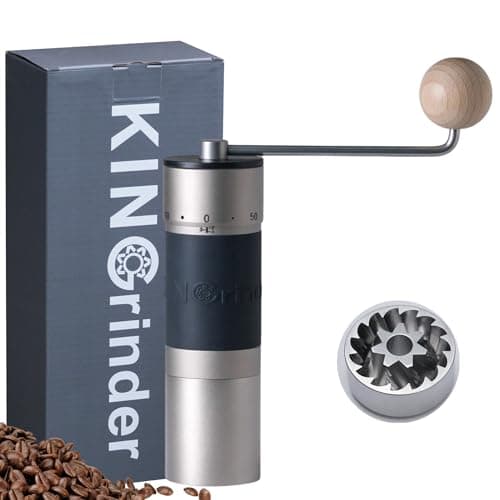 | One hand grinder across filter and espresso | Choose this for the middle ground | |
| 2 | 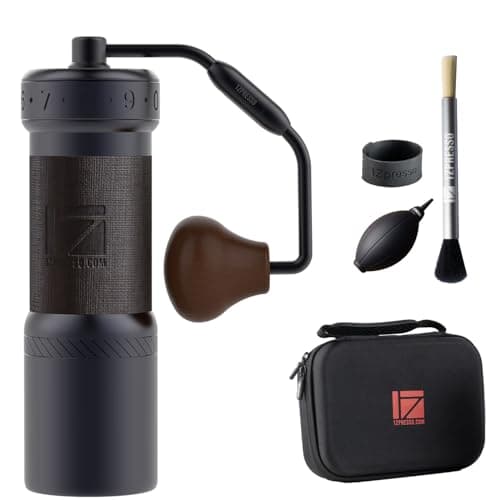 | Switching between brew methods daily | Choose this for fast switching | |
| 3 | 1Zpresso JX-ProThe finest steps here at 12.5 microns per click, at the cost of internal adjustment. | Espresso-first hand grinding | Choose this for espresso steps |
1. Choose this for the middle ground
Kingrinder K6
Manual tier · A 48 mm hand grinder with external adjustment and a hex shaft you can drive with a drill.
A 48 mm heptagonal burr and an external 60-click ring, at 16 microns per step.
The K6 uses a 48 mm heptagonal stainless conical burr with external adjustment at 60 clicks per rotation, listed at 16 microns per click. It holds 30 to 35 g and weighs 630 g.
External adjustment is the practical feature: you change grind size by turning a ring on the outside rather than opening the grinder, so moving between an espresso setting and a pour-over setting takes seconds.
Sixteen microns per click sits between the other two grinders here, which gives workable resolution at the espresso end without making the filter range tediously long to travel.
At 630 g it is the lighter of the two external-adjust grinders on this page.
Specification
- Burrs
- 48 mm heptagonal stainless conical
- Adjustment
- External, 60 clicks per rotation
- Resolution
- 16 microns per click
- Capacity
- 30-35 g
- Weight
- 630 g
- Shaft
- Quarter-inch hex drive
What it does well
- Big burrs and external adjustment for a fraction of the premium options
- The hex shaft turns it into an electric grinder with any cordless drill
- 16 microns per click is genuine espresso resolution
Where it gives ground
- Fit and finish is a step below the premium Taiwanese and German grinders
- Aluminum body picks up marks
- Support and spare parts are thinner than Comandante or 1Zpresso
Skip it if
Skip it if you want the finest possible steps for espresso. The JX-Pro's 12.5 microns per click is finer.
2. Choose this for fast switching
1Zpresso K-Ultra
Manual tier · A 48 mm hand grinder with external adjustment, built as an all-rounder.
100 clicks per rotation, so moving between espresso and filter is a short turn.
The K-Ultra shares the K6's burr format - 48 mm heptagonal conical stainless - and its external adjustment ring, but divides each rotation into 100 clicks at a listed 20 microns per click.
That arithmetic is the difference. Each full turn of the K-Ultra's ring moves the burrs further than a turn of the K6's, so traveling from an espresso setting to a pour-over setting takes less turning. The trade is that each individual click is a slightly larger step.
It weighs 685 g and uses a magnetic catch cup holding 35 to 40 g, which is quicker to remove and replace than a threaded one.
For someone who brews espresso in the morning and pour-over in the afternoon, fast travel is the feature that matters day to day - see the full K-Ultra review.
Specification
- Burrs
- 48 mm heptagonal conical stainless (K burr)
- Adjustment
- External ring, 100 clicks per rotation
- Resolution
- 20 microns per click
- Weight
- 685 g
- Catch cup
- Magnetic, 35-40 g
What it does well
- External adjustment - you change grind without opening anything
- Seven cutting edges rather than six speeds the grind up noticeably
- Genuinely good across espresso, filter and French press
Where it gives ground
- 20 microns per click is coarser than the JX-Pro espresso resolution
- Heavier than a travel grinder should be
- Premium price for a hand grinder
Skip it if
Skip it if you only brew espresso. Finer per-click steps matter more there than fast travel across the range.
3. Choose this for espresso steps
1Zpresso JX-Pro
Manual tier · A 48 mm hand grinder with internal adjustment fine enough for espresso.
The finest steps here at 12.5 microns per click, at the cost of internal adjustment.
The JX-Pro uses a 48 mm steel conical burr with internal adjustment at 40 clicks per rotation, listed at 12.5 microns per click - the finest step of the three grinders here.
Fine steps are what espresso needs. When a shot runs slightly fast or slow, a small step lets you correct it by a small amount rather than overshooting.
The cost is convenience. Internal adjustment means changing the setting inside the grinder, which makes switching between espresso and filter slower than turning an external ring.
If you brew one method and rarely change, internal adjustment is a minor inconvenience against a meaningful gain in resolution.
Specification
- Burrs
- 48 mm steel conical
- Adjustment
- Internal, 40 clicks per rotation
- Resolution
- 12.5 microns per click
What it does well
- 12.5 microns per click is finer resolution than most electric grinders
- 48 mm burrs make short work of an espresso dose
- No power, no static, nothing to break
Where it gives ground
- The adjustment dial sits inside the hopper - you lift the lid to change it
- Grinding espresso by hand every morning gets old for some people
- No dosing aid: you weigh in, you weigh out
Skip it if
Skip it if you switch between espresso and filter every day. External adjustment on the K6 or K-Ultra makes that far quicker.
Resolution against travel
Every hand grinder makes a trade between how fine each step is and how far one turn of the ring moves the burrs. Fine steps help espresso; fast travel helps anyone switching between methods.
The JX-Pro sits at the resolution end, the K-Ultra at the travel end, and the K6 between them. None is objectively best - each is best for a particular routine.
Internal or external adjustment
External adjustment puts the ring on the outside of the body, where you can turn it with beans loaded. Internal adjustment sits inside the grinder, which means taking it partly apart to change the setting.
For a one-method brewer it barely matters. For someone who makes espresso and filter every day, external adjustment is the single most useful feature a hand grinder can have - see hand grinders for espresso for the wider field.