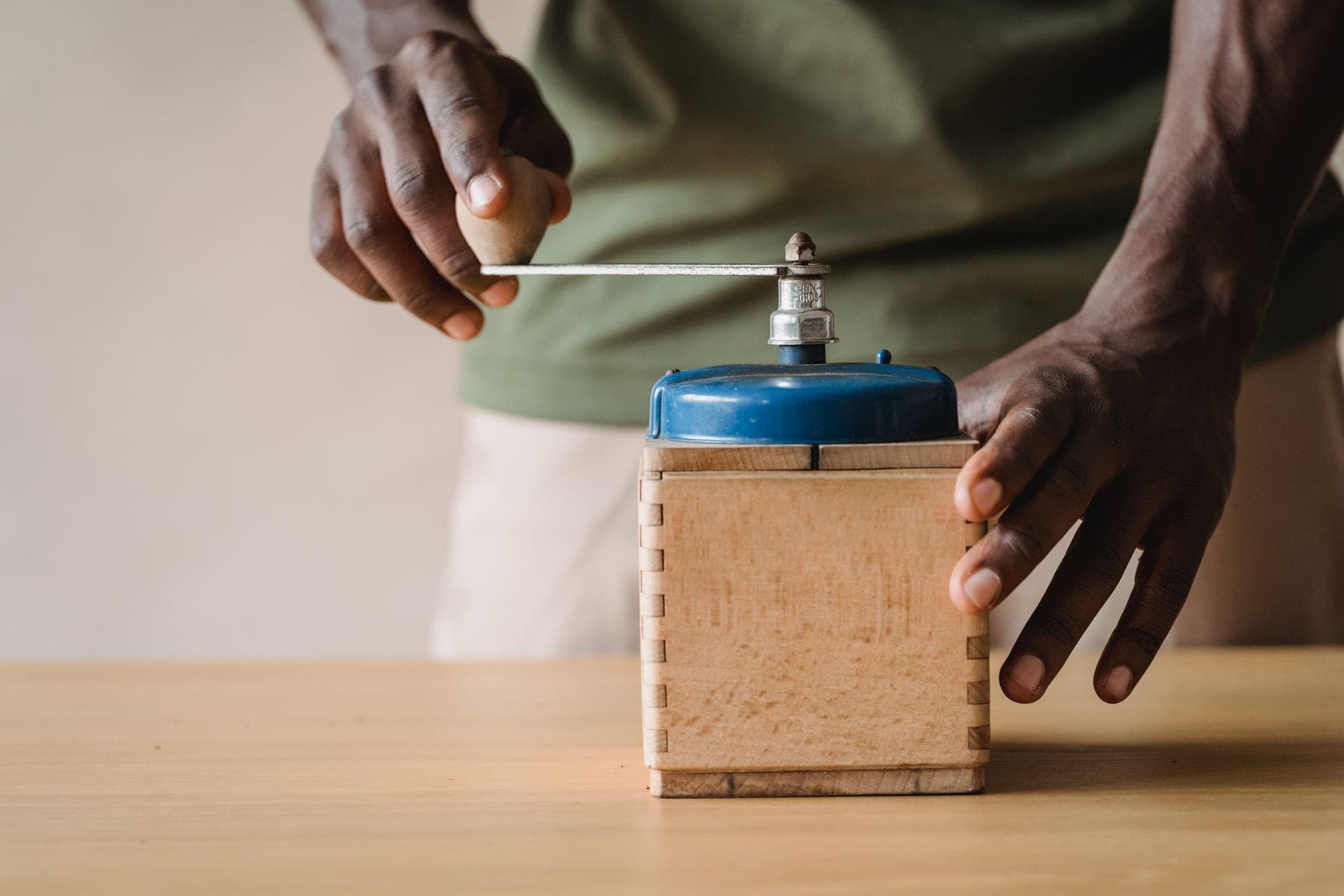
The short answer
Yes, and often better than an electric grinder at the same price. Look for 48 mm burrs, so a dose is not exhausting, and 20 microns per click or finer, so you can actually dial a shot. Smaller burrs will grind espresso and will make it genuinely hard work.
Why hand grinders out-specify electric ones at the same price
A hand grinder has no motor, no gearbox, no electronics and no housing to accommodate them. Its entire cost goes into burrs, bearings and an adjustment mechanism.
An electric grinder at the same price is paying for a motor, a controller, a chassis and a chute - and whatever is left goes into the burrs. That is why a manual grinder routinely publishes finer adjustment than an electric one costing the same or more.
The two specifications that decide it
Scroll the table sideways to see every column.
Both matter, and burr size is the one people underweight. A grinder with excellent resolution and small burrs will dial in beautifully and take a minute and a half of hard cranking to do it - which is the point at which most people stop.
Quick picks
The answer first. Tap any row to jump to the full reasoning for that pick.
Prices shown are checked daily against the retailer, as of October 23, 2026. We never write a price into the text of a page.
| # | Product | Best for | Award | Price |
|---|---|---|---|---|
| 1 | 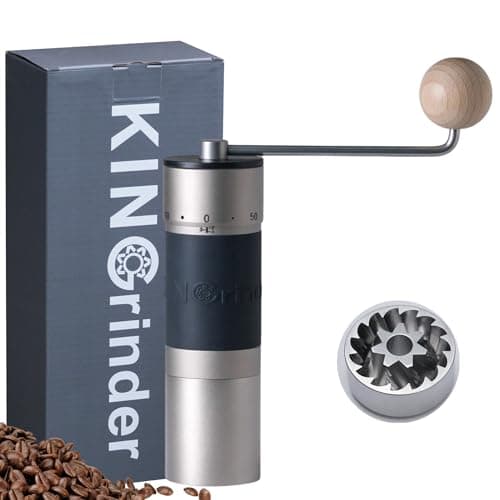 | Anyone unsure they will keep cranking | The hedge | |
| 2 | 1Zpresso JX-Pro12.5 microns per click, which is finer than most electric grinders at any price. | Espresso as the primary brew method | The finest resolution | |
| 3 | 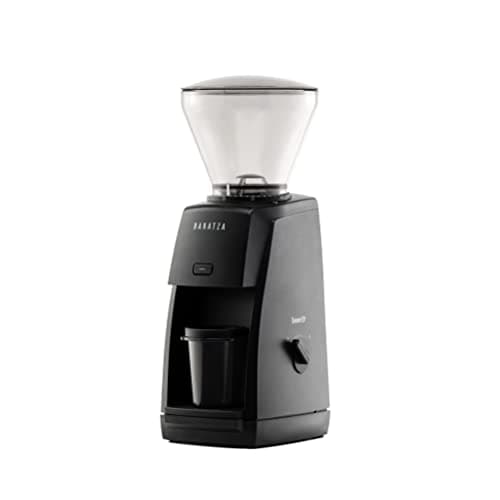 | Daily espresso without the effort | The electric alternative |
1. The hedge
Kingrinder K6
Manual tier · A 48 mm hand grinder with external adjustment and a hex shaft you can drive with a drill.
A hex drive shaft turns it into an electric grinder whenever you want.
The honest objection to hand grinding espresso is the daily effort, and this grinder answers it directly.
The K6 publishes 48 mm heptagonal stainless conical burrs with external adjustment at 60 clicks per rotation and 16 microns per click, a 30-35 g capacity, and 630 g of weight.
It has a quarter-inch hex drive shaft designed to take a bit from a cordless drill, which grinds a dose in seconds.
That removes the single biggest reason people abandon hand grinders for espresso, and it does so without giving up the resolution.
Fit and finish sits below the premium Taiwanese and German options, and parts support is thinner.
Specification
- Burrs
- 48 mm heptagonal stainless conical
- Adjustment
- External, 60 clicks per rotation
- Resolution
- 16 microns per click
- Capacity
- 30-35 g
- Weight
- 630 g
- Shaft
- Quarter-inch hex drive
What it does well
- Big burrs and external adjustment for a fraction of the premium options
- The hex shaft turns it into an electric grinder with any cordless drill
- 16 microns per click is genuine espresso resolution
Where it gives ground
- Fit and finish is a step below the premium Taiwanese and German grinders
- Aluminum body picks up marks
- Support and spare parts are thinner than Comandante or 1Zpresso
Skip it if
Skip it if long-term parts and service matter. 1Zpresso and Comandante are meaningfully better supported.
2. The finest resolution
1Zpresso JX-Pro
Manual tier · A 48 mm hand grinder with internal adjustment fine enough for espresso.
12.5 microns per click, which is finer than most electric grinders at any price.
If espresso is why you are considering a hand grinder, this is the specification that answers the question.
The JX-Pro publishes 40 clicks per rotation at 12.5 microns per click, with each full rotation moving the burrs 0.5 mm, on 48 mm steel conical burrs.
Twelve and a half microns is fine enough that the correction you want is essentially always available - which is precisely the thing coarse-stepped electric grinders cannot promise.
Forty-eight millimeter burrs are large enough that an 18 g espresso dose is reasonable rather than punishing.
The adjustment dial sits inside the hopper, so changing grind means lifting the lid.
Specification
- Burrs
- 48 mm steel conical
- Adjustment
- Internal, 40 clicks per rotation
- Resolution
- 12.5 microns per click
What it does well
- 12.5 microns per click is finer resolution than most electric grinders
- 48 mm burrs make short work of an espresso dose
- No power, no static, nothing to break
Where it gives ground
- The adjustment dial sits inside the hopper - you lift the lid to change it
- Grinding espresso by hand every morning gets old for some people
- No dosing aid: you weigh in, you weigh out
Skip it if
Skip it if you move between espresso and coarse filter constantly. External adjustment is far more pleasant for that.
3. The electric alternative
Baratza Encore ESP
Entry tier · The Encore re-geared for espresso: the same 40 mm burrs on a dual-resolution collar.
If you decide the cranking is not for you, this is the equivalent electric answer.
It is worth knowing what the electric option at a comparable price offers, because for many people it is the right answer.
The Encore ESP publishes 40 mm M2 hardened alloy steel conical burrs made by Etzinger, with dual-resolution stepping: about 20 microns per click across steps 1 to 20 for espresso, and about 90 microns across steps 21 to 40 for filter, at 550 rpm.
Twenty microns is coarser than the JX-Pro's 12.5 and still genuine espresso resolution.
What you get in exchange is a button. For anyone pulling two or three shots every morning, that is not a small consideration.
It is stepped, retention is ordinary for the class, and it is not a quiet grinder.
Specification
- Burrs
- 40 mm M2 steel conical (Etzinger)
- Settings
- 40 stepped, dual resolution
- Espresso range
- Steps 1-20, 20 microns per click
- Filter range
- Steps 21-40, 90 microns per click
- Burr speed
- 550 rpm
What it does well
- 20 microns per click in the espresso range is real dialing resolution
- Redesigned burr housing makes cleaning and shimming easy
- Shims included in the box
Where it gives ground
- Still a stepped grinder - you cannot land between clicks
- Retention is normal-for-the-class, not low
- Same plastic body and noise as the Encore
Skip it if
Skip it if you have no counter space or no outlet where the grinder needs to live.
What grinding espresso by hand is actually like
Roughly half a minute of steady cranking on 48 mm burrs for an 18 g dose, and noticeably longer with meaningful resistance on smaller burrs. Espresso fineness takes substantially more effort than filter grinding on the same grinder, because finer particles mean more work per bean.
For one shot a day, that is a pleasant ritual for a lot of people. For three shots on a weekday morning while getting children out of the door, it is not.
Be honest about which describes you before buying. The failure mode is a good grinder that gets replaced within a year, not a grinder that turns out to be bad.
Internal or external adjustment
Internal adjustment puts the dial inside the hopper, so changing grind means lifting the lid and often removing the catch cup. External adjustment puts a ring on the outside of the body.
Once you are dialed in on one coffee, this hardly matters. While you are dialing in a new bag, or if you move between espresso and pour-over regularly, external adjustment is dramatically less tedious.
What hand grinders do better than electric ones
- Almost no static. Slow grinding generates very little, so grounds stay in the catch cup rather than on the counter.
- Very low retention. Simple geometry with no long chute means little is left behind.
- Silence. Genuinely relevant early in the morning in a shared home.
- Portability. A hand grinder travels; an electric one does not.
- No power requirement, which matters more than it sounds in a crowded kitchen.
The honest recommendation
If you pull one or two shots a day, enjoy a bit of process, and want the best grind quality your money can buy, a hand grinder is an excellent choice for espresso.
If you pull three or more, or anyone else in the household needs to use it, buy an electric grinder - or buy a hand grinder with a drill shaft and keep both options open.