The short answer
Buy a scale with 0.1 g resolution and a built-in timer. Those two things cover 90 percent of what a coffee scale is for. Response time matters if you weigh espresso as it pours, and water resistance matters if the scale lives on a drip tray.
Why this is the first accessory to buy
Coffee is a ratio brewed over a duration. Espresso is dose in, liquid out, over time. Pour-over is dose, water, and time. In both cases, without a scale you are estimating at least two of the three numbers, which means when something tastes different you cannot tell what changed.
That is the whole argument. A scale does not make coffee better by itself - it makes your changes legible, which is what lets you improve.
Quick picks
The answer first. Tap any row to jump to the full reasoning for that pick.
Prices shown are checked daily against the retailer, as of October 23, 2026. We never write a price into the text of a page.
| # | Product | Best for | Award | Price |
|---|---|---|---|---|
| 1 | 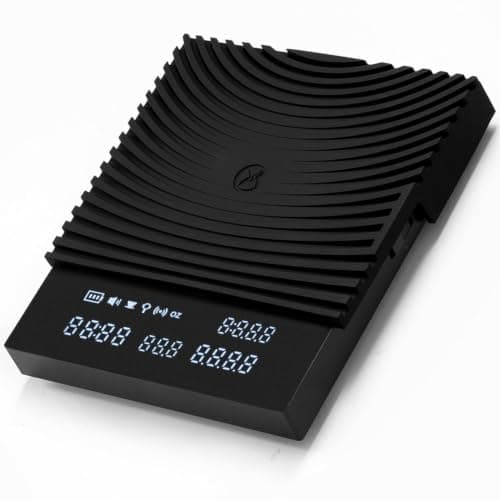 | Most people, for both espresso and brewing | Top pick | |
| 2 | Acaia Lunar10 ms response and a body you can genuinely submerge. | Espresso, on the drip tray, every day | Best for espresso | |
| 3 | Acaia PearlA large, fast platform you can pour against in real time. | Manual brewing, especially with a flow-rate display | Best for pour-over | |
| 4 | 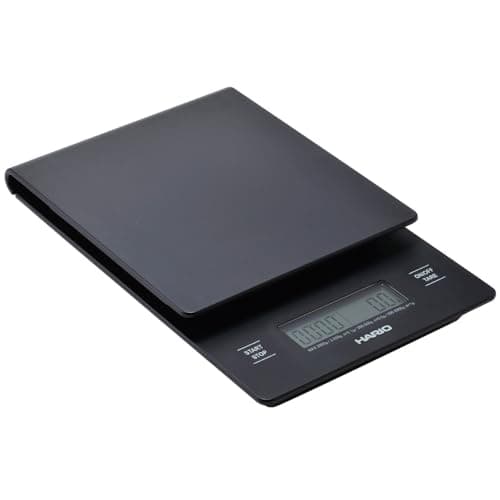 | A first coffee scale | Best budget option |
1. Top pick
Timemore Black Mirror Basic Plus
Mid tier · A rechargeable coffee scale with auto-timing and a flow-rate readout.
Auto-timing and flow rate at a fraction of an Acaia, and it charges over USB-C.
The Black Mirror Basic Plus is the sensible answer for almost everyone. It publishes 2000 g capacity with 0.1 g resolution and a 0.5 g minimum detectable weight, automatic timing, and on the current version a flow-rate readout.
Automatic timing is the feature that changes the workflow: the timer starts when liquid begins hitting the scale, so you are not fumbling for a button while pouring.
It measures 152 x 130 x 26 mm and weighs about 380 g - small enough to fit on most espresso drip trays, large enough to hold a dripper and server.
The 1600 mAh battery runs up to ten hours and charges over USB-C, which removes the drawer full of coin cells that older scales demand. It is not waterproof, and the mirrored top shows every fingerprint.
Specification
- Capacity
- 2000 g
- Resolution
- 0.1 g; minimum detectable 0.5 g
- Timer
- Automatic timing
- Battery
- 1600 mAh, up to 10 hours, USB-C
- Size
- 152 x 130 x 26 mm, about 380 g
What it does well
- Auto-timing and flow rate at a fraction of an Acaia
- USB-C rechargeable rather than a drawer full of coin cells
- Small enough for a drip tray, big enough for a dripper
Where it gives ground
- Not waterproof
- Response is quick but not espresso-instant
- The mirrored top shows every fingerprint
Skip it if
Skip it if the scale will live permanently in a drip tray and get soaked. That is a job for the Lunar.
2. Best for espresso
Acaia Lunar
Upper-mid tier · A compact waterproof espresso scale sized for a machine drip tray.
10 ms response and a body you can genuinely submerge.
The Lunar is built for one job: sitting on an espresso machine's drip tray and surviving. Its anodized aluminum body is fully waterproof - Acaia's own position is that you can submerge it, dry it and carry on.
That matters because a drip tray is a wet environment, and it is where most scales die.
It publishes 2 kg capacity with 0.1 g resolution and a 10 ms response time, which is fast enough to keep up with the beginning of a shot rather than lagging behind it.
The platform is small - deliberately, so it fits under a portafilter - and that makes it unsuitable for pour-over. It is also the most expensive way to weigh 36 grams of coffee that exists.
Specification
- Capacity
- 2 kg
- Resolution
- 0.1 g
- Response
- 10 ms
- Body
- Anodized aluminum, fully waterproof
- Built for
- Espresso, on the drip tray
What it does well
- You can submerge it, dry it and carry on - that is not marketing
- 10 ms response keeps up with a shot starting
- Fits under a portafilter where a brewing scale will not
Where it gives ground
- The platform is too small for pour-over
- The most expensive way to weigh 36 grams of coffee
- Overkill unless you are chasing ratios shot to shot
Skip it if
Skip it if you brew pour-over. The platform is too small for a dripper and server, and the Pearl exists for that.
3. Best for pour-over
Acaia Pearl
Upper-mid tier · A brewing scale with a large platform, built for pour-over and batch brewing.
A large, fast platform you can pour against in real time.
The Pearl is the brewing counterpart: 2 kg capacity, 0.1 g resolution and a 20 ms response time on a platform large enough for a Chemex or a dripper sitting on a server.
The flow-rate display is the feature worth paying for. Pour-over technique is largely about how fast you add water, and a scale that shows grams per second turns that from a feel into a number you can repeat.
Twenty milliseconds is fast enough to pour against without the display lagging behind your kettle, which is the practical requirement.
It is not waterproof - that is the Lunar's job - and it is far too large for most espresso drip trays.
Specification
- Capacity
- 2 kg
- Resolution
- 0.1 g
- Response
- 20 ms
- Built for
- Manual brewing, home and shop
What it does well
- Big enough platform to sit a Chemex or a dripper and server on
- Fast and stable enough to pour against in real time
- Flow-rate display turns pouring into something you can measure
Where it gives ground
- Not waterproof - that is what the Lunar is for
- Too large to sit on most espresso drip trays
- Costs several times what a competent scale costs
Skip it if
Skip it if you only make espresso. It will not fit under a portafilter and the Lunar is the right tool.
4. Best budget option
Hario V60 Drip Scale
Budget tier · A basic brewing scale with an integrated count-up timer.
Does the two jobs a brew scale must do, cheaply.
The V60 Drip Scale is the entry point, and for a first scale it is entirely sufficient. It publishes 2000 g capacity with 0.1 g resolution between 2 and 200 g, and a count-up timer to 99 minutes 59 seconds.
The platform is W120 x D190 x H29 mm - long and narrow, which suits a dripper on a server.
It has auto power-off after five minutes, which is a mixed blessing: convenient for battery life, occasionally irritating mid-brew.
The thing to know before buying is that it is explicitly not water resistant, and it will spend its life under a pouring kettle. Keep a cloth nearby and be careful.
Specification
- Capacity
- 2000 g
- Resolution
- 0.1 g between 2 and 200 g
- Timer
- Count-up to 99:59
- Size
- W120 x D190 x H29 mm
- Water resistance
- None
What it does well
- Does the two things a brew scale must do, for very little money
- Long, narrow platform suits a dripper and server
- Auto power-off after five minutes
Where it gives ground
- Not water resistant, and it sits under a pouring kettle
- Slower response than the premium scales
- No flow-rate display
Skip it if
Skip it if you want auto-timing or flow rate. Those are worth the step up to the Timemore.
The three specifications
Scroll the table sideways to see every column.
Why a kitchen scale usually will not do
Most kitchen scales read in whole grams or in 1 g increments, which is too coarse for an 18 g espresso dose - a gram either way is a meaningful change in the shot. Many also have a minimum detectable weight high enough that they will not register the first few grams of liquid at all.
The other problem is auto-off. A kitchen scale that shuts down after 30 seconds of no change will switch itself off in the middle of a bloom, which is exactly when you need it.
If you already own a kitchen scale that reads to 0.1 g and does not auto-off aggressively, use it. Otherwise this is a genuine purchase rather than a duplicate.
Espresso and brewing want different scales
An espresso scale needs to be small enough to sit on a drip tray under a portafilter, fast enough to keep up with the start of the shot, and ideally waterproof. A brewing scale needs a platform large enough to take a dripper and server, and benefits from a flow-rate display.
Those requirements conflict, which is why Acaia sells two scales. A mid-size scale like the Timemore is the sensible compromise if you do both and want to own one.
What a scale will not fix
It measures; it does not grind. If your grinder produces an inconsistent particle size, weighing precisely tells you that your consistent 18 g dose produced two different shots - which is useful diagnosis and not a solution. The scale is the instrument; the grinder is the variable.