The short answer
Coffee goes stale because of oxygen, light, heat and moisture. A good canister is opaque, airtight and stored at room temperature away from the stove - and the better ones do something about the air already inside, either by vacuum (Fellow Atmos), by pushing the headspace out (Airscape) or by letting fresh beans degas through a one-way valve (Coffee Gator). Clear containers are the common mistake.
What actually stales coffee
The National Coffee Association's storage guidance is unglamorous and correct: keep coffee in an opaque, airtight container at room temperature, away from light, heat and moisture. Every mechanism on this page is an attempt to do one of those things better.
Oxygen is the main culprit. Roasted coffee contains oils and aromatic compounds that oxidize on contact with air, which is why a bag open for three weeks smells like almost nothing. Grinding accelerates it enormously by multiplying the exposed surface area.
Light and heat speed the same reactions up, and moisture starts extracting the coffee before you do. That is why the fridge is a bad idea: it is humid, and coffee absorbs odors readily.
None of this happens on a useful timescale in a few days. If you buy a 12 oz bag and finish it in four days, a folded bag with a clip is genuinely fine. Storage becomes worth money at the point where a bag lasts two weeks or more, which is most households.
The three mechanisms, and which you need
- Vacuum (Atmos). Removes air after sealing. Best for beans you will take a week or two to drink.
- Plunger lid (Airscape). Pushes the headspace air out mechanically as the container empties. Simple, nothing to operate wrongly.
- One-way valve (Coffee Gator). Lets CO2 out of freshly roasted beans without letting oxygen in. Only relevant for coffee roasted in the last week or two.
- Plain airtight (Veken). Stops new air arriving. Covers most of the benefit for most of the coffee people actually buy.
Quick picks
The answer first. Tap any row to jump to the full reasoning for that pick.
| # | Product | Best for | Award | Price |
|---|---|---|---|---|
| 1 | 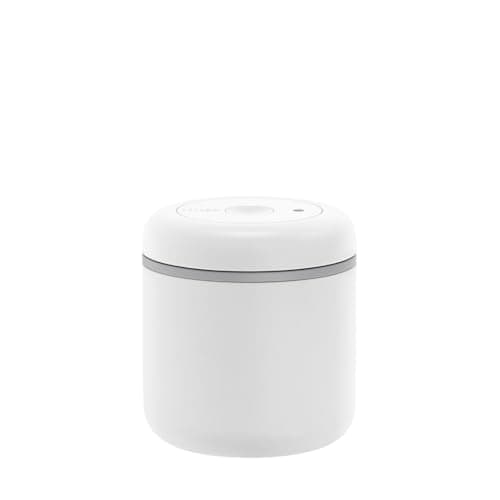 | Beans you will take two weeks to drink | Top pick | |
| 2 | 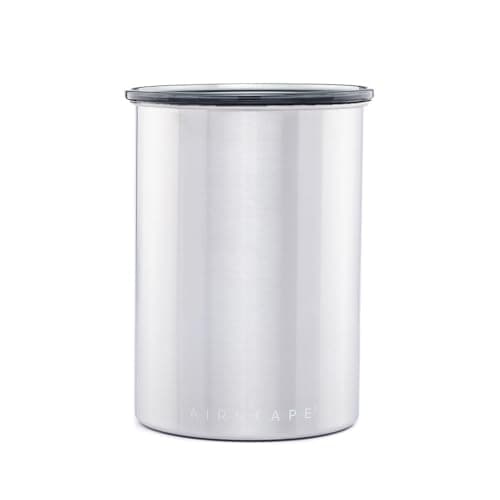 | Removing air with nothing to operate | Best without a vacuum | |
| 3 | 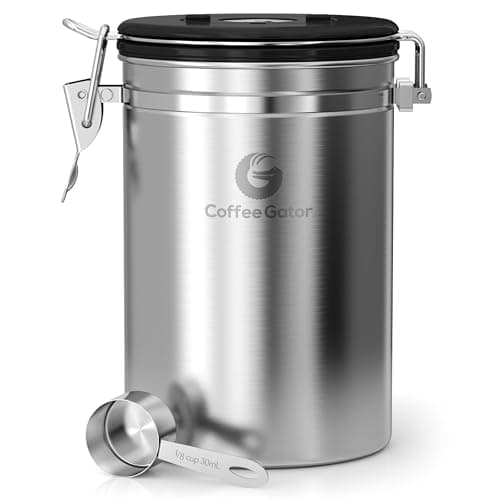 | Coffee bought within days of roasting | Best for freshly roasted beans | |
| 4 | 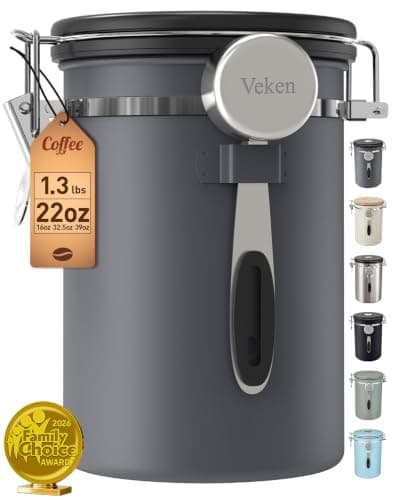 | Getting beans out of the bag for the least money | Best budget | |
| 5 | 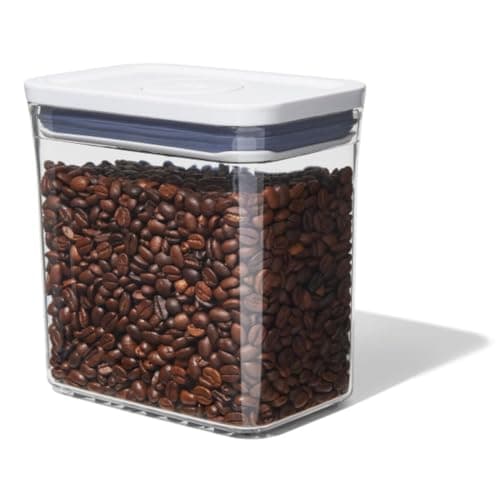 | Flour and sugar, not coffee | Skip this for beans |
1. Top pick
Fellow Atmos Vacuum Canister 0.7 L
Mid tier · A steel canister whose lid twists to pull the air out of the jar.
Twist the lid and it pulls the air out, with an indicator that proves the seal held.
The Atmos is the only canister here that actively removes air rather than sealing it above the beans. Twisting the lid draws the air out, and a visual seal indicator tells you the vacuum actually held.
That distinction matters because the enemy is oxygen, not the bag. A perfectly airtight jar with two inches of headspace still holds enough oxygen to keep oxidizing the beans inside it.
The 0.7 L size holds up to 11 oz of beans, which is a typical 12 oz bag most of the way. Fellow also sells 0.4 L and 1.2 L versions, the largest rated for up to 16 oz of light or medium roast.
The body is 301 18/8 stainless steel with a silicone-wrapped handle, so it is opaque - light is dealt with by the material rather than by a feature.
Fellow's claim is that it keeps coffee fresh twice as long. That is a manufacturer's number rather than an independent test, and the mechanism behind it is sound.
Specification
- Capacity
- 0.7 L, holds up to 11 oz of beans
- Sizes
- 0.4 L, 0.7 L and 1.2 L
- Material
- 301 18/8 stainless steel body, silicone handle wrapper
- Seal
- Twist the lid to remove air; visual seal indicator
- Maker's claim
- Fellow states it keeps coffee fresh twice as long
What it does well
- Actively removes air rather than just sealing it in
- The indicator tells you the vacuum actually held
- Steel body blocks light completely
Where it gives ground
- You have to remember to twist it every single time
- Costs several times what a plain airtight jar does
- 0.7 L is under a pound of beans for most roasts
Skip it if
Skip it if you finish a bag in four days. Nothing oxidizes meaningfully in that time and a plain jar would do.
2. Best without a vacuum
Airscape Classic Stainless Canister
Budget tier · A steel canister with an inner plunger lid that pushes air out as it is pressed down.
An inner plunger lid that pushes the headspace air out as you press it down.
The Airscape's patented inner lid is a plunger: press it down onto the beans and the air above them is forced out past a valve, which then locks.
It is a mechanically simpler answer to the same problem as the Atmos - no twisting sequence, no indicator to read, nothing to maintain.
The body is restaurant-grade 18/8 stainless steel with a BPA-free clear top lid, so you can see the level without opening it. The 64 oz size holds about 1 lb of beans.
A non-slip, stackable base means it behaves in a cupboard rather than sliding around a shelf.
The inner lid presses directly onto the beans, which grinds slightly against the top layer, and there are two lids to keep track of rather than one.
Specification
- Material
- Restaurant-grade 18/8 stainless steel
- Inner lid
- Patented plunger lid forces air out and locks in place
- Outer lid
- BPA-free clear top lid
- Sizes
- Sold in several sizes; the 64 oz holds about 1 lb of beans
- Base
- Non-slip, stackable
What it does well
- The plunger removes headspace air rather than sealing it above the beans
- No electronics, no pump and nothing to fail
- Steel body with a clear top lid so you can see the level
Where it gives ground
- Pressing the lid down grinds against the beans at the top
- Two lids to lose rather than one
- Sizes are confusing to shop for online
Skip it if
Skip it if you want a sealed vacuum rather than reduced headspace. The Atmos does the stronger version of this job.
3. Best for freshly roasted beans
Coffee Gator Canister 22 oz
Budget tier · A stainless canister with a one-way valve for freshly roasted beans.
A one-way CO2 valve, so fresh beans can degas without letting oxygen in.
Freshly roasted coffee releases carbon dioxide for days after roasting. In a fully sealed container that gas builds pressure; in an open one, oxygen comes in.
The Coffee Gator's one-way valve solves exactly that: CO2 escapes, nothing comes back. It is the same valve principle used on roasters' own bags.
The 22 oz size holds a 1 lb bag of medium to dark roast, and the lid carries a date-tracker dial - which answers the only question that matters about stored coffee.
It is stainless steel, so light and moisture are handled, and a measuring scoop is included.
The valve only earns its place for beans roasted in the last week or two. After that it does nothing a plain airtight lid would not, and it cannot remove the air already inside.
Specification
- Capacity
- 22 oz - holds a 1 lb bag of medium to dark roast
- Valve
- One-way CO2 release valve
- Lid
- Date tracker dial
- Material
- Stainless steel
- Included
- Measuring scoop
What it does well
- The one-way valve lets fresh beans degas without letting oxygen back in
- A date dial on the lid answers the question that matters most
- Holds a standard 1 lb bag
Where it gives ground
- The valve only matters for beans roasted in the last week or two
- No way to remove the air already in the jar
- Light roasts take more space than dark, so a 1 lb bag can be a squeeze
Skip it if
Skip it if you buy supermarket coffee. Those beans finished degassing months ago.
4. Best budget
Veken Coffee Canister 22 oz
Budget tier · A plain airtight steel jar with a date tracker and a scoop.
A plain airtight steel jar that does the basics for very little.
The Veken is 304 stainless steel with a silicone-gasket airtight lid, a date tracker and a scoop, sized at 22 oz to fit most 1 lb bags.
Airtight and opaque covers three of coffee's four enemies - oxygen ingress, light and moisture - which is most of the benefit for a fraction of the price of a vacuum canister.
It is the sensible upgrade from a folded-over bag with a clip, and that is a bigger jump than the one from this to an Atmos.
There is no vacuum and no valve, so whatever air is sealed in stays in with the beans.
Gaskets perish eventually, and a generic jar has no coffee-specific design beyond the date dial.
Specification
- Capacity
- 22 oz - fits most 1 lb bags
- Material
- 304 stainless steel
- Seal
- Airtight lid with a silicone gasket
- Lid
- Date tracker
- Included
- Stainless steel scoop
What it does well
- Does the one job storage has to do - keep air, light and moisture out
- Costs a fraction of a vacuum canister
- Steel and silicone, so nothing to break
Where it gives ground
- No vacuum and no valve: the air sealed in stays in
- A generic jar rather than a coffee-specific design
- Gasket seals need replacing eventually
Skip it if
Skip it if you buy freshly roasted coffee in quantity. A valve or a vacuum is worth the difference then.
5. Skip this for beans
OXO Good Grips POP Container 1.7 Qt
Budget tier · The pantry container whose button seals the lid and doubles as the handle.
An excellent pantry container, and clear plastic is the wrong material for coffee.
The POP container is genuinely good at what it was designed for: a push-button airtight seal where the button doubles as the lid handle, BPA-free, top-rack dishwasher safe and stackable at 1.7 qt.
The problem is that it is clear. Light is one of the four things that degrade coffee, and a transparent container on a counter gives it an open door.
There is no vacuum and no one-way valve either, so it seals whatever air is inside alongside the beans.
It is not sold as a coffee product, so there is no date tracking and no consideration of degassing.
In a dark cupboard it is a perfectly reasonable container. On a counter, next to a window, it is the worst option here.
Specification
- Capacity
- 1.7 qt
- Lid
- Push-button airtight seal; the button is the handle
- Material
- BPA-free
- Dishwasher
- Top-rack safe
- Storage
- Stackable, square footprint
What it does well
- One button seals it, so it actually gets sealed every time
- Square and stackable, which is how a cupboard is shaped
- Top-rack dishwasher safe
Where it gives ground
- Clear plastic lets light through, and light is one of coffee's enemies
- No valve and no vacuum - it is an airtight box
- Not sold as a coffee product, so no date tracking
Skip it if
Skip it for coffee on a counter. Keep it for the pantry, where it is excellent.
What each one does about the four enemies
Scroll the table sideways to see every column.
Buy for the coffee you actually buy
If you buy a 12 oz bag from a local roaster the week it was roasted, the valve and the vacuum both earn their place: the beans are still degassing for the first few days and still worth protecting for the next two weeks.
If you buy a supermarket bag that was roasted months ago, no canister recovers what has already gone. An airtight opaque jar simply stops it getting worse - see best espresso beans for the freshness question upstream of storage.
And if you grind ahead, no container fixes that either. Ground coffee stales in days rather than weeks, which is the entire argument for a burr grinder over pre-ground.
Who should buy what
- Fresh roast, two-week bags: the Fellow Atmos.
- Set-and-forget, nothing to operate: the Airscape.
- Coffee bought within days of roasting: the Coffee Gator, for the valve.
- Upgrading from a bag clip: the Veken, which covers the basics cheaply.