The short answer
Choose a cone dripper like the V60 if you want to control the brew yourself and are willing to practice. Choose a flat-bottom dripper like the Kalita Wave if you want consistency without technique. Choose a Chemex if you want the cleanest possible cup and want to serve from the same vessel.
Geometry is the specification
Pour-over brewers have almost no moving parts and no electronics, so what distinguishes them is shape. Three variables account for nearly all of it: the angle of the walls, the number and size of the exit holes, and the thickness of the filter.
Scroll the table sideways to see every column.
Quick picks
The answer first. Tap any row to jump to the full reasoning for that pick.
Prices shown are checked daily against the retailer, as of October 23, 2026. We never write a price into the text of a page.
| # | Product | Best for | Award | Price |
|---|---|---|---|---|
| 1 | 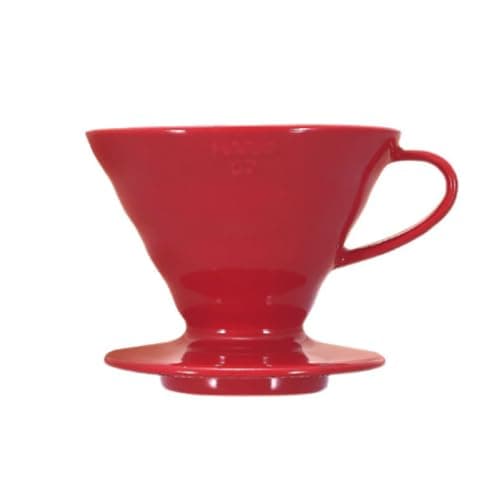 | Anyone who wants to get good at pour-over | Top pick | |
| 2 | 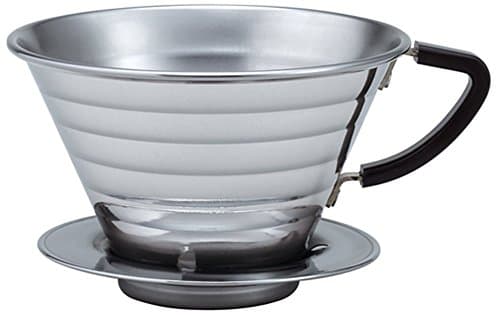 | Consistency without practice | Most forgiving | |
| 3 | 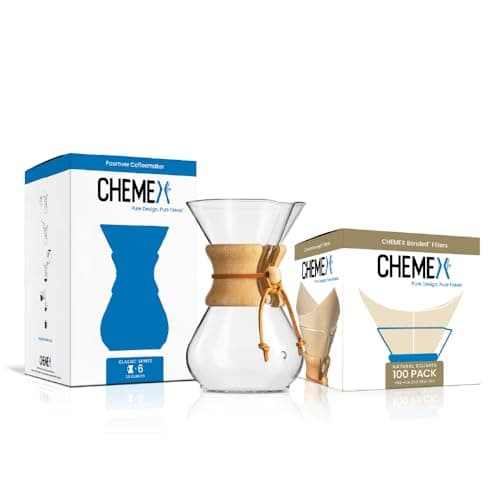 | Brewing for several people, in something worth looking at | Cleanest cup | |
| 4 | 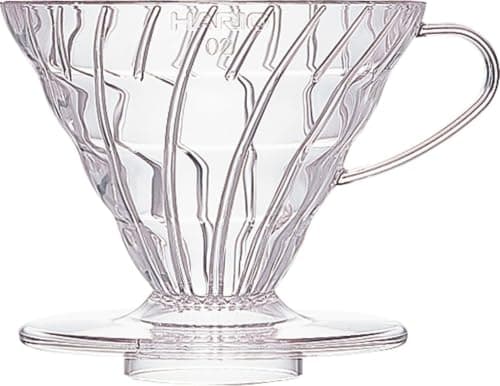 | Trying pour-over before committing | Best value | |
| 5 | 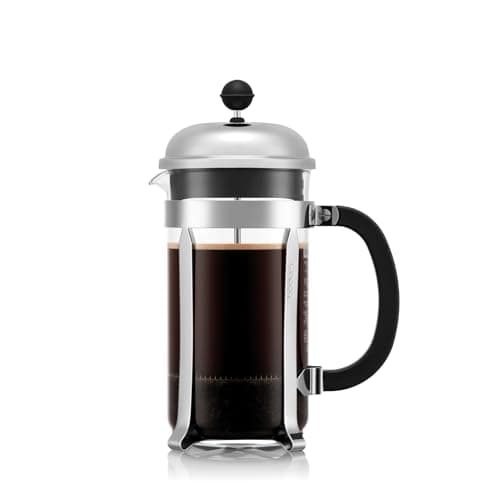 | Immersion brewing, where it is genuinely good | Skip this for pour-over |
1. Top pick
Hario V60 Ceramic Dripper 02
Manual tier · The 60-degree cone dripper that defines modern pour-over.
The highest ceiling of any dripper here, and it will show you every mistake.
The V60 is the dripper modern pour-over is written around, and the reason is in its geometry: a 60-degree cone, inner spiral ribs, and one large hole at the bottom.
That single large hole is the design decision that matters. It does not restrict flow, so the flow rate is set by your grind and your pour rather than by the dripper. Pour quickly for a lighter cup, slowly for a deeper one - the control is entirely yours.
The spiral ribs hold the paper away from the ceramic, so air can escape and the coffee bed can expand during the bloom rather than sealing against the wall.
The ceramic version is made from Arita-yaki, a Japanese ceramic tradition, in size 02 - W140 x D120 x H102 mm, brewing 1 to 4 cups. Ceramic holds heat much better than plastic, which matters on a slow brew, and it does need preheating.
Specification
- Geometry
- 60-degree cone, single large hole
- Ribs
- Inner spiral ribs
- Capacity
- 1-4 cups
- Material
- Arita-yaki ceramic, made in Japan
- Size
- W140 x D120 x H102 mm
What it does well
- The single large hole hands flow control to you rather than the dripper
- Ceramic holds heat far better than plastic
- More published recipes exist for the V60 than for any other brewer
Where it gives ground
- Unforgiving: an uneven pour shows up in the cup
- Ceramic needs preheating and can chip
- Needs a gooseneck kettle to be worth owning
Skip it if
Skip it if you do not own a gooseneck kettle. Without flow control the V60's one big hole becomes a liability rather than an advantage.
2. Most forgiving
Kalita Wave 185
Manual tier · A flat-bottom dripper with three small holes and a wave filter that limits wall contact.
Three small holes and a flat bed do the flow control so your pour does not have to.
The Kalita Wave is the answer if you want good pour-over on a Tuesday morning without concentrating. Its flat bottom with three small extraction holes regulates flow structurally, so an uneven pour matters far less than it does in a cone.
The wave filter's fluted sides keep the paper from touching the walls, which means the bed sits flat and even rather than piling into a cone. A flat bed is much easier to wet uniformly.
The stainless version brews 16 to 26 oz - 2 to 4 cups - at about 2.75 inches high by 4.5 inches wide, and is made in Japan. Stainless does not chip and travels well.
The trade-offs are real: wave filters are proprietary and cost more than cone papers, and stainless sheds heat quickly compared with ceramic.
Specification
- Geometry
- Flat bottom, three extraction holes
- Capacity
- 2-4 cups (a 16-26 oz brew, per Seattle Coffee Gear)
- Material
- Stainless steel, made in Japan
- Filters
- Kalita Wave 185
- Size
- About 2.75 in H x 4.4-4.5 in W
What it does well
- The flat bed is far more forgiving of a sloppy pour than a cone
- Three small holes regulate flow so your technique matters less
- Stainless does not chip and travels well
Where it gives ground
- Wave filters are proprietary and cost more than cone filters
- Stainless sheds heat quickly
- Ceiling is lower than a V60 in expert hands
Skip it if
Skip it if you enjoy the craft. The Wave deliberately takes control away, which is a benefit for some people and a frustration for others.
3. Cleanest cup
Chemex Classic 6-Cup
Manual tier · A single-piece borosilicate brewer that uses very thick bonded filters.
The thick bonded filter produces a clarity nothing else here matches.
The Chemex is a single piece of borosilicate glass with a wood collar and leather tie, holding 30 oz at 8.5 inches high and 5.125 inches in diameter.
Its distinguishing feature is the filter. Chemex Bonded filters are dramatically thicker than ordinary cone papers, which strips out oils and fines that would otherwise reach the cup. The result is the cleanest, most tea-like coffee of anything on this page.
Because it brews and serves in one vessel, it is the natural choice when there are people in the kitchen. Nothing else here doubles as a carafe.
The thickness that produces the clarity also slows the brew considerably, so it wants a coarser grind than a V60 at the same dose. And the proprietary filters are a permanent running cost.
Specification
- Capacity
- 30 oz
- Size
- 8.5 in H x 5.125 in diameter
- Material
- Borosilicate glass, wood collar and leather tie
- Filters
- Chemex Bonded (FP-1, FC-100, FS-100, FSU-100)
What it does well
- The thick bonded filter produces the cleanest cup of any common brewer
- Brews and serves in one vessel, which matters when guests are involved
- It looks like an object, not an appliance
Where it gives ground
- The proprietary filters are a permanent running cost
- Slow, and unforgiving if you grind too fine
- Glass, with a wood collar that should not be soaked
Skip it if
Skip it if you like body in your coffee. The bonded filter removes exactly the oils that produce it, and that is the point rather than a flaw.
4. Best value
Hario V60 Plastic Dripper 02
Budget tier · The same 60-degree cone geometry in plastic.
Identical geometry to the ceramic, for a fraction of the outlay.
The plastic V60 has the same 60-degree cone, the same inner spiral ribs and the same single large hole as the ceramic version, in the same 02 size brewing 1 to 4 cups.
Brewing geometry is what determines how a dripper behaves, and on that measure this is the same dripper. Anyone telling you the ceramic makes better coffee is describing a thermal difference that is real and small.
Plastic does not need preheating the way ceramic does, which is a genuine convenience on a weekday, and it is effectively unbreakable - which makes it the obvious choice for travel and camping.
It looks cheap, it stains over time, and it has no thermal mass. If you brew a lot and value the object, the ceramic is worth the difference. If you are finding out whether pour-over suits you, start here.
Specification
- Geometry
- 60-degree cone, single large hole
- Ribs
- Inner spiral ribs
- Capacity
- 1-4 cups
- Material
- Plastic
What it does well
- Same brewing geometry as the ceramic for a fraction of the outlay
- Does not need preheating the way ceramic does
- Effectively unbreakable, so it travels
Where it gives ground
- Feels cheap next to ceramic or glass
- Plastic will stain over time
- No thermal mass, though that matters less than people claim
Skip it if
Skip it if the object matters to you. The ceramic is nicer to own and holds heat better; the coffee is close to identical.
5. Skip this for pour-over
Bodum Chambord French Press
Budget tier · The classic 34 oz French press: borosilicate carafe in a chrome-plated steel frame.
An excellent brewer that is not pour-over, and behaves nothing like one.
The Chambord appears in pour-over shopping constantly, and it is worth being clear that it is a different brewing method rather than a variant of the same one.
A French press is immersion: the grounds sit in the full volume of water for several minutes and are then separated by a mesh plunger. Pour-over is percolation: water passes through the bed continuously and leaves.
That difference produces a genuinely different cup. Its stainless mesh lets oils and fines through, giving a heavy, textured body that no paper filter can produce - which is a virtue if that is what you want.
The 34 oz borosilicate carafe in a chrome-plated steel frame, made in Portugal, is a good product. It just does not do what the rest of this page does, and it is far more punishing of an inconsistent grinder than any dripper here.
Specification
- Capacity
- 34 oz, 3-4 cups
- Carafe
- Borosilicate glass
- Filter
- Stainless steel mesh plunger
- Frame
- Chrome-plated steel, made in Portugal
What it does well
- No paper, no capsules, no consumables at all
- Full-bodied cup that no paper filter can produce
- Every part is replaceable and cheap
Where it gives ground
- Metal mesh lets fines and oils through - that is the trade, not a defect
- Punishes an inconsistent grinder harder than any other brewer
- Glass carafe in a household with a tile floor
Skip it if
Skip it if you came here for pour-over. Buy it happily if you want immersion - see manual brewers.
The kettle is not optional
For a cone dripper especially, the kettle matters more than the dripper. A gooseneck spout delivers a thin, controllable stream you can place precisely; an ordinary kettle throws water where it wants. Since flow through a V60 is set by your pour, an uncontrolled pour means an uncontrolled brew.
If you are buying pour-over equipment for the first time and can only afford two things, buy a plastic V60 and a gooseneck kettle rather than a ceramic dripper and no kettle.
What your grinder has to do
Pour-over is percolation, which means water finds the path of least resistance through the bed. A grinder producing lots of fines alongside larger particles creates a bed that both chokes and channels - slow to drain and unevenly extracted at the same time.
If your pour-over tastes muddy and you own an entry-level grinder, the honest answer is often that an AeroPress will make better coffee than a V60 will, because immersion gives every particle the same contact time. That is a real recommendation rather than a consolation.
Ceramic, plastic, glass or steel
- Ceramic holds heat best and needs preheating. It chips.
- Plastic needs no preheating, is unbreakable, and stains. Brewing behavior is identical.
- Glass looks best and is fragile. Thermally, between ceramic and plastic.
- Stainless is indestructible and sheds heat fastest. Best for travel.
The material affects heat retention and durability. It does not change the geometry, and geometry is what makes a dripper behave the way it does.