The range, side by side
Scroll the table sideways to see every column.
Quick picks
The answer first. Tap any row to jump to the full reasoning for that pick.
Prices shown are checked daily against the retailer, as of October 23, 2026. We never write a price into the text of a page.
| # | Product | Best for | Award | Price |
|---|---|---|---|---|
| 1 | 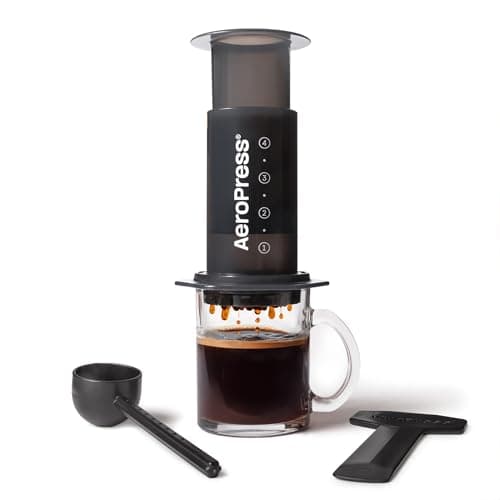 | One or two cups, quickly, from any grinder | The brewer reviewed | |
| 2 | 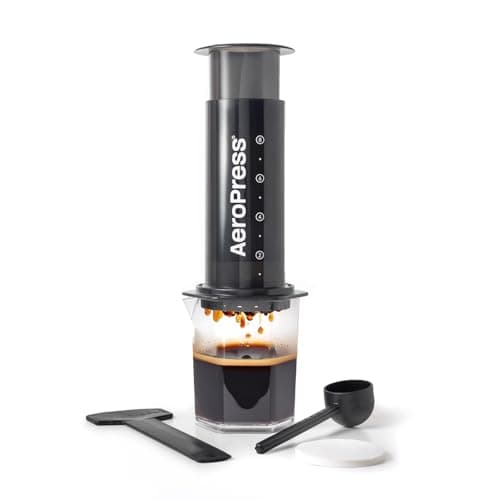 | Two mugs at once | The one for a household | |
| 3 | 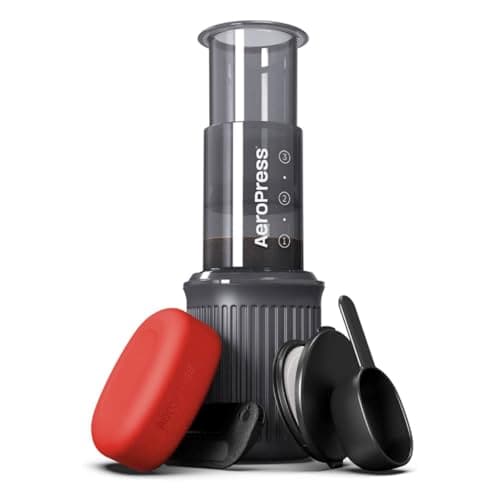 | Travel and camping | The travel one |
1. The brewer reviewed
AeroPress Original
Manual tier · A hand-pressed immersion brewer using a paper or metal filter.
The best coffee-per-effort ratio available, and the right first brewer for most people.
The AeroPress Original brews up to 10 oz, makes 1 to 3 cups and weighs about 6.5 oz. Coffee and water sit in the chamber for a set time, then you press the water through a paper or metal filter into the cup.
Its defining property is forgiveness. Immersion gives every particle the same contact time, so a grinder producing a wide range of particle sizes yields an averaged cup rather than a channeled one. That is why it works well with equipment that a V60 would expose.
It is also fast: under two minutes from grinding to drinking, and cleanup is ejecting the puck and rinsing - about ten seconds.
It is not espresso. Espresso is defined by roughly nine bars of pressure through a compacted puck; a hand press generates a small fraction of that. What it makes is a strong, clean, concentrated coffee, which is a different and perfectly good thing.
Specification
- Capacity
- 10 oz, 1-3 cups
- Weight
- About 6.5 oz
- Filters
- Paper or metal mesh
What it does well
- Almost impossible to brew a bad cup with
- Forgiving of grinder inconsistency in a way pour-over is not
- Cleans up in about ten seconds
Where it gives ground
- Not espresso, whatever the marketing around it says
- One or two cups at a time
- Plunging takes real hand pressure
Skip it if
Skip it if you brew for more than two people at a time, or if you want the clarity a percolation brewer gives with a good grinder.
2. The one for a household
AeroPress XL
Manual tier · A double-size AeroPress for brewing two mugs at once.
Twice the volume, same behavior, incompatible accessories.
The XL brews 20 oz / 591 ml, weighs about 10.2 oz and measures 7.6 inches high by 4.6 inches wide. It solves the AeroPress's single real limitation, which is batch size.
Brewing behaves the same way - immersion, then a press - so recipes scale reasonably and the forgiveness is unchanged.
One practical warning worth knowing before you buy: accessories are not cross-compatible. The metal mesh filter that fits the Original, Go and Clear does not fit the XL, so a household owning both needs two sets of everything.
It is also too big to travel with, which is the trade for the volume.
Specification
- Capacity
- 20 oz / 591 ml
- Weight
- About 10.2 oz
- Size
- 7.6 in H x 4.6 in W
- Filters
- XL-specific; Original, Go and Clear metal filters do not fit
What it does well
- Solves the AeroPress one real limitation: batch size
- Same brewing behavior scaled up
- Two mugs in one press
Where it gives ground
- Accessories are not cross-compatible with the smaller models
- Too big to travel with
- Needs a properly strong plunge
Skip it if
Skip it if you drink one cup at a time. The Original is smaller, cheaper and shares accessories with the rest of the range.
3. The travel one
AeroPress Go
Manual tier · The travel AeroPress: smaller, and it packs inside its own mug.
Best coffee-per-gram in a suitcase, and dead weight at home.
The Go brews 8 oz - one cup - weighs about 5.6 oz and measures 4.5 inches high by 3.6 inches wide, with the whole kit nesting inside its own mug.
That packaging is the entire product, and for travel it is genuinely excellent: no other way of making coffee this good takes up so little space.
It brews the same way as the Original, so nothing is lost in the cup.
At home the mug is dead weight, the shorter chamber means some published recipes do not fit, and one cup is a real constraint. Buy it as a second AeroPress that lives in a bag.
Specification
- Capacity
- 8 oz, one cup
- Weight
- About 5.6 oz
- Size
- 4.5 in H x 3.6 in W
What it does well
- The whole kit nests into the mug it comes with
- Lightest way to make genuinely good coffee away from home
- Brews the same way as the Original
Where it gives ground
- One cup only
- Shorter chamber limits some published recipes
- The bundled mug is the point; at home it is dead weight
Skip it if
Skip it as your only AeroPress. The Original is better in every way that matters on a kitchen counter.
Why it forgives a mediocre grinder
This is the property that should decide whether you buy one, and it is rarely explained properly.
In a pour-over, water flows continuously through the bed and takes the path of least resistance. Fine particles migrate downward, pack together, restrict flow locally, and force water to find easier routes - which means some coffee is over-extracted and some is barely touched. That is channeling, and it tastes bitter and sour at the same time.
In an AeroPress, the coffee sits in water. A boulder and a speck of dust both get the same 90 seconds. The dust over-extracts slightly and the boulder under-extracts slightly, and the result averages out into something entirely drinkable.
That is why we recommend the AeroPress to anyone whose grinder is the weak point in their setup - which, in most kitchens, it is.
What it is not
It is not espresso. The pressure a person can generate through the plunger is a small fraction of the nine bars that define espresso, and the extraction it produces is different in kind rather than degree. Marketing that implies otherwise is misleading, and it sets up people who buy one expecting a shot to be disappointed by an excellent brewer.
It is also not a high-ceiling brewer. A V60 with a good grinder and a gooseneck kettle will show you more of a coffee than an AeroPress can. The AeroPress trades that ceiling for a much higher floor.
Paper or metal filter
The paper filter traps oils and fines and produces a clean cup. The metal filter passes both, giving a heavier, more textured result closer to a French press, and removes the running cost entirely. Both are legitimate and it is worth trying each - it is one of the cheapest ways to change what your coffee tastes like.
Verdict
If you are buying one brewer and you do not already own a serious grinder, buy this. It is fast, nearly impossible to get wrong, cleans in ten seconds and makes genuinely good coffee from equipment that would embarrass a dripper. Buy the Original unless you specifically need the XL's volume or the Go's packaging.