The short answer
AeroPress publishes its own grind recommendation: medium-fine, which it pins to Baratza Encore settings 11 to 13, with 16 to 18 g of coffee and water at 185 F. Any burr grinder that lands in that range repeatably will do - the Timemore C3 is the cheapest one that does it properly, the Encore is the electric the instructions actually name, and a blade grinder cannot do it at any price.
What the AeroPress actually asks of a grinder
The AeroPress is the easiest brewer on this site to grind for, and the reason is arithmetic. The dose is 16 to 18 g - about a third of a French press load. The grind is medium-fine, which sits in the middle of every burr grinder's range rather than at either extreme. And the brew is short: 30 seconds of steeping for fresh-ground coffee, then a gentle press.
That combination forgives a lot. A short steep gives fines less time to over-extract, and the paper filter catches most of what a French press would leave in the cup. It does not forgive an uneven grind, because uneven grind means two extractions happening at once.
The one thing the AeroPress asks that drip does not is a small, clean single dose. There is no reason to own a 450 g hopper for a brewer that takes 17 g, which is why hand grinders dominate this list - see hand vs electric grinders.
How we picked
- It has to reach medium-fine repeatably. A setting you cannot return to is not a setting.
- Single-dose capacity of at least 17 g. Anything less means grinding twice for one cup.
- Burrs, not blades. Particle distribution is the whole game here.
- Priced against the brewer. The AeroPress is an inexpensive brewer; a grinder costing four times as much needs to be earning it on other methods.
Quick picks
The answer first. Tap any row to jump to the full reasoning for that pick.
| # | Product | Best for | Award | Price |
|---|---|---|---|---|
| 1 | 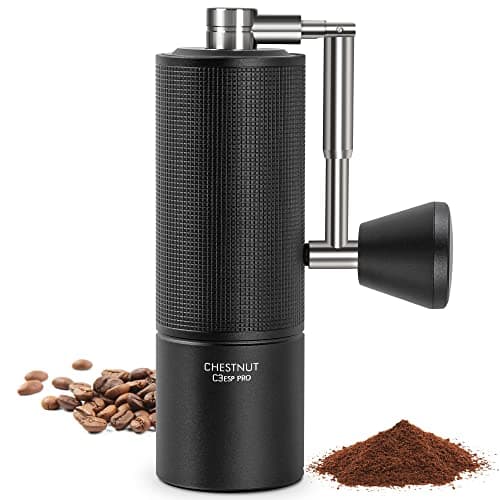 | One AeroPress a day, on a budget | Top pick | |
| 2 | 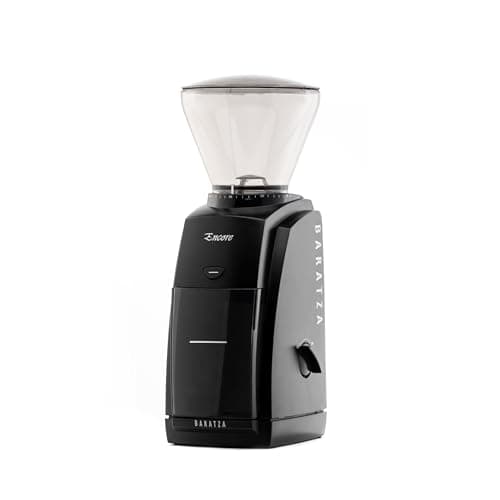 | Pressing a button at 6 a.m. | Best electric | |
| 3 | 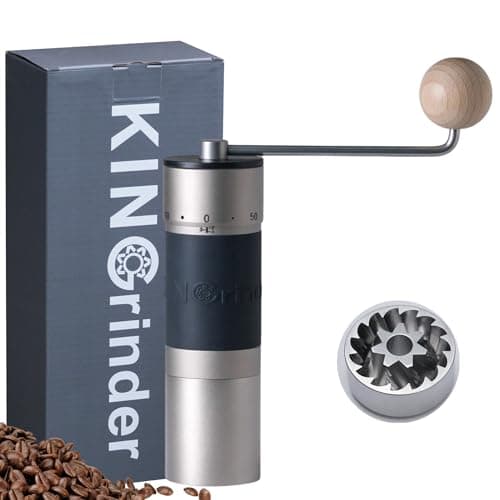 | One grinder for AeroPress now and espresso later | Best if espresso is also coming | |
| 4 | 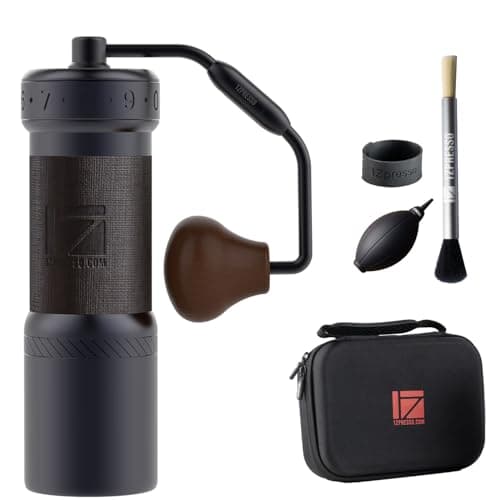 | An AeroPress, a V60 and a French press on the same grinder | Best all-rounder | |
| 5 | 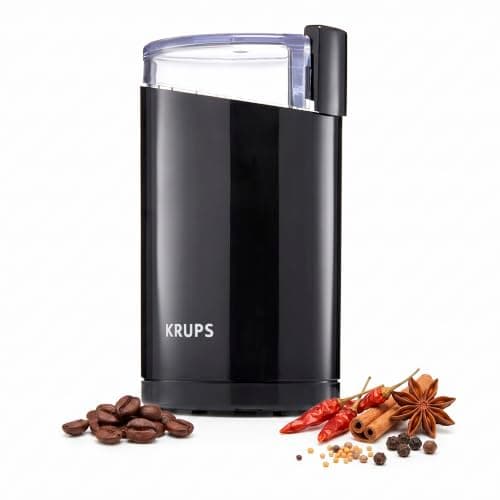 | Spices, not coffee | Skip this |
1. Top pick
Timemore Chestnut C3
Manual tier · The budget hand grinder that made stainless conical burrs cheap.
38 mm stainless burrs and a 25 g capacity - almost exactly one AeroPress dose.
AeroPress's own instructions ask for 16 to 18 g of medium-fine coffee. The C3 holds 25 g, which means a single AeroPress dose fits in one load with room to spare and nothing is left rattling in a hopper.
Its 38 mm S2C stainless conical burrs sit at 55 to 58 HRC, and its roughly 36 settings move about 0.0233 mm - around 23 microns - per click. Medium-fine lands in the middle of that range, where a click either way is a small, audible change rather than a jump.
The body is aluminum with a double-bearing axis and no plastic internals. That matters for a grinder you will crank 300 times a year: the burrs stay aligned, so the grind stays the same in month twelve as in month one.
Grinding 17 g by hand takes under a minute at this size. That is the entire argument for a hand grinder on an AeroPress: the dose is small, so the work is small.
What it will not do is espresso. 38 mm burrs make an espresso dose slow work and its espresso resolution is marginal - fine for the AeroPress, wrong if a machine is coming.
Specification
- Burrs
- 38 mm S2C stainless conical, 55-58 HRC
- Settings
- Roughly 36, about 0.0233 mm per click
- Capacity
- 25 g
- Weight
- About 530 g
- Build
- Aluminum body, double-bearing axis, no plastic internals
What it does well
- Filter-grade grind quality at a genuinely low price
- Metal internals and double bearings, not a toy
- Small and light enough to travel with
Where it gives ground
- 38 mm burrs make an espresso dose slow work
- Espresso resolution is marginal
- 25 g capacity limits you to one brew at a time
Skip it if
Skip it if you also brew for a French press or a carafe. 25 g is one AeroPress, not a pot - see best grinders for French press.
2. Best electric
Baratza Encore
Entry tier · The standard entry burr grinder for filter brewing.
The grinder AeroPress names in its own instructions, at settings 11 to 13.
AeroPress's published method does not say 'medium-fine' and leave you to guess. It says 'medium-fine ground coffee (e.g. Baratza Encore setting of 11-13)'. That is the only grinder setting the manufacturer names anywhere in its instructions.
The Encore's 40 stepped settings cover 250 to 1200 microns on 40 mm conical burrs made in Europe. Settings 11 to 13 sit in the lower third of that span, which is why the same grinder also handles drip at 15 to 20 and French press at the top.
Burr speed is roughly 450 to 550 rpm. Slow burrs put less heat into a small dose and throw less static, which is the difference between grounds landing in the AeroPress chamber and grounds landing on the counter.
There is no timer and no scale, so you weigh 17 g of beans and grind all of it. For an AeroPress that is the right workflow anyway - single dose, nothing retained from yesterday.
It is loud, its body is plastic, and its retention is normal for the class rather than low. None of that changes the grind.
Specification
- Burrs
- 40 mm conical, made in Europe
- Settings
- 40 stepped
- Grind range
- 250-1200 microns
- Burr speed
- Roughly 450-550 rpm to limit heat and static
What it does well
- The reference answer for pour-over, drip and French press
- Fully serviceable, with parts sold individually for years
- Low burr speed keeps static and heat down
Where it gives ground
- Bottom of its range is too coarse for espresso - that is the ESP model job
- Stepped settings only
- Plastic body and a loud motor
Skip it if
Skip it if espresso is also in your plans - the Encore's fine end stops short. See Encore vs Encore ESP.
3. Best if espresso is also coming
Kingrinder K6
Manual tier · A 48 mm hand grinder with external adjustment and a hex shaft you can drive with a drill.
48 mm burrs, external adjustment and 16 microns per click, for well under the premium hand grinders.
The K6 runs 48 mm heptagonal stainless conical burrs with external adjustment - 60 clicks per rotation, about 16 microns per click. Sixteen microns is fine enough to dial espresso, which means the AeroPress setting is a known number of clicks away rather than a different grinder.
Bigger burrs also cut faster. Where the C3's 38 mm burrs make you work for an espresso dose, 48 mm burrs get through a 17 g AeroPress dose quickly and a 20 g espresso dose without drama.
External adjustment is the practical part: you change grind by turning a numbered ring, so moving between AeroPress and espresso and back takes seconds and lands on the same number each time.
Its quarter-inch hex shaft accepts a cordless drill. That sounds like a gimmick until the morning you have to grind three doses.
Fit and finish is a step below 1Zpresso and Comandante, the aluminum body marks, and spare parts and support are thinner. You are buying burrs and adjustment, not jewelry.
Specification
- Burrs
- 48 mm heptagonal stainless conical
- Adjustment
- External, 60 clicks per rotation
- Resolution
- 16 microns per click
- Capacity
- 30-35 g
- Weight
- 630 g
- Shaft
- Quarter-inch hex drive
What it does well
- Big burrs and external adjustment for a fraction of the premium options
- The hex shaft turns it into an electric grinder with any cordless drill
- 16 microns per click is genuine espresso resolution
Where it gives ground
- Fit and finish is a step below the premium Taiwanese and German grinders
- Aluminum body picks up marks
- Support and spare parts are thinner than Comandante or 1Zpresso
Skip it if
Skip it if the AeroPress is the whole plan and always will be. You are paying for espresso resolution you will not use.
4. Best all-rounder
1Zpresso K-Ultra
Manual tier · A 48 mm hand grinder with external adjustment, built as an all-rounder.
48 mm K burrs with 100 clicks per rotation and a 35-40 g catch cup.
The K-Ultra's external ring gives 100 clicks per rotation at about 20 microns each, so the whole filter range is reachable and repeatable. AeroPress, V60 and French press are three numbers you write down once.
Its 48 mm heptagonal burrs have seven cutting edges rather than six, which speeds the grind noticeably against comparable hand grinders - a 17 g dose is short work.
The magnetic catch cup holds 35 to 40 g, so it also covers a two-mug pour-over or an AeroPress XL dose in one load.
At 685 g it is heavier than a grinder you would pack for a weekend, and it costs what a decent electric grinder costs. It earns that only if you brew several ways.
Twenty microns per click is coarser than 1Zpresso's espresso-focused models, so espresso is possible rather than precise - the J-Ultra is the model for that.
Specification
- Burrs
- 48 mm heptagonal conical stainless (K burr)
- Adjustment
- External ring, 100 clicks per rotation
- Resolution
- 20 microns per click
- Weight
- 685 g
- Catch cup
- Magnetic, 35-40 g
What it does well
- External adjustment - you change grind without opening anything
- Seven cutting edges rather than six speeds the grind up noticeably
- Genuinely good across espresso, filter and French press
Where it gives ground
- 20 microns per click is coarser than the JX-Pro espresso resolution
- Heavier than a travel grinder should be
- Premium price for a hand grinder
Skip it if
Skip it if you brew one way. Its range is the point, and one method does not need it.
5. Skip this
KRUPS F203 Blade Grinder
Budget tier · A 200 W blade grinder that chops rather than grinds - fine for spices, poor for coffee.
A blade grinder chops; it cannot produce a medium-fine grind at all.
A blade grinder has no grind setting. Particle size depends on how long you hold the button, which means every batch is different and no batch is even.
What comes out is a mixture of dust and chunks. In an AeroPress the dust passes the paper filter as sludge and the chunks never extract, so the same brew is bitter and sour at once.
The AeroPress is forgiving about technique, not about grind. Its short steep and gentle press cannot rescue particles that are two different sizes.
It is genuinely useful for spices, nuts and seeds, and it is cheap and compact. Those are real virtues for a different job.
If the budget is tight, a hand grinder at half the price of the cheapest electric burr grinder beats any blade grinder made - see burr vs blade.
Specification
- Type
- Blade, not burr
- Power
- 200 W
- Capacity
- 3 oz
- Blades
- Stainless steel
- Safety
- Lid-activated switch
What it does well
- Fast and inexpensive
- Handles spices, nuts and seeds as well as coffee
- Compact and simple to clean
Where it gives ground
- Chops beans into a mix of dust and chunks rather than an even grind
- No grind setting - particle size depends on how long you hold the button
- The dust it makes passes straight through a French press screen
Skip it if
Skip it for coffee, full stop. Keep it for spices if you already own one.
Grind settings for the AeroPress, by grinder
Scroll the table sideways to see every column.
Hand or electric?
For one AeroPress a day, a hand grinder is the more sensible purchase. A 17 g dose is under a minute of cranking, a good hand grinder costs less than a mediocre electric one, and single-dosing is built in rather than worked around.
Electric wins on two counts. If you make several cups, or if anyone else in the house has to operate it before coffee, the button is worth real money. The Encore is the honest answer there, and it is the one the brewer's own documentation names.
Who should buy what
- One AeroPress a day, tight budget: the Timemore C3.
- Someone else makes the coffee, or you make several: the Baratza Encore.
- An espresso machine is coming within a year: the Kingrinder K6 - one grinder covers both.
- AeroPress plus pour-over plus French press: the 1Zpresso K-Ultra.