The short answer
Buy a V60 if you brew one or two cups and want to control the extraction yourself. Buy a Chemex if you brew for three or four and want the cleanest possible cup in something you can serve from. The V60's papers are cheap and universal; the Chemex's bonded filters are proprietary and are the ongoing cost of owning one.
Side by side
Scroll the table sideways to see every column.
Quick picks
The answer first. Tap any row to jump to the full reasoning for that pick.
Prices shown are checked daily against the retailer, as of October 23, 2026. We never write a price into the text of a page.
| # | Product | Best for | Award | Price |
|---|---|---|---|---|
| 1 | 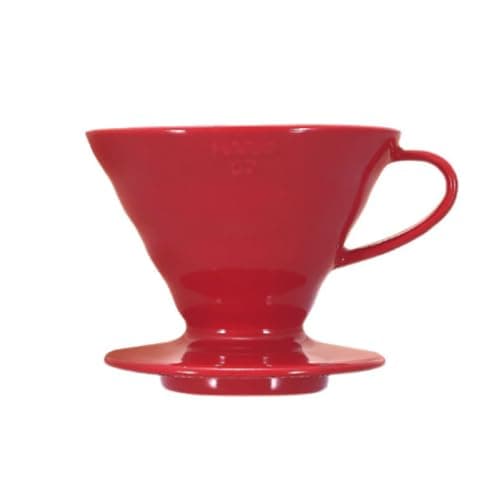 | One or two cups, with technique | Choose this for control | |
| 2 | 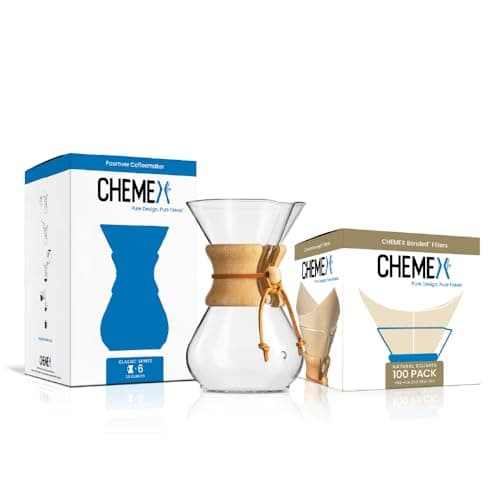 | Three or four cups, cleanest possible cup | Choose this for clarity and volume |
1. Choose this for control
Hario V60 Ceramic Dripper 02
Manual tier · The 60-degree cone dripper that defines modern pour-over.
You set the flow rate, which means a higher ceiling and a lower floor.
The V60's 60-degree cone, inner spiral ribs and single large hole mean the dripper imposes almost no restriction. Flow rate is decided by your grind size and your pour.
That is the reason it is the brewer most published recipes are written for: you can change the outcome deliberately by changing how you pour, which is not true of a brewer that regulates flow itself.
The ceramic 02 size measures W140 x D120 x H102 mm and brews 1 to 4 cups, in Arita-yaki ceramic that holds heat well and wants preheating.
Papers are cheap and available everywhere, in both bleached and unbleached, which matters over years in a way the purchase price does not.
Specification
- Geometry
- 60-degree cone, single large hole
- Ribs
- Inner spiral ribs
- Capacity
- 1-4 cups
- Material
- Arita-yaki ceramic, made in Japan
- Size
- W140 x D120 x H102 mm
What it does well
- The single large hole hands flow control to you rather than the dripper
- Ceramic holds heat far better than plastic
- More published recipes exist for the V60 than for any other brewer
Where it gives ground
- Unforgiving: an uneven pour shows up in the cup
- Ceramic needs preheating and can chip
- Needs a gooseneck kettle to be worth owning
Skip it if
Skip it if you brew for three or four people regularly. The 02 tops out where a Chemex is just getting started.
2. Choose this for clarity and volume
Chemex Classic 6-Cup
Manual tier · A single-piece borosilicate brewer that uses very thick bonded filters.
The thickest filter in common use, in the only brewer that is also the carafe.
The Chemex is a single piece of borosilicate glass with a wood collar and leather tie, 30 oz capacity, 8.5 inches tall and 5.125 inches in diameter.
Its bonded filters are substantially thicker than ordinary cone papers. That thickness removes oils and fine particles that a V60 paper lets through, producing a cup with strikingly little body and unusually clean flavor separation.
Because it brews into itself, it is the only brewer here that serves. For guests, that matters more than any specification.
The filters are proprietary - FP-1, FC-100, FS-100, FSU-100 - and they are a permanent running cost with no third-party equivalent.
Specification
- Capacity
- 30 oz
- Size
- 8.5 in H x 5.125 in diameter
- Material
- Borosilicate glass, wood collar and leather tie
- Filters
- Chemex Bonded (FP-1, FC-100, FS-100, FSU-100)
What it does well
- The thick bonded filter produces the cleanest cup of any common brewer
- Brews and serves in one vessel, which matters when guests are involved
- It looks like an object, not an appliance
Where it gives ground
- The proprietary filters are a permanent running cost
- Slow, and unforgiving if you grind too fine
- Glass, with a wood collar that should not be soaked
Skip it if
Skip it if you like a full-bodied cup, or if you brew one cup at a time. It is built for volume and clarity.
The filter is the whole comparison
Both are cones, so the bed shape is broadly similar. What differs is what the paper does. A standard V60 filter is thin: it holds back grounds and passes a good proportion of the oils and very fine particles. A Chemex bonded filter is dramatically thicker: it holds back grounds, oils and fines alike.
The result in the cup is not subtle. A Chemex brew has almost no body - it is clean, bright and closer to tea in texture. A V60 brew has noticeably more weight and a fuller mouthfeel.
That thickness also slows the brew considerably, which is why a Chemex generally wants a coarser grind than a V60 at the same dose. Grind for a Chemex the way you grind for a V60 and you will be waiting a long time.
Batch size, which decides it more often than taste
A V60 02 brews 1 to 4 cups, and in practice most people use it for one or two. A Chemex 6-cup holds 30 oz. If you are brewing for a household in the morning, that difference decides the purchase before flavor enters into it.
Brewing a large batch on a V60 is possible and awkward: the bed gets deep, the drawdown slows, and the last of the pour extracts differently from the first. The Chemex was designed for that volume.
Running costs
V60 papers are made by many manufacturers and cost very little. Chemex bonded filters are proprietary and are the reason a Chemex costs more to own than to buy. Over a few years of daily brewing that difference is real, and it is worth factoring in rather than discovering.
Which is harder to brew well?
The V60, comfortably. Its unrestricted hole means your pour sets the flow, so a careless pour produces a genuinely bad cup. The Chemex's filter provides so much resistance that the brew is slower and more self-regulating - it is more forgiving of pour technique while being less forgiving of grind size.
Both want a gooseneck kettle, and both want a grinder that does not produce a lot of fines. On the Chemex, fines will slow an already slow brew to a stall.