The short answer
Buy the K6 if you want espresso-capable hand grinding for the least money: 48 mm burrs, external adjustment and 16 microns per click are specifications that used to cost twice as much. Buy something else if fit, finish, spare parts and support matter to you as much as the grind, because that is precisely where Kingrinder economizes.
What the specification says
Three numbers define this grinder. The burrs are 48 mm heptagonal stainless conical. The adjustment is external with 60 clicks per rotation. And each click moves about 16 microns.
Burr diameter sets throughput: a 48 mm burr set removes more coffee per rotation than a 38 mm set, so the same dose takes fewer turns and less effort. That is why 48 mm is the size premium hand grinders converged on, and why finding it at this price is the story here.
Sixteen microns per click is the specification that makes espresso possible. Espresso dialing happens in small steps - the difference between a 25-second shot and a 35-second one can be two clicks. A grinder that moves 40 microns at a time turns that into guesswork.
The hex shaft is not a gimmick
The K6's shaft is a quarter-inch hex, the same drive a cordless drill takes. Fit the drill, hold the grinder, and a 20 g dose takes seconds rather than a minute of cranking.
It matters most for espresso, where the dose is fine and therefore the hardest work. It is also the honest answer to the main objection to hand grinders: that they are tiring when you make more than one drink.
Where the money was saved
Fit and finish. The K6 is a clear step below 1Zpresso and Comandante. The aluminum body picks up marks, and the tolerances feel like a grinder built to a price rather than to a standard.
Support and spares. This is the real risk. Premium makers sell burrs, bearings and shafts individually and answer email. Kingrinder's parts and support network is thinner, so a failure in year three is a harder problem to solve.
Brand resale. A used Comandante sells quickly at a known price. A used K6 does not, which quietly narrows the gap in total cost between the two.
Quick picks
The answer first. Tap any row to jump to the full reasoning for that pick.
| # | Product | Best for | Award | Price |
|---|---|---|---|---|
| 1 | 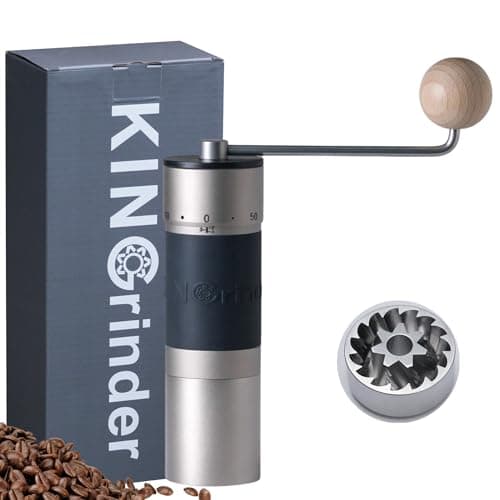 | One hand grinder for espresso and filter | The grinder reviewed | |
| 2 | 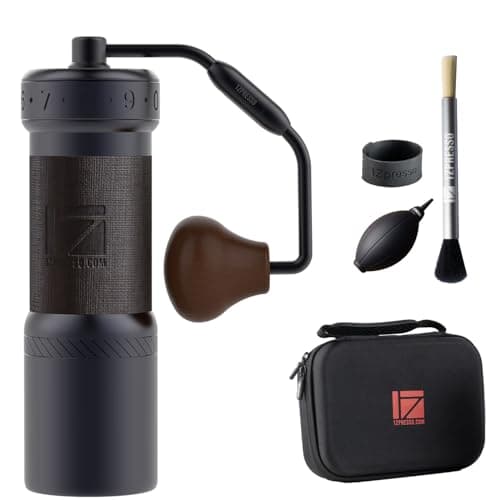 | Buying once and not thinking about it again | The premium alternative | |
| 3 | 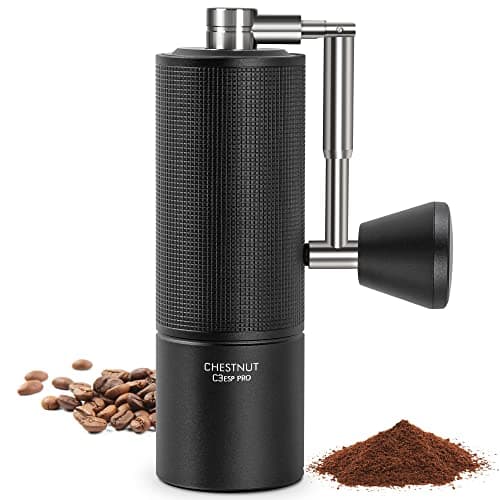 | Filter brewing only, on the tightest budget | The cheaper step down |
1. The grinder reviewed
Kingrinder K6
Manual tier · A 48 mm hand grinder with external adjustment and a hex shaft you can drive with a drill.
Espresso-grade adjustment and full-size burrs at a price that used to buy neither.
The K6 runs 48 mm heptagonal stainless conical burrs - the same nominal diameter as hand grinders costing twice as much. Diameter is what sets how fast a grinder cuts and how much work each rotation does, so this is the specification that matters most and the one the K6 does not economize on.
Adjustment is external: 60 clicks per rotation at about 16 microns per click. Sixteen microns is genuine espresso resolution - small enough that one click visibly changes a shot's flow rather than being lost in the noise.
External means you turn a numbered ring on the outside of the body. You are not dismantling anything to change grind, so espresso this morning and pour-over tonight are two numbers you can return to exactly.
Capacity is 30 to 35 g and the grinder weighs 630 g. That covers an espresso dose, an AeroPress dose or a single V60 in one load.
The quarter-inch hex shaft is the K6's oddest feature and its most practical: chuck a cordless drill onto it and the hand grinder becomes an electric one for the mornings you are grinding three doses.
Specification
- Burrs
- 48 mm heptagonal stainless conical
- Adjustment
- External, 60 clicks per rotation
- Resolution
- 16 microns per click
- Capacity
- 30-35 g
- Weight
- 630 g
- Shaft
- Quarter-inch hex drive
What it does well
- Big burrs and external adjustment for a fraction of the premium options
- The hex shaft turns it into an electric grinder with any cordless drill
- 16 microns per click is genuine espresso resolution
Where it gives ground
- Fit and finish is a step below the premium Taiwanese and German grinders
- Aluminum body picks up marks
- Support and spare parts are thinner than Comandante or 1Zpresso
Skip it if
Skip it if you want the object as much as the grind. Fit and finish is a clear step below the premium hand grinders.
2. The premium alternative
1Zpresso K-Ultra
Manual tier · A 48 mm hand grinder with external adjustment, built as an all-rounder.
The same 48 mm class with finer external adjustment, better finish and real support.
The K-Ultra also uses 48 mm heptagonal burrs, but its external ring gives 100 clicks per rotation at about 20 microns per click - more clicks around the dial, slightly coarser steps.
Its seven cutting edges speed the grind noticeably, and at 685 g with a magnetic 35 to 40 g catch cup it is built as an all-rounder rather than an espresso specialist.
Where it clearly beats the K6 is the things a specification sheet does not list: machining tolerances, spare parts, and a support path if something fails.
It costs meaningfully more, and for filter brewing the extra money buys refinement rather than a better cup.
For espresso specifically, 20 microns per click is a coarser step than the K6's 16 - see 1Zpresso vs Kingrinder K6.
Specification
- Burrs
- 48 mm heptagonal conical stainless (K burr)
- Adjustment
- External ring, 100 clicks per rotation
- Resolution
- 20 microns per click
- Weight
- 685 g
- Catch cup
- Magnetic, 35-40 g
What it does well
- External adjustment - you change grind without opening anything
- Seven cutting edges rather than six speeds the grind up noticeably
- Genuinely good across espresso, filter and French press
Where it gives ground
- 20 microns per click is coarser than the JX-Pro espresso resolution
- Heavier than a travel grinder should be
- Premium price for a hand grinder
Skip it if
Skip it if you are buying on specification alone. The K6 matches the burr diameter for less.
3. The cheaper step down
Timemore Chestnut C3
Manual tier · The budget hand grinder that made stainless conical burrs cheap.
38 mm burrs, about 23 microns per click, and half the grinding speed.
The C3's 38 mm S2C stainless burrs are a full 10 mm smaller than the K6's, which shows up as slower grinding and more effort per dose.
Its roughly 36 settings move about 23 microns each - fine for filter, marginal for espresso, which Timemore does not pretend otherwise.
Capacity is 25 g and weight is about 530 g, so it is the more portable of the two.
Its aluminum body and double-bearing axis are honest engineering at the price; there are no plastic internals to wear.
If espresso is not in the plan, the money saved here is money you would not have used - see best grinders for pour over.
Specification
- Burrs
- 38 mm S2C stainless conical, 55-58 HRC
- Settings
- Roughly 36, about 0.0233 mm per click
- Capacity
- 25 g
- Weight
- About 530 g
- Build
- Aluminum body, double-bearing axis, no plastic internals
What it does well
- Filter-grade grind quality at a genuinely low price
- Metal internals and double bearings, not a toy
- Small and light enough to travel with
Where it gives ground
- 38 mm burrs make an espresso dose slow work
- Espresso resolution is marginal
- 25 g capacity limits you to one brew at a time
Skip it if
Skip it if an espresso machine is coming. Its resolution runs out exactly where espresso starts.
How it compares in its class
Scroll the table sideways to see every column.
Who should buy it
- People buying one grinder for espresso and filter, who want the resolution without the premium price.
- Anyone with a cordless drill, because the hex shaft removes the main objection to hand grinding.
- Travelers who pull espresso, since nothing electric at this resolution packs into a bag.
Who should not
- Filter-only households, who are paying for espresso resolution they will never use.
- People who want support and spares, where 1Zpresso and Comandante are genuinely worth their premium.
- Anyone who makes four drinks a morning by hand - at that point an electric grinder is the right tool.