The short answer
For travel, weight and packability decide it. The Timemore C3 at about 530 g is the default: light, tough, and exactly one dose of capacity. The Kingrinder K6 adds espresso resolution for 100 g more, the 1Zpresso J-Ultra folds down and dials shots at 8 microns per click, and the Comandante C40 is the heavy, expensive one people carry anyway because of the cup. Any electric grinder, however compact, is the wrong category.
What actually matters in a bag
- Published weight. Everything here is between about 530 g and 1.63 lb, and you will feel the difference in a carry-on.
- A folding or removable handle. A fixed crank is the part that catches on everything else you packed.
- Catch-cup capacity against your dose. 25 g is one cup; 35 to 40 g covers two or a double espresso.
- No glass, no outlet. Both rule out the compact electric grinders people are tempted by.
- External adjustment. Changing grind for a strange brewer, without tools, on a desk.
Match the grinder to how you brew away from home
If travel brewing means an AeroPress or a dripper, you need filter resolution and low weight - the C3 is the whole answer, and best grinders for AeroPress covers the pairing.
If you travel with a manual espresso maker, resolution stops being optional: 16 microns per click on the K6 or 8 on the J-Ultra is what lets you adjust for a different bag of beans in a different kitchen.
And if you are going somewhere with a rental kitchen and other people, capacity matters more than grams: the Comandante's 40 g container grinds for two.
Quick picks
The answer first. Tap any row to jump to the full reasoning for that pick.
| # | Product | Best for | Award | Price |
|---|---|---|---|---|
| 1 | 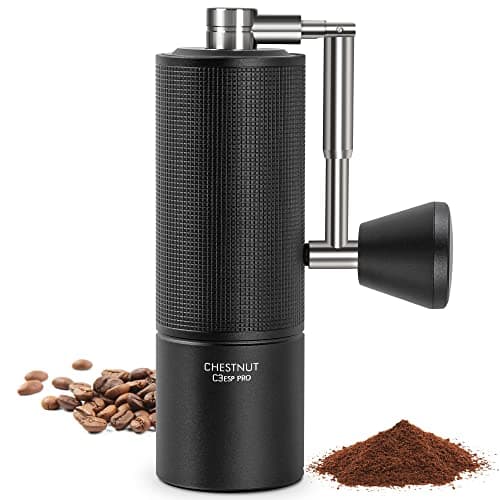 | A week away with one cup a day | Top pick | |
| 2 | 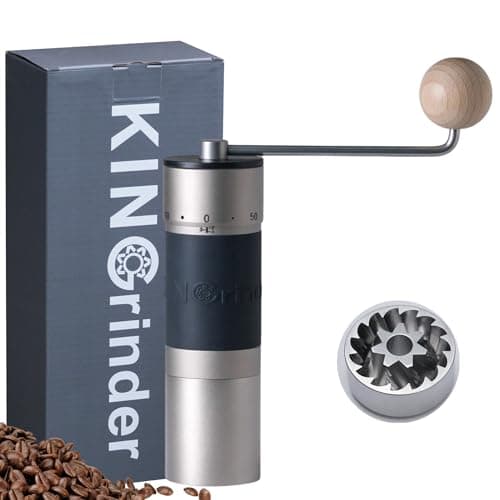 | Taking espresso capability on a trip | Best value for espresso travel | |
| 3 | 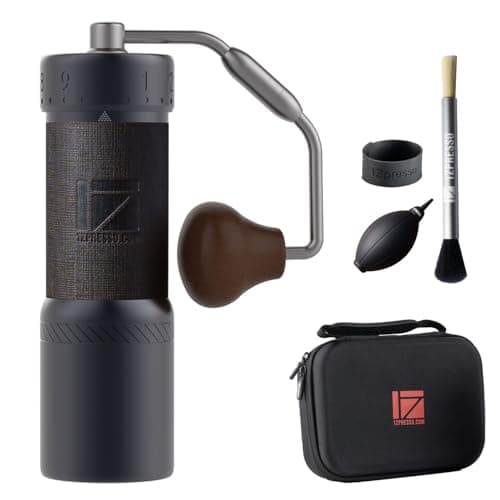 | Dialing shots away from home | Best for travel espresso | |
| 4 | 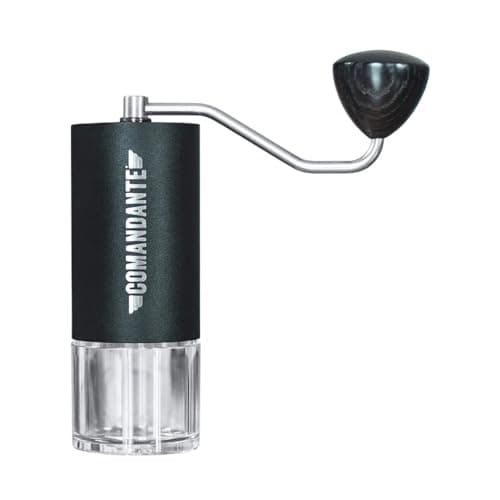 | Travelers who refuse to compromise the cup | The one people take anyway | |
| 5 | 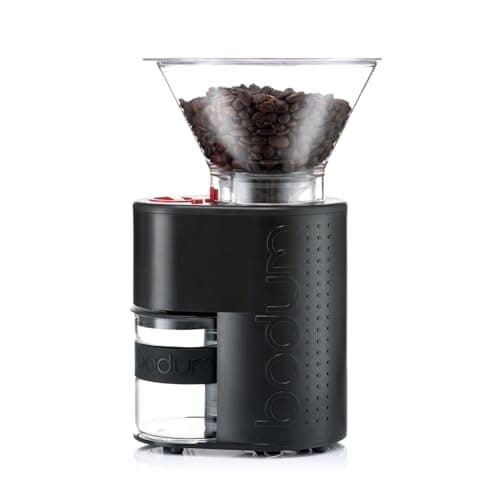 | A kitchen counter, not a bag | Skip this for travel |
1. Top pick
Timemore Chestnut C3
Manual tier · The budget hand grinder that made stainless conical burrs cheap.
About 530 g, 25 g capacity, and the lowest price that still holds alignment.
At about 530 g the C3 is the lightest grinder here, and 25 g of capacity is exactly one AeroPress or single pour-over dose - the brew most people make in a hotel room.
Its 38 mm S2C stainless burrs and roughly 36 settings cover the filter range properly, so travel coffee is not a downgrade in the cup.
The aluminum body and double-bearing axis are what survive a bag. Cheap grinders lose burr alignment when knocked; this one is built not to.
It is small enough to sit inside an AeroPress chamber in a packing cube, which is the classic travel-coffee trick.
Espresso is marginal, and 25 g means grinding twice if you are making coffee for two.
Specification
- Burrs
- 38 mm S2C stainless conical, 55-58 HRC
- Settings
- Roughly 36, about 0.0233 mm per click
- Capacity
- 25 g
- Weight
- About 530 g
- Build
- Aluminum body, double-bearing axis, no plastic internals
What it does well
- Filter-grade grind quality at a genuinely low price
- Metal internals and double bearings, not a toy
- Small and light enough to travel with
Where it gives ground
- 38 mm burrs make an espresso dose slow work
- Espresso resolution is marginal
- 25 g capacity limits you to one brew at a time
Skip it if
Skip it if you pull espresso on the road. The resolution is not there.
2. Best value for espresso travel
Kingrinder K6
Manual tier · A 48 mm hand grinder with external adjustment and a hex shaft you can drive with a drill.
630 g, 48 mm burrs, external adjustment at 16 microns per click.
The K6 packs 48 mm heptagonal burrs and external adjustment - 60 clicks per rotation, about 16 microns each - into 630 g.
Sixteen microns is genuine espresso resolution, which matters if you travel with a manual espresso maker rather than only a dripper.
External adjustment is a travel feature in itself: you change grind by counting clicks on a numbered ring, with nothing to disassemble on a hotel desk.
Capacity is 30 to 35 g, enough for a double espresso dose or a generous single pour-over.
Fit and finish is below the premium grinders and the aluminum body marks, which on a travel grinder is cosmetic rather than functional.
Specification
- Burrs
- 48 mm heptagonal stainless conical
- Adjustment
- External, 60 clicks per rotation
- Resolution
- 16 microns per click
- Capacity
- 30-35 g
- Weight
- 630 g
- Shaft
- Quarter-inch hex drive
What it does well
- Big burrs and external adjustment for a fraction of the premium options
- The hex shaft turns it into an electric grinder with any cordless drill
- 16 microns per click is genuine espresso resolution
Where it gives ground
- Fit and finish is a step below the premium Taiwanese and German grinders
- Aluminum body picks up marks
- Support and spare parts are thinner than Comandante or 1Zpresso
Skip it if
Skip it if you want the lightest possible kit. The C3 saves 100 g and most of the money.
3. Best for travel espresso
1Zpresso J-Ultra
Manual tier · A hand grinder built around espresso: 48 mm coated burrs and 8 microns of travel per click.
670 g, folding handle, magnetic catch cup, 8 microns per click.
The J-Ultra's 48 mm coated espresso burrs adjust externally at 8 microns per click - the finest 1Zpresso publishes - in a 670 g package.
The folding handle is the specification that makes it travel: it collapses into a shorter, rounder object that packs beside a travel espresso maker rather than fighting it.
Its magnetic catch cup holds 35 to 40 g, so a double dose is one load, and the cup does not separate in a bag.
Eight microns per click means a hotel-room shot can be dialed rather than accepted, which is the whole reason to carry a grinder this good.
Its espresso-focused burrs give up some of the coarse end, so a French press in a rental kitchen is possible rather than ideal - see J-Ultra vs K-Ultra.
Specification
- Burrs
- 48 mm coated conical, espresso design
- Adjustment
- External ring, 8 microns per click
- Capacity
- 35-40 g
- Weight
- 670 g
- Handle
- Foldable, magnetic catch cup
What it does well
- Eight microns per click is the finest adjustment 1Zpresso publishes
- External adjustment means you can change grind without disassembly
- Folds down, so it travels in a way no electric grinder does
Where it gives ground
- Espresso-focused burrs mean the filter range is shorter than the K-Ultra's
- Hand grinding an espresso dose is real work every morning
- The catch cup holds 35 to 40 g, so batch brewing means grinding twice
Skip it if
Skip it if your travel brewing is a dripper. You would be carrying espresso precision you never use.
4. The one people take anyway
Comandante C40 MK4
Manual tier · The reference hand grinder for filter brewing, built around a nitrogen-steel burr.
1.63 lb of stainless steel, a 40 g container, and the clarity benchmark.
The C40 MK4 grinds on 39 mm high-nitrogen martensitic steel burrs with a stainless body, axle, crank and ball bearings - built to be handed down rather than replaced.
Its 40 g bean container is the largest here, which makes it the one grinder on this list that covers coffee for two without a second grind.
The crank action is effortless for a grinder this precise, which matters when you are grinding on a kitchen counter you do not own.
At 1.63 lb it is the heaviest option here, and its stepped adjustment at roughly 25 to 30 microns per click is coarse for espresso.
It also costs more than several capable electric grinders, which is a strange thing to put in a suitcase - and thousands of people do it anyway.
Specification
- Burrs
- 39 mm conical, high-nitrogen martensitic steel
- Adjustment
- Stepped, roughly 25-30 microns per click
- Capacity
- 40 g bean container
- Build
- Stainless body, axle, crank and ball bearings
- Weight
- 1.63 lb
What it does well
- The clarity benchmark other hand grinders are measured against
- Built to be handed down rather than replaced
- Effortless crank action for a grinder this precise
Where it gives ground
- Click resolution is coarse for espresso
- Costs more than several capable electric grinders
- Smaller burrs than the 48 mm competition
Skip it if
Skip it if weight or price is a real constraint. The C3 does most of the job for a fraction of both.
5. Skip this for travel
Bodum Bistro Burr Grinder
Budget tier · A compact conical burr grinder with a glass grounds catcher and a preset timer.
A compact electric grinder is still an electric grinder.
The Bistro is genuinely compact for an electric burr grinder, with a 220 g detachable hopper and a glass catcher that keeps static down.
None of that makes it a travel grinder. It needs an outlet, it has a glass component, and its footprint is counter-shaped rather than bag-shaped.
Its 12 settings across the whole range is coarse control, so it is not even the compromise-free choice at home.
Voltage is the other trap: a US grinder plugged into a European outlet needs a transformer, not an adapter.
It is here because compact electric grinders get bought for trips and then left in the hotel room - a hand grinder is the category that travels.
Specification
- Burrs
- Conical
- Settings
- 12
- Hopper
- 220 g, detachable
- Catcher
- Borosilicate glass with a rubberized grip
What it does well
- The glass catcher genuinely reduces static compared with a plastic bin
- Compact and better looking than anything else in the bracket
- Detachable hopper makes swapping beans easy
Where it gives ground
- Smaller burr set and fewer settings than the OXO at a similar price
- 12 settings across the whole range is coarse control
- Espresso is out of reach in practice
Skip it if
Skip it for travel specifically. As a cheap home grinder it is a reasonable object.
Weights and capacities
Scroll the table sideways to see every column.
What a hand grinder gives up to travel
Capacity is the honest limit. A 25 to 40 g catch cup means one or two doses, so a hand grinder in a rental kitchen with four coffee drinkers becomes a queue rather than a convenience.
Effort is the other. Grinding 17 g of medium-roast filter coffee is under a minute; grinding 18 g fine for espresso is real work, and doing it three times before anyone else is awake is how travel grinders end up abandoned in a cupboard.
What you do not give up is the cup. A good hand grinder matches electric grinders costing considerably more, because the money goes into burrs rather than a motor and a housing - see hand vs electric coffee grinders.
Match the brewer to the bag as well
The grinder is half a travel kit. An AeroPress is the usual other half because it is light, unbreakable and forgiving, and most hand grinders pack inside its chamber.
If you travel for work and stay in hotels, add a small scale - dose by weight is the one variable you can keep constant when the water, the kettle and the beans all change - see best coffee makers for one person.
Packing notes that are not on any spec sheet
Empty and wipe the burr chamber before you pack. Coffee oils go rancid, and a grinder that sat in a bag for a week with grounds in it tastes like it.
Pack the grinder inside your brewer where possible - an AeroPress chamber takes most hand grinders - and put the catch cup on separately so a magnetic joint cannot pop open under pressure.
Note your setting before you leave. Every grinder here is adjusted by counting from a closed position, and rediscovering your number in a hotel room with unfamiliar beans is a worse start to a trip than writing it on a piece of tape.