The short answer
Buy the J-Ultra if you pull espresso by hand and want the smallest adjustment steps available: 8 microns per click on 48 mm coated burrs, with a 35-40 g catch cup and a carrying case in the box. Buy the K-Ultra instead if your week includes French press and cold brew, because the J-Ultra's espresso-focused burrs give up some of the coarse end. And buy the Kingrinder K6 if the budget matters more than the last 8 microns.
What the specification actually says
Three numbers define this grinder. The burrs are 48 mm with a premium coating, cut for espresso. The external adjustment moves 8 microns per click. And the magnetic, twist-off catch cup holds 35 to 40 g.
Burr diameter sets throughput: a 48 mm set removes more coffee per rotation than the 38 mm burrs in budget hand grinders, so an 18 g espresso dose takes fewer turns and less effort. That is why this diameter is what premium hand grinders use, and it matters more for espresso than for anything else, because fine grinding is the hardest work a hand grinder does.
1Zpresso lists the grinder at 700 g on its product page and 670 g on its specification page, 19 x 18.5 x 5.5 cm, built from wood, polycarbonate, silicone, stainless steel and aluminum alloy. The crank folds, and the box includes a cleaning brush, a blower and a carrying case.
Why 8 microns per click is the whole point
Espresso responds sharply to grind. The difference between a shot that runs in 22 seconds and one that takes 33 is often two or three clicks, which means the size of one click decides whether dialing in is a sequence of decisions or a series of overshoots.
At 8 microns, a single click is small enough to change a shot without jumping past the setting you wanted. At 20 microns - the K-Ultra's step - you are working in bigger increments and relying on taste to tell you which side of the target you landed on. Both get there; one gets there with less wasted coffee.
For filter brewing the logic reverses. A V60 tolerates a far wider window, so 8-micron steps mean a lot of clicking to travel from espresso to French press. That is the trade this grinder makes deliberately - see the grind size chart for how wide those windows actually are.
External adjustment, and why it matters on a hand grinder
The adjustment ring sits on the outside of the body with numbers printed on it. You change grind by turning it and counting, with nothing to disassemble and no burr carrier to lift out.
On an internally adjusted grinder, moving between espresso and pour-over means taking the thing apart on a counter, which people do once and then stop doing. External adjustment is what makes a single grinder genuinely multi-purpose in practice rather than on paper.
Write the number down the first time a shot tastes right. On a grinder with this much resolution, the note is the difference between repeatability and starting over - the same discipline as how to dial in espresso.
The travel case is not a throwaway detail
The crank folds, the catch cup twists off and magnetizes back on, and 1Zpresso puts a carrying case in the box. Those three things together are why this grinder turns up in hotel rooms next to travel espresso makers.
It is still 700 g of metal and wood, so it is a deliberate thing to pack rather than a light one. If weight is the constraint rather than resolution, a 530 g budget hand grinder is the honest answer - see best hand grinders for travel.
Where it stops
The coarse end. Espresso-focused burrs give up range at the top. It grinds for French press; it is simply not the grinder that range was designed around, and the K-Ultra's K burr set is.
Hand grinding espresso is work. Eighteen grams at espresso fineness is real effort every morning, however good the burrs are. Nothing about 48 mm burrs makes that effortless - they make it quicker.
Price against electric. This costs what a capable entry electric espresso grinder costs. You are buying portability, silence and burr quality rather than convenience, and for a household where someone else makes the coffee that is the wrong trade - see hand vs electric coffee grinders.
Quick picks
The answer first. Tap any row to jump to the full reasoning for that pick.
| # | Product | Best for | Award | Price |
|---|---|---|---|---|
| 1 | 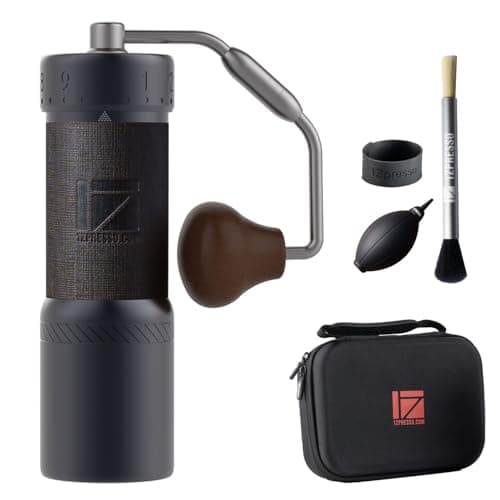 | Dialing espresso by hand, at home or away | The grinder reviewed | |
| 2 | 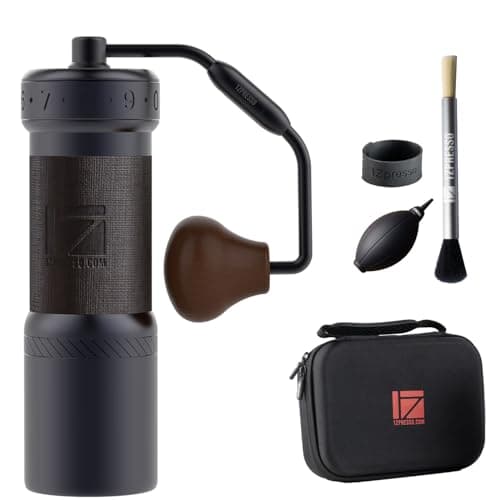 | Espresso, pour-over and French press on one grinder | The all-rounder sibling | |
| 3 | 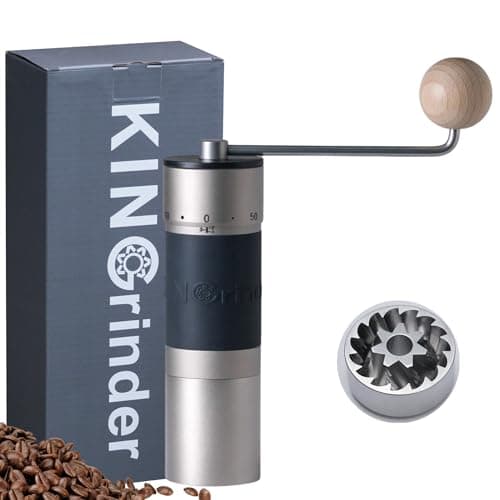 | Espresso-capable hand grinding on a budget | The value alternative |
1. The grinder reviewed
1Zpresso J-Ultra
Manual tier · A hand grinder built around espresso: 48 mm coated burrs and 8 microns of travel per click.
Eight microns per click - the finest adjustment 1Zpresso publishes - on 48 mm coated burrs.
The J-Ultra's burr set is 48 mm with what 1Zpresso calls a premium coating, designed around espresso. Forty-eight millimeters is the diameter premium hand grinders converged on, because it decides how much coffee each rotation cuts and therefore how much work a fine dose is.
Adjustment is external and moves 8 microns per click. That is the number this grinder exists for: it is the finest step 1Zpresso publishes anywhere in its range, and it is what makes a shot something you steer rather than something you accept.
The magnetic catch cup holds 35 to 40 g and twists off, which covers a double espresso dose or a single pour-over in one load without the cup parting company with the grinder in a bag.
1Zpresso lists it at 700 g and 19 x 18.5 x 5.5 cm in wood, polycarbonate, silicone, stainless steel and aluminum alloy, with a foldable crank. The box includes a cleaning brush, a blower and a carrying case - the case is the reason this grinder travels rather than merely being portable.
Its burrs are cut for espresso, so the coarse end of its range is shorter than the all-round K-Ultra's. It brews filter perfectly well; it was simply not designed around French press.
Specification
- Burrs
- 48 mm coated conical, espresso design
- Adjustment
- External ring, 8 microns per click
- Capacity
- 35-40 g
- Weight
- 670 g
- Handle
- Foldable, magnetic catch cup
What it does well
- Eight microns per click is the finest adjustment 1Zpresso publishes
- External adjustment means you can change grind without disassembly
- Folds down, so it travels in a way no electric grinder does
Where it gives ground
- Espresso-focused burrs mean the filter range is shorter than the K-Ultra's
- Hand grinding an espresso dose is real work every morning
- The catch cup holds 35 to 40 g, so batch brewing means grinding twice
Skip it if
Skip it if espresso is occasional and French press is daily - you would be buying resolution at the wrong end of the range.
2. The all-rounder sibling
1Zpresso K-Ultra
Manual tier · A 48 mm hand grinder with external adjustment, built as an all-rounder.
The same 48 mm class with 100 clicks per rotation at about 20 microns each.
The K-Ultra uses 48 mm heptagonal conical K burrs with an external ring giving 100 clicks per rotation at roughly 20 microns per click.
Seven cutting edges rather than six speed the grind noticeably, and the 35 to 40 g magnetic catch cup matches the J-Ultra's.
Twenty microns is workable for espresso and generous for filter, which is the trade: it covers the whole range rather than excelling at one end.
At 685 g it is heavier than a travel grinder should be, and it costs meaningfully more than the J-Ultra.
If your week includes French press and cold brew as well as shots, that range is worth the coarser steps - see the K-Ultra review.
Specification
- Burrs
- 48 mm heptagonal conical stainless (K burr)
- Adjustment
- External ring, 100 clicks per rotation
- Resolution
- 20 microns per click
- Weight
- 685 g
- Catch cup
- Magnetic, 35-40 g
What it does well
- External adjustment - you change grind without opening anything
- Seven cutting edges rather than six speeds the grind up noticeably
- Genuinely good across espresso, filter and French press
Where it gives ground
- 20 microns per click is coarser than the JX-Pro espresso resolution
- Heavier than a travel grinder should be
- Premium price for a hand grinder
Skip it if
Skip it if espresso is the only thing you brew. The J-Ultra's 8-micron steps are the better tool for that.
3. The value alternative
Kingrinder K6
Manual tier · A 48 mm hand grinder with external adjustment and a hex shaft you can drive with a drill.
48 mm burrs and 16 microns per click for a good deal less.
The K6 matches the 48 mm burr class with external adjustment - 60 clicks per rotation, about 16 microns per click - at a price well below either 1Zpresso.
Sixteen microns is genuine espresso resolution. It is twice the J-Ultra's step, which means more overshoot while dialing, and it is still fine enough to steer a shot.
Its quarter-inch hex shaft takes a cordless drill, which removes the main objection to hand grinding when you are making several drinks.
Capacity is 30 to 35 g at 630 g, so it is lighter than both 1Zpresso grinders.
Fit, finish, spare parts and support are all a step below - see the Kingrinder K6 review.
Specification
- Burrs
- 48 mm heptagonal stainless conical
- Adjustment
- External, 60 clicks per rotation
- Resolution
- 16 microns per click
- Capacity
- 30-35 g
- Weight
- 630 g
- Shaft
- Quarter-inch hex drive
What it does well
- Big burrs and external adjustment for a fraction of the premium options
- The hex shaft turns it into an electric grinder with any cordless drill
- 16 microns per click is genuine espresso resolution
Where it gives ground
- Fit and finish is a step below the premium Taiwanese and German grinders
- Aluminum body picks up marks
- Support and spare parts are thinner than Comandante or 1Zpresso
Skip it if
Skip it if you want the object as much as the grind, or if you expect a long support path.
How it compares in its class
Scroll the table sideways to see every column.
Who should buy it
- People who pull espresso and grind by hand, because 8 microns per click is the reason to pay for a premium hand grinder at all.
- Travelers with a manual espresso maker, where the folding crank, twist-off cup and case earn their place.
- Anyone in an apartment, since a hand grinder makes no noise a neighbor can hear - see best quiet coffee grinders.
- Owners of a budget hand grinder who have hit its resolution, which is the most common upgrade path into this grinder.
Who should not
- Filter-first drinkers - the K-Ultra covers the coarse end properly.
- Households where several people make coffee, where an electric grinder is simply the right tool.
- Anyone grinding for a carafe, because 35 to 40 g per load means grinding twice.
- Budget buyers - the Kingrinder K6 reaches espresso resolution for considerably less.