The short answer
Buy the AeroPress if you want a fast, portable, unbreakable brewer and do not mind pressing it yourself. Buy the Clever Dripper if you want a larger brew with no technique at all - steep it, set it on a mug, walk away. Both are immersion brewers that filter through paper, so both give a cleaner cup than a French press.
Same category, different mechanism
Both brewers steep coffee and water together, which is why both forgive an uneven grind: every particle sees the same water for the same time, so a budget grinder is less of a handicap than it is in a pour-over.
The AeroPress then adds pressure. Pressing the plunger forces the brew through the paper in seconds, which is why its recipes use short steeps - 30 seconds for fresh-ground coffee by AeroPress's own instructions.
The Clever relies on gravity and a valve. Longer steeps, no pressure, and a release you trigger by setting it down.
Capacity is the practical fork
Ten ounces against eighteen. One is a mug; the other is a large mug or two modest cups. If you regularly make coffee for two, the Clever does it in one brew and the AeroPress needs a concentrate-and-dilute recipe.
Neither scales beyond that. For a carafe, the answer is a different brewer - see best pour-over coffee makers.
Quick picks
The answer first. Tap any row to jump to the full reasoning for that pick.
| # | Product | Best for | Award | Price |
|---|---|---|---|---|
| 1 | 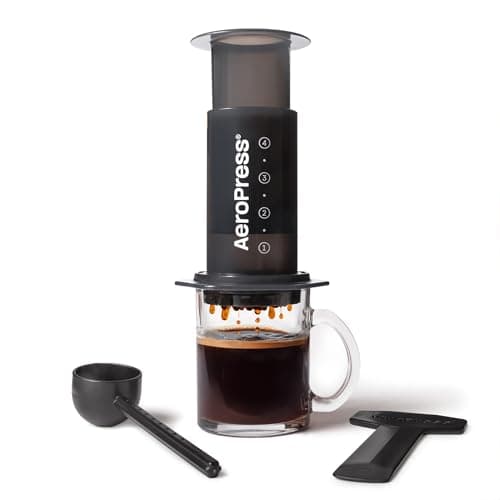 | One cup, anywhere, fast | If you want control and portability | |
| 2 | 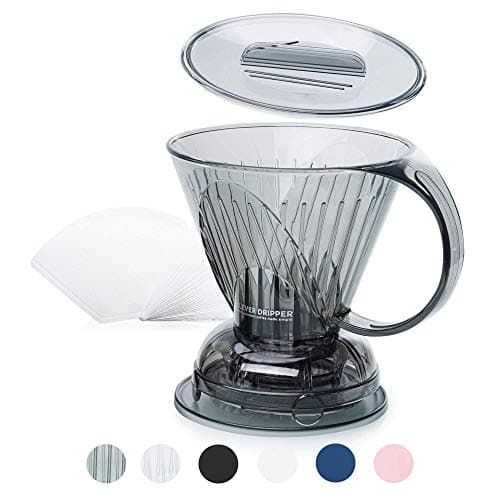 | A clean cup with no technique at all | If you want it hands-off |
1. If you want control and portability
AeroPress Original
Manual tier · A hand-pressed immersion brewer using a paper or metal filter.
10 oz, a hand press, and cleanup in about ten seconds.
The AeroPress brews 10 oz - one to three cups by its own count, one generous mug in practice - by immersion, then pushes the brew through a paper or metal filter with hand pressure.
That press is the difference. It finishes the brew in seconds rather than waiting for gravity, which is why an AeroPress recipe is a 30-second steep rather than a four-minute one.
It weighs about 6.5 oz and is effectively unbreakable, so it doubles as the travel brewer - see best hand grinders for travel for the other half of that kit.
Cleanup is the reason people keep using it: eject the puck, rinse the plunger, done.
It is not espresso whatever the marketing says, it makes one or two cups at a time, and plunging takes real hand pressure - which matters if grip strength is a concern.
Specification
- Capacity
- 10 oz, 1-3 cups
- Weight
- About 6.5 oz
- Filters
- Paper or metal mesh
What it does well
- Almost impossible to brew a bad cup with
- Forgiving of grinder inconsistency in a way pour-over is not
- Cleans up in about ten seconds
Where it gives ground
- Not espresso, whatever the marketing around it says
- One or two cups at a time
- Plunging takes real hand pressure
Skip it if
Skip it if you want a bigger brew or a hands-off one. The Clever does both.
2. If you want it hands-off
Clever Coffee Dripper Large
Budget tier · A cone dripper with a valve in the base, so it steeps like an immersion brewer and then drains.
Brews up to 18 oz and releases when you set it on a cup.
The Clever brews up to 18 oz in BPA-free Eastman Tritan, holding the brew behind a drip stop until the dripper is placed on a cup, which opens the valve.
There is no pour technique and no pressure: add coffee, add water, wait, release. The only variables are dose, grind and time - all measurable.
Eighteen ounces is nearly double the AeroPress's capacity, which makes it the better choice for a large mug or two small ones.
It ships with 100 paper filters, so the clean cup an immersion brewer cannot otherwise give you is the default.
The plastic body feels like what it costs next to glass or ceramic, and it needs a cup or carafe wide enough to sit on securely - see the Hario Switch review for the glass alternative.
Specification
- Capacity
- Brews up to 18 oz
- Material
- BPA-free Eastman Tritan
- Valve
- Drip stop holds the brew until the dripper is set on a cup
- Included
- 100 paper filters
- Cleaning
- Plastic and silicone parts are removable
What it does well
- Immersion brewing removes pour technique from the result
- A paper filter still gives a clean cup, unlike a French press
- Cheap, light and almost impossible to break
Where it gives ground
- Plastic body in a category where glass and ceramic exist
- Brews one batch at a time and needs a cup wide enough to sit on
- Steeping takes longer than a pour-over
Skip it if
Skip it if you travel with your brewer. It is counter equipment, not luggage.
Side by side
Scroll the table sideways to see every column.
Filters and running costs
The AeroPress uses its own paper discs - cheap, tiny, and sold in packs of 350 - or a reusable metal mesh if you prefer more body and no consumables.
The Clever ships with 100 papers and then takes standard cone filters, which are stocked everywhere. Neither brewer locks you into a proprietary supply chain, which is more than can be said for capsule machines.
Both filters are small enough that the running cost is negligible next to the coffee itself.
Cup character
Both produce a clean cup because both use paper. The AeroPress's short, pressurized brew tends toward a punchier, more concentrated result - part of why people dilute it.
The Clever's longer gravity steep is gentler and rounder, closer to a very clean French press. Neither is better; they taste different enough that plenty of people own both.
Grind sits in a similar place for both - medium-fine for the AeroPress, medium to medium-fine for the Clever - and both tolerate being slightly off in a way a pour-over does not, because immersion time does the work your pour would otherwise have to do.
Which one is yours
- You travel, camp or commute: the AeroPress.
- You want the biggest hands-off brew: the Clever.
- You are handing the brewer to somebody who does not care how it works: the Clever.
- You want to experiment with recipes: the AeroPress, which has the deepest recipe culture of any brewer.
- Grip strength is a concern: the Clever - no pressing at all.