The short answer
Choose the Flair Classic to find out whether manual espresso is for you: a real lever press with the gauge fitted and two portafilters in the box. Choose the Nanopresso only for travel. The Cafelat Robot is the best combination of capability and simplicity, and the Flair 58 the most capable of the lot - both are sold by their makers rather than through Amazon, so we have no link to either that would earn us anything, and we would rather say so than send you off a page pretending otherwise.
Why anyone chooses a lever
The usual assumption is that a manual maker is the budget option. That is not really why people buy them. A lever gives you something no home pump machine offers as standard: control of the pressure over the course of the shot.
A vibration pump delivers roughly one pressure for the whole extraction. A lever lets you start soft to let the puck settle, rise to full pressure through the body of the shot, and ease off at the end as the puck gives up. On pump machines that behavior is sold as pressure profiling and it is expensive.
Scroll the table sideways to see every column.
Quick picks
The answer first. Tap any row to jump to the full reasoning for that pick.
Prices shown are checked daily against the retailer, as of October 25, 2026. We never write a price into the text of a page.
| # | Product | Best for | Award | Price |
|---|---|---|---|---|
| 1 | 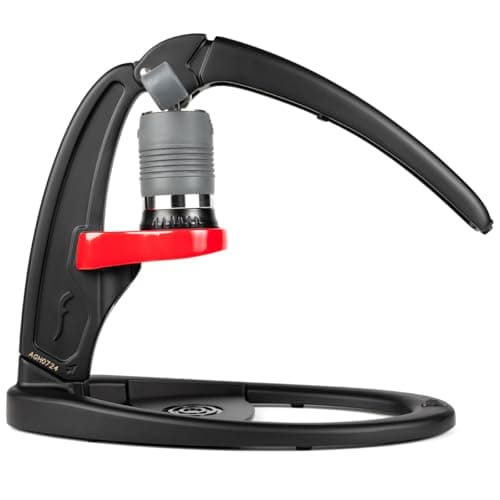 | Finding out whether manual espresso suits you | Top pick | |
| 2 | Cafelat RobotAlmost nothing on it can fail, and it makes espresso that embarrasses machines costing far more. | Someone who wants serious espresso without a pump, boiler or electronics | The one enthusiasts buy | |
| 3 | 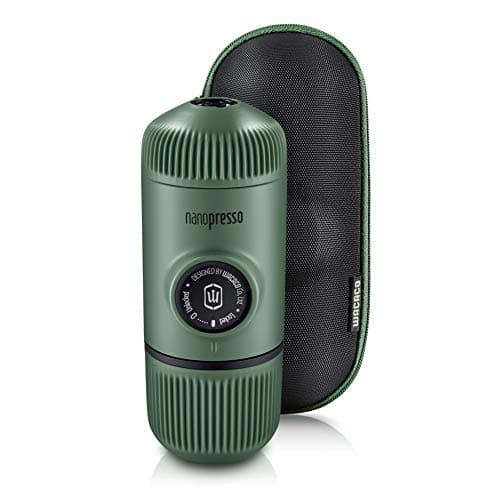 | Hotels, offices, campsites and anywhere without a kitchen | Best for travel | |
| 4 | Flair 5858 mm standard basket, a heated group, and lever control - the manual maker with the fewest compromises. | Someone who already knows they want a lever and will not want to upgrade again | Most capable |
1. Top pick
Flair Classic
Manual tier · The original Flair: an all-manual lever press with a pressure gauge and two portafilters.
A lever press with the gauge fitted and two portafilters in the box.
The Classic is the original Flair and the least expensive way into a genuine lever press. There is no pump, no boiler and nothing to plug in - you supply the pressure through the lever.
Flair publishes a 40 mm portafilter taking a 12 to 18 g dose, a 60 ml water capacity per shot, and an output it lists as 40 ml in one specification block and up to 45 ml in another. It is a single-shot machine either way.
Two portafilters come in the box - a bottomless 2-in-1 and a flow-control one - along with the pressure gauge and stem, a dispersion screen, the brewing cylinder, a dosing cup and tamper, a funnel and a drip tray. For a press at this price that is an unusually complete kit.
At 5 lb and 12.5 by 6.25 by 10 inches assembled, it takes very little counter and comes apart for a cupboard. Flair does not publish a preheating requirement for it.
The real limit is the 40 mm portafilter: the 58 mm accessory market that makes the Flair 58 interesting does not fit this one at all.
Specification
- Portafilter
- 40 mm
- Dose
- 12-18 g
- Water capacity
- 60 ml per shot
- Yield
- Flair publishes both 40 ml max output and up to 45 ml
- Gauge
- Pressure gauge and stem included
- In the box
- Bottomless 2-in-1 and flow-control portafilters, dispersion screen, brewing cylinder, dosing cup/tamper, funnel, drip tray
- Weight
- 5 lb (2.27 kg)
- Assembled size
- 12.5 x 6.25 x 10 in
- Power
- None
What it does well
- The cheapest way into a genuine lever press with a pressure gauge fitted
- Two portafilters in the box, including a bottomless one
- Nothing to descale, nothing electrical to fail
Where it gives ground
- A 40 mm portafilter, so 58 mm accessories do not fit it
- 60 ml of water per shot means boiling a kettle for every single cup
- No steam wand - Flair sells steamers as separate products
Skip it if
Skip it if you want the least effort per shot. The Robot's dual levers make the same pressure meaningfully easier to apply.
2. The one enthusiasts buy
Cafelat Robot
Manual tier · A dual-lever manual press with a fixed basket and no electronics at all.
Almost nothing on it can fail, and it makes espresso that embarrasses machines costing far more.
The Robot is a dual-lever press with a fixed basket, a silicone gasket and nothing else. There is no pump, no boiler, no PID, no solenoid and no electronics of any kind. The list of parts that can fail is close to empty.
You pour kettle water into the basket, lower the arms and push. Because the two arms give you leverage, applying high pressure smoothly is much easier than the effort makes it sound - and because it is your hands doing it, you are shaping the pressure curve directly.
That is the real argument for a lever. A pump machine holds one pressure for the whole shot. With a lever you can pre-infuse gently, ramp up, and taper off at the end - a profile that expensive pump machines charge a great deal to approximate.
The fixed basket is the honest limitation. It is a 58 mm class basket, but it is part of the body, so you cannot swap in a precision aftermarket basket the way you would on a portafilter machine. A pressure gauge is available as a fitted option and is worth having while you learn.
Specification
- Basket
- Non-removable, 58 mm class
- Mechanism
- Dual-lever arm
- Gauge
- Pressure gauge available as a fitted option
- Power
- None - nothing to plug in
What it does well
- Almost nothing on it can fail - no pump, no boiler, no electronics
- The dual-lever arrangement makes high pressure easy to apply smoothly
- You shape the pressure curve directly, which no pump machine allows
Where it gives ground
- The basket is fixed to the body, so you cannot swap in aftermarket baskets
- No steam wand - milk drinks need a separate solution
- You preheat with kettle water, which is a routine rather than a setting
Skip it if
Skip it if you drink milk drinks. There is no steam wand, so cappuccinos need a separate solution entirely - a milk frother at minimum.
3. Best for travel
Wacaco Nanopresso
Manual tier · A pocket-sized hand-pumped espresso maker built for travel rather than the counter.
Fits in a jacket pocket and needs no power - which nothing else here can claim.
At 336 g and 15.6 cm tall, the Nanopresso is small enough to travel with properly rather than notionally. You hand-pump it, so it needs no power at all.
It takes ground coffee in a pressurized basket, or Nespresso Original capsules with the appropriate adapter. That flexibility is exactly what you want traveling, because it means you are not dependent on finding a grinder or a specific pod.
The pressurized basket is the compromise, and it is a real one. A pressurized basket manufactures crema by forcing coffee through a restriction after extraction, which means it produces a decent-looking shot regardless of grind quality - and also means a better grind does not reward you.
Judged as a travel tool it is excellent. Judged as a kitchen appliance it is not competitive with anything else on this page, and it is not trying to be.
Specification
- Weight
- 336 g
- Height
- 15.6 cm
- Basket
- Pressurized
- Capsule option
- Nespresso Original compatible with the adapter
What it does well
- Small enough for a jacket pocket - nothing else pressurizes coffee at this size
- Hand-pumped, so it works with no power at all
- Takes ground coffee or Original capsules, which matters when traveling
Where it gives ground
- Pressurized basket, so it manufactures crema rather than rewarding your grind
- Single small shot at a time
- A travel tool - on a kitchen counter almost anything else is better
Skip it if
Skip it as your only espresso maker at home. On a counter, the Flair or the Robot make dramatically better coffee for similar effort.
4. Most capable
Flair 58
Manual tier · A manual lever press using a full 58 mm basket, with an electric group preheater.
58 mm standard basket, a heated group, and lever control - the manual maker with the fewest compromises.
The Flair 58 removes the two things that limit the cheaper levers. It takes standard 58 mm portafilter baskets, so every precision basket, funnel, distribution tool and tamper on the market fits it.
It also addresses the thermal problem directly with a heated brew head, which is the difference between a shot that holds temperature through the extraction and one that fades. On the cheaper levers this is a preheating ritual; here it is handled.
You still supply the pressure, so you still shape the curve. What you gain over the Robot is standard-basket compatibility and thermal stability; what you give up is simplicity and a considerable amount of money.
It is the most expensive thing on this page and the only one that will not leave you wanting the next one. Whether that is worth it depends entirely on whether you already know this is your method.
Specification
- Portafilter
- 58 mm system, 16-20 g dose
- Water capacity
- 90 ml per shot, up to 55 ml yield
- Preheat
- Integrated controller, three roast settings
- Gauge
- Pressure gauge included
- Weight
- 12 lb
What it does well
- You control the pressure profile by hand - nothing at this price does that
- 58 mm basket, so commercial accessories fit
- Nothing to descale and almost nothing to break
Where it gives ground
- No steam wand at all - milk drinks need a separate solution
- One shot at a time, with a real workflow between shots
- Demands a very good grinder to be worth the effort
Skip it if
Skip it if you have never pulled a lever shot. Start with the Classic and find out whether the ritual appeals before spending this much.
Nothing here steams milk
This is the category's defining limitation and it should be the first thing you check against your own habits. No manual espresso maker on this page has a steam wand, because none of them has a boiler capable of producing steam.
If you drink espresso, americanos or cortados made with warm milk, that is fine. If you drink cappuccinos daily, you need a separate solution - and the honest answer is that a machine with a steam wand may simply suit you better.
Your grinder matters more here, not less
Removing the pump does not remove the need for a good grind - it increases it. With no pump forcing the issue, an uneven grind channels immediately and obviously, and there is no pressurized basket hiding it.
A capable hand grinder pairs naturally with a manual maker: both are unpowered, both are portable, and the combination makes espresso anywhere. It is also, honestly, the cheapest genuinely good espresso setup that exists.
The effort, honestly
Grinding by hand, preheating the press, dosing, tamping, pulling the lever and cleaning up is a five-minute routine rather than a thirty-second one. Plenty of people find that time the best part of the morning; plenty of others discover after a fortnight that they do not.
There is no shame in the second answer. If you suspect it is yours, a super-automatic is a more honest purchase than a lever you will stop using.