The short answer
The best beginner espresso machine is one with an unpressurized basket, so the shot responds to what you do, and PID or comparable temperature control, so you are only learning one variable at a time. A pressurized basket is the feature to avoid - it hides your mistakes, which is the opposite of what a first machine should do.
The single most important specification for a beginner
It is not price, wattage, or bar pressure. It is whether the basket is pressurized. An unpressurized basket generates resistance through the coffee itself, so a grind that is too coarse produces a fast, thin shot and a grind that is too fine chokes the machine. Those failures are how you learn. A pressurized basket generates resistance through a restricted wall behind the coffee, producing something crema-topped regardless - which feels like success and teaches you nothing.
Every machine on this list except the last has an unpressurized basket as standard. That is the line we drew.
Quick picks
The answer first. Tap any row to jump to the full reasoning for that pick.
Prices shown are checked daily against the retailer, as of October 23, 2026. We never write a price into the text of a page.
| # | Product | Best for | Award | Price |
|---|---|---|---|---|
| 1 | 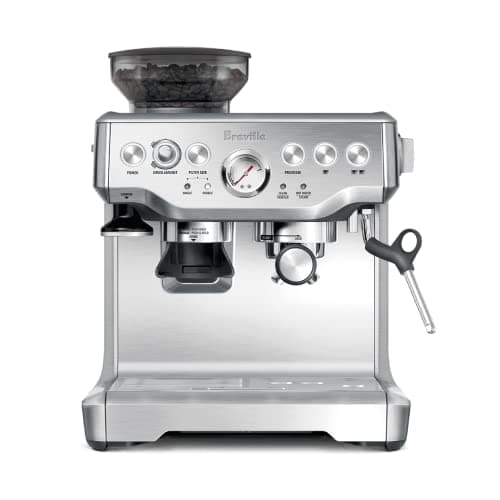 | A first machine with nothing else to research | Top pick | |
| 2 | 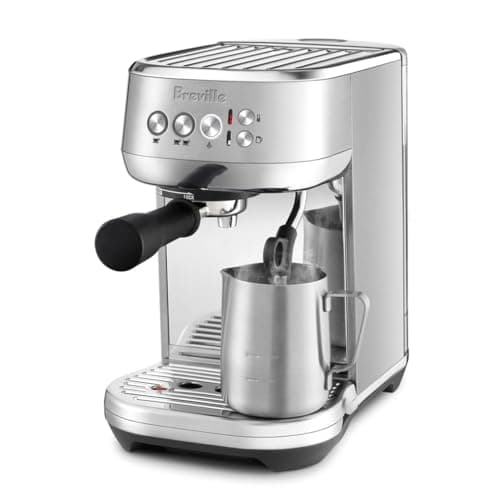 | Beginners with a grinder, or with a grinder budget | Best if you already have a grinder | |
| 3 | 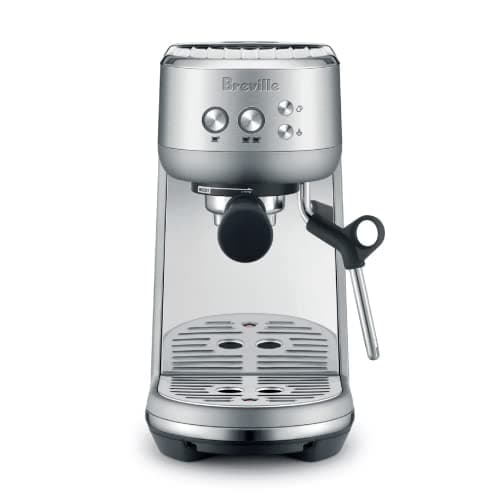 | Beginners who want to learn properly from the start | Best for learning milk | |
| 4 | 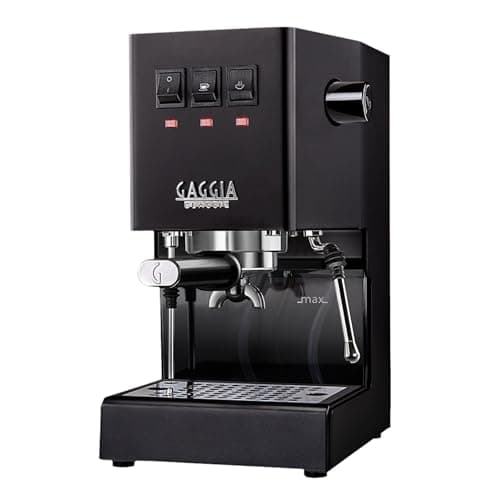 | Someone who enjoys learning a craft | Best if you want to learn everything | |
| 5 | 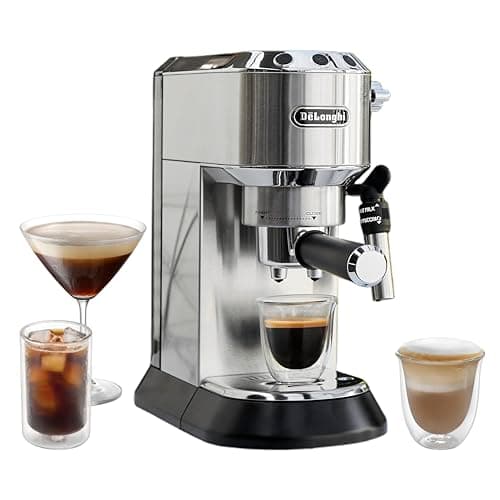 | A kitchen too small for anything else | Skip this |
1. Top pick
Breville Barista Express
Mid tier · The all-in-one: espresso machine with a conical burr grinder built into the case.
One box, one learning curve, and PID doing the hard part for you.
The best first machine is the one that lets you learn one thing at a time. The Barista Express does that by taking temperature off the table - PID control at 200 F means brew temperature is handled - and putting the grinder in the same case so you are not making two purchasing decisions before you have made a single shot.
That leaves you with dose, grind and shot length to learn, which is enough for the first few months.
The 54 mm basket is a real basket rather than a pressurized one, so the shot responds to what you do. That feedback is the whole point of a first machine and it is what separates this from the cheaper starter machines.
The 16 grind settings will eventually frustrate you, and that is fine - by the time they do, you will know exactly what you want from a standalone grinder, which is a much better position to buy from than guessing now.
Specification
- Portafilter
- 54 mm stainless
- Grinder
- Integrated conical burr, 16 settings
- Heating
- Thermocoil, 200 F, PID controlled
- Footprint
- 15.9 x 13.1 x 12.4 in
What it does well
- One box, one price, one plug - nothing else to buy
- PID temperature control at this level is not a given
- Enormous owner base, so parts and answers are easy to find
Where it gives ground
- 16 grind settings is coarse resolution for espresso dialing
- The built-in grinder is the weakest component and cannot be upgraded
- Wide footprint for a single-boiler machine
Skip it if
Skip it if you already own a grinder that can handle espresso. Buy a grinder-less machine and keep the grinder you have.
2. Best if you already have a grinder
Breville Bambino Plus
Entry tier · The Bambino with automatic milk texturing added.
Removes the two things beginners struggle with most: waiting and milk.
If you already own a burr grinder that adjusts finely, this is the better start. The Bambino Plus is ready in three seconds, which removes the friction that stops beginners practicing, and it textures milk automatically, which removes the second-hardest skill from your first month.
That leaves grind and dose as the only variables you are learning, which is genuinely the right number to start with.
The 54 mm basket takes an 18 g dose, low-pressure pre-infusion runs before the 15 bar pump settles to 9 bar, and the whole machine is 11.9 x 7.4 x 14.3 inches - small enough to sit beside a grinder on a normal counter.
The automatic milk is a trade you should make deliberately. It is the right call while you learn the espresso side; it becomes a limit if you later want to pour latte art, and there is no path from automatic to manual on this machine.
Specification
- Portafilter
- 54 mm stainless, 18 g dose
- Heating
- ThermoJet, ready in 3 seconds
- Pump
- 15 bar Italian pump, 9 bar extraction
- Milk
- Automatic texturing, 16 fl oz / 480 ml jug
- Footprint
- 11.9 x 7.4 x 14.3 in
What it does well
- Automatic milk texturing gets a usable microfoam without practice
- Same three-second heat-up as the standard Bambino
- Fits a narrow counter with a grinder beside it
Where it gives ground
- You are paying for the milk automation, not better espresso
- Still no grinder
- Auto-steam removes the control an enthusiast eventually wants
Skip it if
Skip it if you have no grinder and no budget for one. A capable machine fed by a bad grinder is a frustrating first experience.
3. Best for learning milk
Breville Bambino
Entry tier · A compact 54 mm espresso machine with a manual steam wand and no grinder.
The same machine with the milk left to you - which is the point.
The standard Bambino is the Plus with a manual steam wand instead of automatic texturing, and for a beginner who intends to get good rather than to get coffee, it is the better buy.
Steaming milk is a skill you can learn in a few weeks of practice, and learning it on a manual wand from the beginning is far easier than unlearning automation later.
Everything else is shared: 54 mm basket, 18 g dose, ThermoJet heating in three seconds, low-pressure pre-infusion, 9 bar extraction, and a footprint of 11.9 x 6.1 x 13.5 inches that is the narrowest serious machine available.
As with the Plus, there is no grinder, and that purchase is not optional.
Specification
- Portafilter
- 54 mm, 18 g dose
- Heating
- ThermoJet, ready in 3 seconds
- Extraction
- Low-pressure pre-infusion, then 9 bar
- Footprint
- 11.9 x 6.1 x 13.5 in
- Grinder
- None - buy separately
What it does well
- Three-second heat-up means it is genuinely usable on a weekday
- The narrowest footprint of any machine here
- Real steam wand you control yourself
Where it gives ground
- No grinder, so the real budget is machine plus grinder
- Manual milk texturing has a learning curve
- Small tank means frequent refills if you pull several drinks
Skip it if
Skip it if nobody in the household wants to learn to steam milk. The Plus exists for exactly that situation.
4. Best if you want to learn everything
Gaggia Classic Evo Pro
Mid tier · A 58 mm single-boiler machine with commercial parts and a large modification community.
The most educational first machine, and the least forgiving one.
This is a real recommendation with a real warning attached. The Gaggia teaches you more about espresso than anything else in this list, because it automates nothing: you time the shot, you time the temperature, you learn what the machine is doing.
The hardware is genuinely good - a 58 mm portafilter opening the whole accessory market, a 3-way solenoid valve for a dry puck, a 2.1 L tank and a professional two-hole steam wand.
The absence of PID means brew temperature moves within a thermostat band, and getting a consistent shot means learning to time against the heating light. That is a skill, and for some people it is the fun part.
For others it is a chore they resent every morning. Be honest with yourself about which you are before buying, because this is the one machine here that can genuinely put someone off the hobby.
Specification
- Portafilter
- 58 mm
- Power
- 1425 W total; 1375 W to the boiler
- Boiler
- 140 ml max capacity, 105 ml operating
- Water tank
- 2.1 L / 72 fl oz
- Steam
- Two-hole professional wand
- Valve
- 3-way solenoid
What it does well
- 58 mm from the start - every basket, tamper and portafilter fits
- The 3-way solenoid gives a dry puck, which cheap machines do not
- Serviceable and heavily documented; parts are everywhere
Where it gives ground
- No PID as shipped; brew temperature drifts with the thermostat
- Long recovery between brewing and steaming
- The modification path is a hobby, not a feature
Skip it if
Skip it if you want coffee rather than a hobby. There is no shame in that and this is the wrong machine for it.
5. Skip this
De Longhi Dedica EC685
Budget tier · A six-inch-wide thermoblock machine with a pressurized 51 mm portafilter.
The most-recommended beginner machine, and it cannot teach you anything.
The Dedica tops a great many beginner lists, and the reason is price rather than suitability. Its specification is honest: a 51 mm pressurized portafilter, a 1 L tank, a 15 bar pump and a 1350 W thermoblock in a body 5.9 inches wide.
The pressurized basket is the disqualifying feature for a beginner specifically. It creates back-pressure through a restricted wall rather than through the coffee, which means it produces crema whether or not your grind is right. That is a machine that cannot tell you when you have made a mistake, and a beginner's most valuable equipment is feedback.
The 51 mm size closes the usual fix. On a 54 mm Breville you can add a bottomless portafilter and an unpressurized basket and start learning properly. The 51 mm accessory market barely exists.
The width is genuinely exceptional and is the one reason to buy one: if your counter cannot take anything else, a compromised machine you own beats a better one you cannot fit.
Specification
- Portafilter
- 51 mm, pressurized
- Water tank
- 35 oz / 1 L
- Pump
- 15 bar
- Power
- 1350 W thermoblock
- Footprint
- 5.9 in W x 13 in D x 13 in H
What it does well
- Genuinely tiny - fits where nothing else will
- Forgiving with supermarket beans thanks to the pressurized basket
- Fast to heat
Where it gives ground
- The pressurized basket manufactures crema; it hides grind quality rather than rewarding it
- 51 mm is an accessory dead end compared with 54 mm or 58 mm
- Panarello-style frother, not a bare steam wand
Skip it if
Skip it unless the footprint is a hard constraint. Beginners need feedback more than they need a low price, and this machine is designed to hide their mistakes.
What a beginner should buy alongside the machine
- 1A grinder, if the machine does not have one. Not optional. See espresso grinders under $300.
- 2A scale with a timer. Espresso is dose in, liquid out, over time. Without a scale you are guessing at two of three. Scale picks.
- 3Fresh beans with a roast date. Stale coffee produces a fast, thin shot no adjustment fixes. See beans for espresso.
- 4Nothing else, for at least a month. Tampers, distribution tools and portafilters can wait until you know what is bothering you.
What to expect in the first month
Your first several shots will be bad, and they will be bad in specific, diagnosable ways. Sour and thin means under-extracted, usually too coarse. Bitter and drying means over-extracted, usually too fine or too long. Both at once usually means the water found a channel rather than passing evenly. How to dial in espresso walks through the diagnosis properly, and it is the single most useful thing to read before your first shot rather than after your twentieth.
Give it a month of daily practice before concluding anything about your equipment. Most first-machine disappointment turns out to be grind and dose rather than hardware, and replacing the machine at week two is an expensive way to keep the same problem.