The short answer
Four specifications decide it. Non-pressurized baskets, because pressurized ones cap extraction no matter what else you buy. Portafilter size, because 58 mm and 54 mm have accessories and 51 mm does not. Temperature control, because PID is what makes shots repeatable. And the grinder question, because a machine without one is only half a purchase - and a machine with one built in is usually the weaker grinder.
1. Pressurized or non-pressurized baskets
A non-pressurized basket makes the coffee bed create the resistance. Grind, dose and tamp decide the shot, which is demanding and is also the only way espresso gets good.
A pressurized - dual-wall - basket creates back pressure with a small hole instead. It produces crema-looking foam from any coffee, including stale pre-ground, and it means grind quality barely changes the result.
That is forgiving at the start and a hard ceiling later. If you own or want a burr grinder, buy a machine that takes non-pressurized baskets - see bottomless vs pressurized.
2. Portafilter size decides your accessories forever
- 58 mm is the commercial standard. Everything is made for it: precision baskets, bottomless portafilters, distribution tools, puck screens, tampers.
- 54 mm is Breville's size. Well supported, though a smaller market than 58 mm.
- 51 mm - De'Longhi's entry machines - is close to an accessory dead end.
- Pods are a different product entirely, with no portafilter and no dialing.
3. Temperature control
Espresso extracts in a narrow temperature band. A thermostat switches the heater around a target, so brew temperature oscillates; a PID controller predicts and trims, so it settles.
In practice, PID means the shot you dialed yesterday behaves the same today. Machines like the Breville Infuser include it; the Gaggia Classic Evo Pro does not, which is why PID kits are the first modification people fit.
4. The grinder question
Espresso is more sensitive to grind than any other brewing method, so the grinder is not an accessory. A machine without one is half a purchase, and the budget has to cover both.
All-in-one machines solve that in one box at the cost of grind resolution - 16 settings on a Barista Express against 40 on an entry standalone grinder, and no upgrade path. Whether that trade is right depends entirely on whether you already own a grinder.
Quick picks
The answer first. Tap any row to jump to the full reasoning for that pick.
| # | Product | Best for | Award | Price |
|---|---|---|---|---|
| 1 | 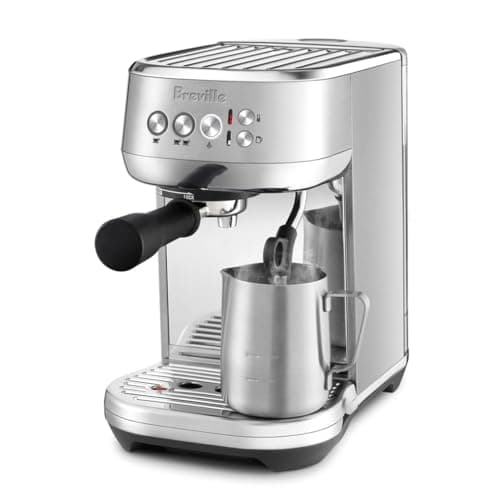 | Cappuccinos on a weekday | If milk is the main event | |
| 2 | 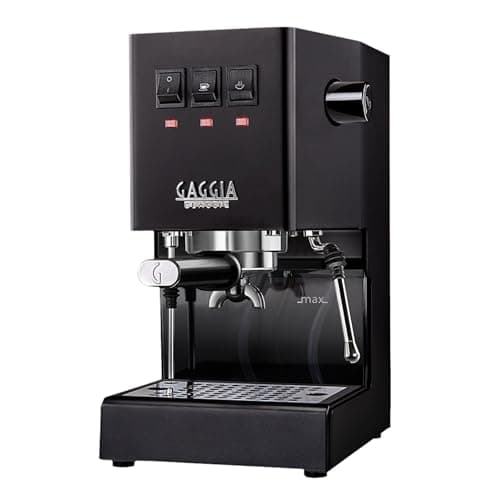 | Learning espresso properly and keeping the machine | If you want the hobby | |
| 3 | 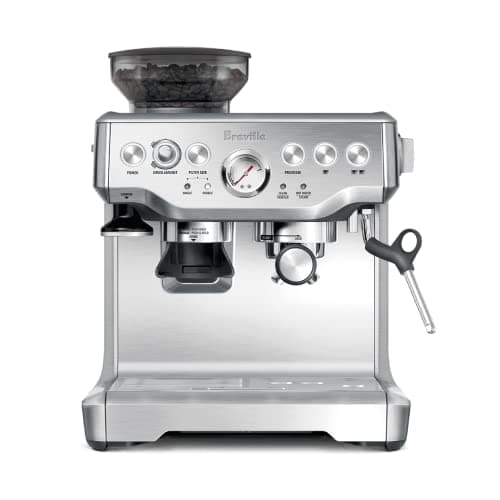 | Starting from nothing, in one purchase | If you have no grinder |
1. If milk is the main event
Breville Bambino Plus
Entry tier · The Bambino with automatic milk texturing added.
Three-second heat-up and automatic milk texturing at 54 mm.
The Bambino Plus heats in three seconds via ThermoJet and textures milk automatically to a set temperature and foam level, on a 54 mm 18 g basket.
For a household whose coffee is mostly milk drinks, that automation removes the steepest part of the learning curve.
Its 15 bar pump extracts at 9 bar with low-pressure pre-infusion, so the espresso underneath the milk is real espresso rather than a pressurized approximation.
Its footprint is 11.9 x 7.4 x 14.3 in, narrow enough to sit beside a grinder.
There is no grinder, so the budget is machine plus grinder - and the automation is exactly the control an enthusiast eventually wants back.
Specification
- Portafilter
- 54 mm stainless, 18 g dose
- Heating
- ThermoJet, ready in 3 seconds
- Pump
- 15 bar Italian pump, 9 bar extraction
- Milk
- Automatic texturing, 16 fl oz / 480 ml jug
- Footprint
- 11.9 x 7.4 x 14.3 in
What it does well
- Automatic milk texturing gets a usable microfoam without practice
- Same three-second heat-up as the standard Bambino
- Fits a narrow counter with a grinder beside it
Where it gives ground
- You are paying for the milk automation, not better espresso
- Still no grinder
- Auto-steam removes the control an enthusiast eventually wants
Skip it if
Skip it if you want to learn milk yourself. The machine does the interesting part for you.
2. If you want the hobby
Gaggia Classic Evo Pro
Mid tier · A 58 mm single-boiler machine with commercial parts and a large modification community.
58 mm, a 3-way solenoid, commercial parts and a modification path.
The Classic Evo Pro takes the 58 mm commercial standard, which means every basket, tamper, distribution tool and bottomless portafilter fits it.
Its 3-way solenoid releases pressure after the shot, leaving a dry puck - the most visible daily difference between a real espresso machine and a cheap one.
A 140 ml brass boiler fed by 1375 W heats and recovers quickly, and its two-hole professional wand puts milk texture entirely in your hands.
The 2.1 L tank is the largest in its class by a distance.
It ships without PID, so temperature drifts with the thermostat, and the modification community around it is a hobby rather than a feature - see the Gaggia review.
Specification
- Portafilter
- 58 mm
- Power
- 1425 W total; 1375 W to the boiler
- Boiler
- 140 ml max capacity, 105 ml operating
- Water tank
- 2.1 L / 72 fl oz
- Steam
- Two-hole professional wand
- Valve
- 3-way solenoid
What it does well
- 58 mm from the start - every basket, tamper and portafilter fits
- The 3-way solenoid gives a dry puck, which cheap machines do not
- Serviceable and heavily documented; parts are everywhere
Where it gives ground
- No PID as shipped; brew temperature drifts with the thermostat
- Long recovery between brewing and steaming
- The modification path is a hobby, not a feature
Skip it if
Skip it if you want an appliance rather than a project.
3. If you have no grinder
Breville Barista Express
Mid tier · The all-in-one: espresso machine with a conical burr grinder built into the case.
Machine and conical burr grinder in one case, with PID at 200 F.
The Barista Express puts a conical burr grinder with 16 settings inside a 54 mm machine with PID-controlled thermocoil heating at 200 F.
For someone starting from zero it removes the second purchase, which is why it has the largest owner base in home espresso.
Sixteen grind settings is coarse for espresso dialing, and the built-in grinder is the one component you cannot upgrade.
Its footprint is 15.9 x 13.1 x 12.4 in - wider than a compact machine and a separate grinder side by side.
If you already own a grinder, you are buying a weaker one - see the Barista Express review.
Specification
- Portafilter
- 54 mm stainless
- Grinder
- Integrated conical burr, 16 settings
- Heating
- Thermocoil, 200 F, PID controlled
- Footprint
- 15.9 x 13.1 x 12.4 in
What it does well
- One box, one price, one plug - nothing else to buy
- PID temperature control at this level is not a given
- Enormous owner base, so parts and answers are easy to find
Where it gives ground
- 16 grind settings is coarse resolution for espresso dialing
- The built-in grinder is the weakest component and cannot be upgraded
- Wide footprint for a single-boiler machine
Skip it if
Skip it if you own a good grinder already. Put the money into the machine instead.
What does not decide it
Bar pressure. Nearly every machine advertises 15 or 19 bar; espresso is extracted at about 9. A higher number on the box is a pump specification, not a quality one.
Cup warmers and lights. Pleasant. Irrelevant to the coffee.
Boiler count, at entry level. Single boiler versus dual boiler matters when you are making several milk drinks back to back, not when you are making two - see dual boiler vs single boiler.
Budget the whole setup, not the machine
- Machine. The headline number, and rarely the whole cost.
- Grinder. Assume real money unless the machine includes one.
- Scale and tamper. Small, necessary - see best espresso tampers.
- Beans, forever. The recurring cost that decides what the setup actually tastes like.