The published specification
Scroll the table sideways to see every column.
Quick picks
The answer first. Tap any row to jump to the full reasoning for that pick.
Prices shown are checked daily against the retailer, as of October 23, 2026. We never write a price into the text of a page.
| # | Product | Best for | Award | Price |
|---|---|---|---|---|
| 1 | 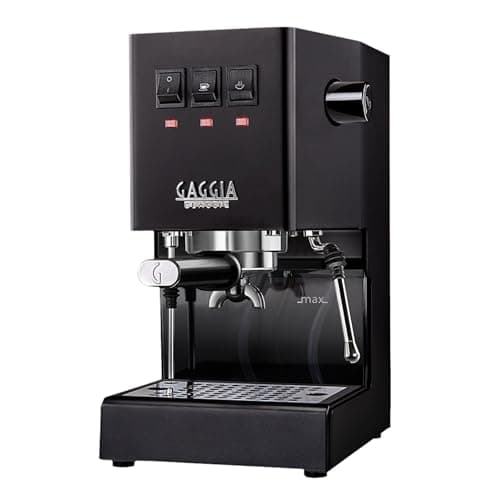 | Someone who wants commercial parts and enjoys a machine that asks something of them | The machine reviewed | |
| 2 | 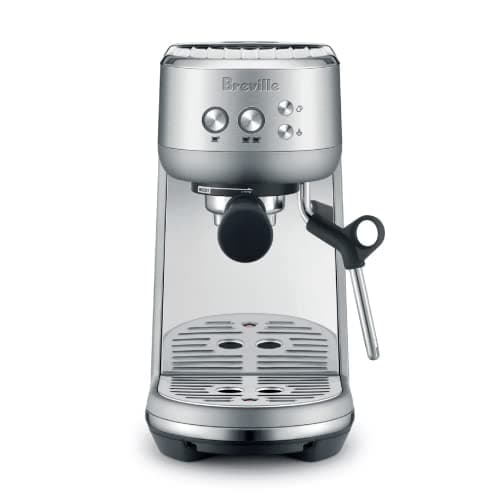 | Weekday coffee without a warm-up | The convenience alternative | |
| 3 | 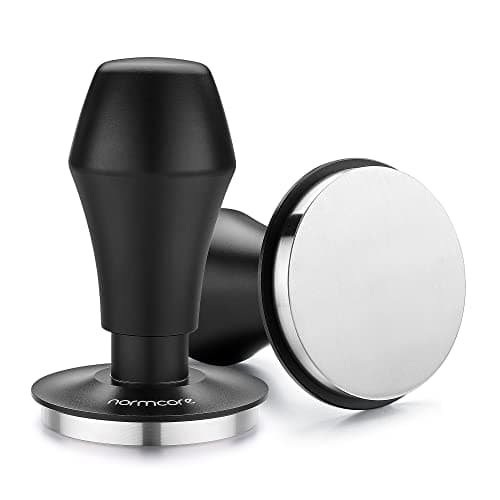 | Making the 58 mm advantage real | The first accessory to add |
1. The machine reviewed
Gaggia Classic Evo Pro
Mid tier · A 58 mm single-boiler machine with commercial parts and a large modification community.
The cheapest honest route into the 58 mm world, if you accept the routine.
The Classic Evo Pro is a 58 mm single-boiler espresso machine drawing 1425 W in total, of which 1375 W goes to a boiler with a 140 ml maximum capacity and around 105 ml operating volume. The water tank holds 2.1 L, there is a 3-way solenoid valve, and the steam wand is a two-hole professional design.
That specification list is unusual at this price. The 58 mm portafilter puts you in the commercial accessory ecosystem. The solenoid valve releases group pressure after the shot so the puck comes out dry. The two-hole wand can texture milk properly rather than merely aerating it.
What is absent is temperature control. There is no PID, so brew temperature moves within the thermostat's band, and the small boiler mass means it moves reasonably quickly.
The result is a machine that rewards a routine. Owners learn to time the shot against the heating element's cycle, and once learned it is reliable - but it is a skill, not a setting.
Specification
- Portafilter
- 58 mm
- Power
- 1425 W total; 1375 W to the boiler
- Boiler
- 140 ml max capacity, 105 ml operating
- Water tank
- 2.1 L / 72 fl oz
- Steam
- Two-hole professional wand
- Valve
- 3-way solenoid
What it does well
- 58 mm from the start - every basket, tamper and portafilter fits
- The 3-way solenoid gives a dry puck, which cheap machines do not
- Serviceable and heavily documented; parts are everywhere
Where it gives ground
- No PID as shipped; brew temperature drifts with the thermostat
- Long recovery between brewing and steaming
- The modification path is a hobby, not a feature
Skip it if
Skip it if you want to press a button and get the same result without thinking. Everything good about this machine depends on your attention.
2. The convenience alternative
Breville Bambino
Entry tier · A compact 54 mm espresso machine with a manual steam wand and no grinder.
Three seconds to ready and no routine, at the cost of everything the Gaggia has in metal.
If the temperature routine is what puts you off, the Bambino is the honest alternative at a similar price. A ThermoJet heater reaches extraction temperature in three seconds and stays there without any input from you.
The espresso specification is modern: 54 mm basket, 18 g dose, low-pressure pre-infusion, 9 bar extraction, in a body 11.9 x 6.1 x 13.5 inches.
What you give up is the 58 mm ecosystem, the solenoid valve and the dry puck, the 2.1 L tank and the professional steam wand.
The full head to head is here, because these two machines genuinely disagree about what a home espresso machine should be.
Specification
- Portafilter
- 54 mm, 18 g dose
- Heating
- ThermoJet, ready in 3 seconds
- Extraction
- Low-pressure pre-infusion, then 9 bar
- Footprint
- 11.9 x 6.1 x 13.5 in
- Grinder
- None - buy separately
What it does well
- Three-second heat-up means it is genuinely usable on a weekday
- The narrowest footprint of any machine here
- Real steam wand you control yourself
Where it gives ground
- No grinder, so the real budget is machine plus grinder
- Manual milk texturing has a learning curve
- Small tank means frequent refills if you pull several drinks
Skip it if
Skip it if 58 mm accessories or a serviceable machine are what you came for. Those are the Gaggia's whole case.
3. The first accessory to add
Normcore Spring-Loaded Tamper V4
Mid tier · A calibrated tamper with interchangeable springs and a self-leveling plate.
58 mm opens the commercial accessory market, and this is where to start using it.
The practical benefit of a 58 mm machine only arrives when you use the accessories it unlocks, and a calibrated tamper is the sensible first one.
The Normcore V4 comes in 58 mm and 58.5 mm and ships with 15 lb, 25 lb and 30 lb springs, so you can find the pressure that suits your grind rather than guessing. The base is 304 stainless, available flat or ripple.
The leveling plate is the part that matters most: it rests on the basket rim while you press, so the tamp is square to the basket every time. An angled tamp is one of the most common causes of channeling and it is invisible until you use a bottomless portafilter.
It is heavier and clunkier than a plain tamper, and the click that signals correct pressure can be mistaken for the end of the stroke until you are used to it.
Specification
- Sizes
- 51 mm, 53.3 mm, 58 mm, 58.5 mm
- Springs
- 15 lb, 25 lb and 30 lb included
- Base
- 304 stainless, flat or ripple
- Leveling
- Plate rests on the basket rim as you press
What it does well
- Removes tamp pressure and tamp angle as variables in one purchase
- Three springs let you find the pressure your machine likes
- Costs a fraction of the machines that automate the same thing
Where it gives ground
- Heavier and clunkier than a plain tamper
- The click can be mistaken for the end of the stroke
- You must buy the size that matches your basket exactly
Skip it if
Skip it if you already tamp level and consistently - a calibrated tamper adds little for someone with good technique.
Why the 58 mm portafilter is the headline
58 mm is the commercial standard, and it is the reason this machine has the following it does. Every basket, every tamper, every distribution tool and every bottomless portafilter made for professional machines fits it. Nothing you buy for this machine is stranded if you upgrade later.
That is a genuinely different proposition from a 54 mm home machine, whose accessory market is healthy but proprietary in shape. If you expect this to be a first machine rather than an only one, it is the strongest argument on the page.
The solenoid valve
A 3-way solenoid opens a third path when the pump stops, venting the pressure above the puck through the drip tray. The puck comes out dry and knocks into the bin cleanly, rather than sitting as a wet slurry that has to be rinsed out.
This affects workflow rather than flavor, and over daily use it is a real quality-of-life difference. It is also a component that machines at this price almost never have.
The temperature problem, stated plainly
The boiler holds 140 ml at most and roughly 105 ml in operation, heated by a 1375 W element. That is a small mass heated hard, and with a thermostat rather than a PID, brew temperature oscillates through a band rather than sitting on a number.
The consequence is that when you start the shot relative to the heating cycle changes the temperature at the puck. Owners manage this with temperature surfing - waiting for the heating light to cycle, then starting the shot at a consistent point afterwards. It is entirely learnable and it is a routine you perform every single time.
PID controller kits exist for this machine and are among the most common modifications made to it. We would suggest living with the machine as designed for a couple of months first: many owners find the routine unobtrusive, and modifying a machine you have not yet learned is a good way to change something that was not the problem.
Steam performance
The two-hole professional wand is a bare wand, not a Panarello sleeve - which means you control the tip position and can therefore texture proper microfoam rather than stiff foam. That is the hardware requirement for latte art, and it is unusual at this price.
The small boiler is the limit. Steam is available and recovery between brewing and steaming takes real time, so this is a one-or-two-drink machine rather than a dinner-party one.
Verdict
Buy it if you want commercial parts, a machine you can service, and a route into the 58 mm accessory world - and if you find the routine engaging rather than annoying. Do not buy it if you want a machine that requires nothing of you, or if your grinder is not good: this machine displays grind problems rather than smoothing them over. And whatever you decide, budget for the grinder alongside it.