The short answer
Buy the Bambino if you want espresso with the least friction: three seconds to ready, a tiny footprint, and nothing to learn beyond the coffee. Buy the Gaggia Classic Evo Pro if you want a 58 mm commercial basket, a dry puck from the solenoid valve, and a machine you can work on - accepting that it needs a warm-up and a routine.
Specification side by side
Scroll the table sideways to see every column.
Quick picks
The answer first. Tap any row to jump to the full reasoning for that pick.
Prices shown are checked daily against the retailer, as of October 23, 2026. We never write a price into the text of a page.
| # | Product | Best for | Award | Price |
|---|---|---|---|---|
| 1 | 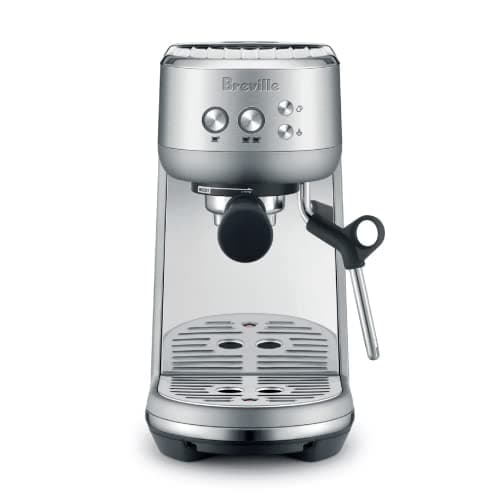 | Weekday coffee in a small kitchen | Choose this for convenience | |
| 2 | 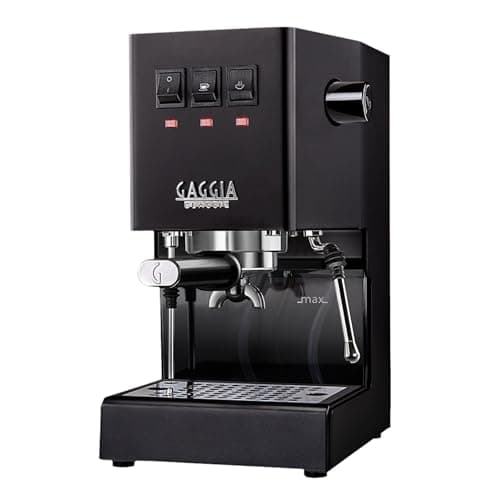 | Someone who wants a machine they can grow into and work on | Choose this for substance |
1. Choose this for convenience
Breville Bambino
Entry tier · A compact 54 mm espresso machine with a manual steam wand and no grinder.
Ready in three seconds, six inches wide, and it asks nothing of you.
The Bambino's argument is friction. A ThermoJet heater at extraction temperature in three seconds means the machine is ready before your grinder has finished, and a body 6.1 inches deep means it fits where nothing else does.
The espresso specification is modern and complete: a 54 mm basket taking 18 g, low-pressure pre-infusion, and 9 bar extraction.
What that buys, in practice, is shots. A machine you can use in ninety seconds gets used every morning; a machine that needs a warm-up gets used on Saturdays. Frequency is the largest factor in how quickly you improve.
What you give up is metal. This is a thermoblock machine in a compact plastic-and-steel body, with a 54 mm basket rather than the commercial 58 mm size, and it is not a machine you will be repairing in fifteen years.
Specification
- Portafilter
- 54 mm, 18 g dose
- Heating
- ThermoJet, ready in 3 seconds
- Extraction
- Low-pressure pre-infusion, then 9 bar
- Footprint
- 11.9 x 6.1 x 13.5 in
- Grinder
- None - buy separately
What it does well
- Three-second heat-up means it is genuinely usable on a weekday
- The narrowest footprint of any machine here
- Real steam wand you control yourself
Where it gives ground
- No grinder, so the real budget is machine plus grinder
- Manual milk texturing has a learning curve
- Small tank means frequent refills if you pull several drinks
Skip it if
Skip it if you want commercial parts, a dry puck, or a machine you can service. Those are not what this one is for.
2. Choose this for substance
Gaggia Classic Evo Pro
Mid tier · A 58 mm single-boiler machine with commercial parts and a large modification community.
58 mm, a solenoid valve, a real steam wand - and a routine you have to learn.
The Gaggia's argument is hardware. A 58 mm portafilter puts you in the commercial accessory ecosystem permanently. A 3-way solenoid valve releases group pressure after the shot so the puck comes out dry rather than as slurry. A 2.1 L tank is more than double the Bambino's practical capacity. The two-hole steam wand is a professional design.
None of those things are available on the Bambino at any price, and none of them can be added to it.
The cost is temperature. The boiler holds 140 ml maximum, around 105 ml operating, driven by a 1375 W element out of 1425 W total - a small mass heated hard, with no PID. Brew temperature moves within the thermostat band, which is why owners time shots against the heating light.
It is also slow to be ready and slow to recover between brewing and steaming. This is a machine that expects you to plan around it.
Specification
- Portafilter
- 58 mm
- Power
- 1425 W total; 1375 W to the boiler
- Boiler
- 140 ml max capacity, 105 ml operating
- Water tank
- 2.1 L / 72 fl oz
- Steam
- Two-hole professional wand
- Valve
- 3-way solenoid
What it does well
- 58 mm from the start - every basket, tamper and portafilter fits
- The 3-way solenoid gives a dry puck, which cheap machines do not
- Serviceable and heavily documented; parts are everywhere
Where it gives ground
- No PID as shipped; brew temperature drifts with the thermostat
- Long recovery between brewing and steaming
- The modification path is a hobby, not a feature
Skip it if
Skip it if you want to make coffee without thinking about the machine. Every advantage it has, you have to work for.
What the solenoid valve actually does
This is the specification most comparison articles list and few explain. A 3-way solenoid valve opens a third path when the pump stops, venting the pressure trapped above the coffee puck out through the drip tray. Without it, that pressure stays in the group and the puck absorbs the remaining water, so it comes out as a wet slurry that has to be rinsed rather than knocked out.
The practical effect is on cleanup rather than flavor, and it is the difference between a five-second and a thirty-second turnaround between shots. Over a few years of daily use that is not a trivial feature.
The 58 mm question, which is really about the future
A 58 mm portafilter means the tampers, distribution tools and bottomless portafilters you buy for this machine will fit any commercial-standard machine you own afterwards. A 54 mm Breville has a healthy accessory market of its own, but it is a Breville-shaped market and those parts do not carry forward.
If you expect this to be your only espresso machine, this argument does not apply. If you expect it to be your first, it matters more than the price difference.
Temperature: the honest trade
The Bambino's thermoblock heats water as it passes, so temperature is broadly consistent by design and requires nothing of you. The Gaggia's small boiler under thermostat control does not hold a tight band, which is why the temperature-surfing routine exists - watching the heating element cycle and starting the shot at a known point in that cycle.
That routine works, and thousands of owners use it daily. Whether it is a charming ritual or a daily irritation is genuinely a matter of temperament, and it is the question to answer honestly before choosing.
Both need the same thing next
Neither machine has a grinder, and neither will produce good espresso without one. If you are comparing these two, the more consequential decision is which espresso grinder you pair with it - and if the budget only stretches to one good purchase, make it the grinder and take the cheaper machine.