The short answer
Buy the Gaggia Classic Pro if you have or will buy a good grinder and want commercial 58 mm parts you can service and upgrade. Buy the Barista Express if you want one machine that grinds and holds temperature for you, with nothing else to buy.
Side by side
Scroll the table sideways to see every column.
Quick picks
The answer first. Tap any row to jump to the full reasoning for that pick.
Prices shown are checked daily against the retailer, as of October 25, 2026. We never write a price into the text of a page.
| # | Product | Best for | Award | Price |
|---|---|---|---|---|
| 1 | 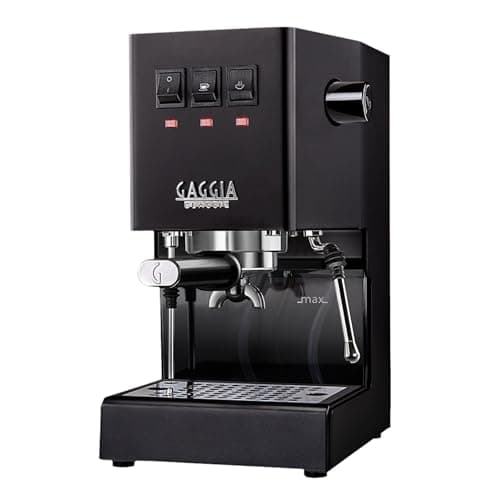 | Someone who owns, or will buy, a good grinder | Choose this for commercial parts | |
| 2 | 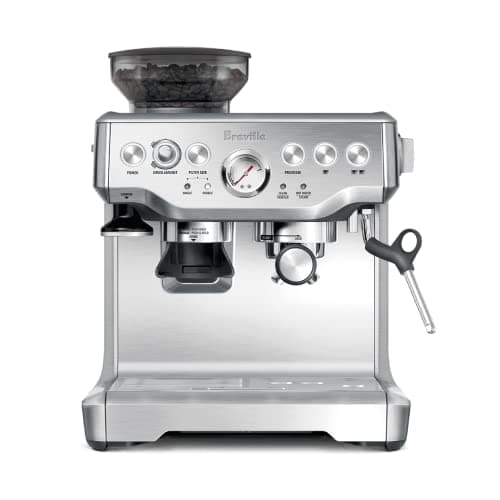 | A complete first setup with nothing else to buy | Choose this for one box |
1. Choose this for commercial parts
Gaggia Classic Evo Pro
Mid tier · A 58 mm single-boiler machine with commercial parts and a large modification community.
58 mm, a solenoid valve and a two-hole wand - and a routine to learn.
The Classic Evo Pro is a 58 mm single-boiler machine: 1425 W in total, 1375 W to a boiler of 140 ml maximum and around 105 ml operating, a 2.1 L tank, a 3-way solenoid valve and a two-hole professional steam wand.
58 mm is the commercial standard, so professional baskets, tampers and distribution tools fit it. The solenoid releases pressure after the shot so the puck comes out dry, and it lets the machine be backflushed.
What it does not have is a PID. Brew temperature moves within the thermostat's band, and owners learn to time shots against the heating cycle. It is a skill rather than a setting.
It has no grinder, so the fair comparison is Gaggia plus grinder against the Express.
Specification
- Portafilter
- 58 mm
- Power
- 1425 W total; 1375 W to the boiler
- Boiler
- 140 ml max capacity, 105 ml operating
- Water tank
- 2.1 L / 72 fl oz
- Steam
- Two-hole professional wand
- Valve
- 3-way solenoid
What it does well
- 58 mm from the start - every basket, tamper and portafilter fits
- The 3-way solenoid gives a dry puck, which cheap machines do not
- Serviceable and heavily documented; parts are everywhere
Where it gives ground
- No PID as shipped; brew temperature drifts with the thermostat
- Long recovery between brewing and steaming
- The modification path is a hobby, not a feature
Skip it if
Skip it if you want consistent results without a routine. Everything good about it depends on your attention - see the full review.
2. Choose this for one box
Breville Barista Express
Mid tier · The all-in-one: espresso machine with a conical burr grinder built into the case.
A built-in grinder and PID temperature control, ready to make espresso from beans.
The Barista Express pairs a 54 mm stainless portafilter with an integrated conical burr grinder listed at 16 settings, heated by a PID-controlled thermocoil at 200 F, in a 15.9 x 13.1 x 12.4 inch body.
The PID is its quiet advantage over the Gaggia: it holds brew temperature to a set point, so there is no heating-cycle routine to learn.
The built-in grinder removes the separate purchase, which is why it is so often a first machine. It also caps the setup, because an integrated grinder cannot be upgraded.
The 54 mm size has a large aftermarket now, but it is Breville's own size, not the commercial standard.
Specification
- Portafilter
- 54 mm stainless
- Grinder
- Integrated conical burr, 16 settings
- Heating
- Thermocoil, 200 F, PID controlled
- Footprint
- 15.9 x 13.1 x 12.4 in
What it does well
- One box, one price, one plug - nothing else to buy
- PID temperature control at this level is not a given
- Enormous owner base, so parts and answers are easy to find
Where it gives ground
- 16 grind settings is coarse resolution for espresso dialing
- The built-in grinder is the weakest component and cannot be upgraded
- Wide footprint for a single-boiler machine
Skip it if
Skip it if you already own a capable grinder - you would be paying for a second, lesser one - see the full review.
Temperature: a routine or a setting
The biggest difference in daily use is temperature. The Gaggia's thermostat lets brew temperature drift within a band, so owners learn when in the heating cycle to pull a shot. The Express's PID holds a set point.
Neither is wrong. The routine is learnable and many owners enjoy it; the PID simply removes it. Be honest about which you would prefer on a busy morning.
The grinder changes the comparison
The Express includes a grinder and the Gaggia does not, so their prices are not directly comparable. A fair comparison adds a capable espresso grinder to the Gaggia's side - see espresso grinders.
Made that way, the Gaggia setup has more headroom: the grinder can be replaced independently, and the 58 mm group takes every commercial accessory. The Express is the more convenient single purchase.