The short answer
Buy the Barista Pro if you make several drinks in a row - its ThermoJet heater and 30-step grinder fix the Express's two real frustrations. Buy the Barista Express if you make one or two drinks at a time, because it makes very similar espresso and its slower heater will barely register.
The two differences that matter
Scroll the table sideways to see every column.
Everything else is close enough to treat as equal. Both grind on demand into a 54 mm portafilter, both leave the tamp and the shot to you, and both steam through a manual wand.
Quick picks
The answer first. Tap any row to jump to the full reasoning for that pick.
Prices shown are checked daily against the retailer, as of October 25, 2026. We never write a price into the text of a page.
| # | Product | Best for | Award | Price |
|---|---|---|---|---|
| 1 | 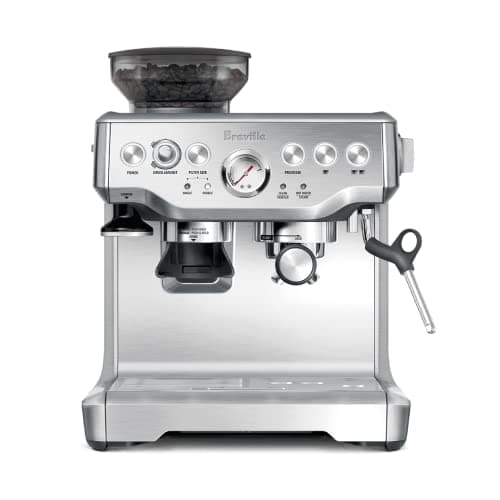 | One or two drinks at a time | Choose this for one drink a day | |
| 2 | 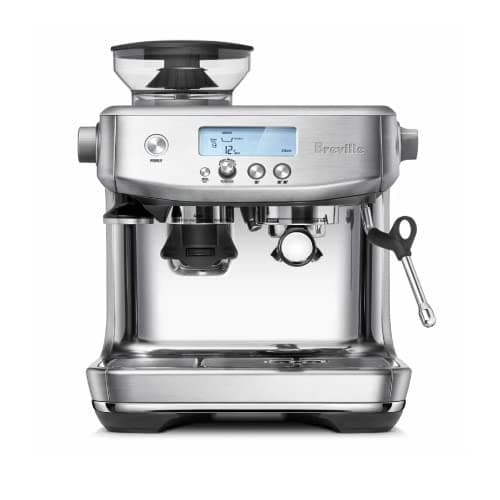 | Households making several drinks at once | Choose this for speed |
1. Choose this for one drink a day
Breville Barista Express
Mid tier · The all-in-one: espresso machine with a conical burr grinder built into the case.
The machine that made all-in-one espresso mainstream, and still enough for most mornings.
The Barista Express pairs a 54 mm stainless portafilter with an integrated conical burr grinder listed at 16 settings, heated by a PID-controlled thermocoil at 200 F.
The PID matters: it holds brew temperature to a set point rather than letting it drift with a thermostat's cycle, which is why these machines pull consistent shots once dialed in.
Where it falls behind the Pro is waiting. A thermocoil takes longer to reach temperature than a ThermoJet, and the change from brewing to steaming is slower. For a single drink the wait is barely noticeable; for four in a row it is most of the experience.
Sixteen grind settings is coarser stepping than the Pro offers, which can make it harder to land exactly on the shot you want with some beans.
Specification
- Portafilter
- 54 mm stainless
- Grinder
- Integrated conical burr, 16 settings
- Heating
- Thermocoil, 200 F, PID controlled
- Footprint
- 15.9 x 13.1 x 12.4 in
What it does well
- One box, one price, one plug - nothing else to buy
- PID temperature control at this level is not a given
- Enormous owner base, so parts and answers are easy to find
Where it gives ground
- 16 grind settings is coarse resolution for espresso dialing
- The built-in grinder is the weakest component and cannot be upgraded
- Wide footprint for a single-boiler machine
Skip it if
Skip it if you routinely make several milk drinks back to back. The wait between brewing and steaming is the Express's real weakness.
2. Choose this for speed
Breville Barista Pro
Mid tier · All-in-one with the fast ThermoJet heater and finer grind adjustment than the Express.
A three-second heat-up and finer grind steps - the Express's two annoyances addressed.
The Barista Pro keeps the Express's concept and changes the two things owners complain about. ThermoJet heating reaches temperature in about three seconds, and the grinder is listed at 30 settings rather than 16.
The heater is the bigger change in daily use. Moving from brewing to steaming is quick enough that it stops interrupting a run of drinks, and there is no warm-up to wait for first thing in the morning.
Finer grind steps make dialing in more precise. With 30 settings, one step changes the shot by less, so it is easier to land on the extraction you want rather than choosing between two that are both slightly wrong.
It is slightly larger at 16.1 x 13.8 x 13.1 inches against the Express at 15.9 x 13.1 x 12.4, and it costs more for what is, functionally, a faster machine with a better-stepped grinder.
Specification
- Grinder
- Baratza European precision burrs, 30 settings
- Heating
- ThermoJet, 3-second heat-up
- Footprint
- 16.1 x 13.8 x 13.1 in
What it does well
- 30 grind settings - nearly double the Barista Express
- Three-second heat-up in an all-in-one body
- Burrs sourced from Baratza rather than a generic set
Where it gives ground
- Still a single thermoblock: no simultaneous brew and steam
- Large footprint
- Grinder is fixed to the machine lifespan
Skip it if
Skip it if you make one drink a day. The Express makes very similar coffee and its waiting will not bother you - see the full Express review.
Why the heater matters more than it sounds
A thermocoil heats water as it passes through a coiled element, and changing its target temperature - from brewing to steaming - takes time. A ThermoJet is a faster design and makes the same change in seconds.
If your morning is one espresso, you will never notice. If it is a flat white for you and another for someone else, the Express has you waiting at each switch between brewing and steaming, and the Pro does not.
Why grind steps matter
Espresso is sensitive to small changes in grind size. When a grinder's steps are wide, you can find yourself choosing between a setting that runs slightly fast and one that runs slightly slow, with nothing in between.
Thirty settings narrows those gaps. It does not turn the Pro's grinder into a standalone grinder - it is still integrated and still cannot be upgraded - but it makes the machine easier to dial in precisely. See the built-in grinder roundup for how both compare with the Impress.