The short answer
Buy the Barista Pro if the Barista Express's two annoyances are what is stopping you: Breville publishes a three-second ThermoJet heat-up and 30 grind settings from Baratza burrs, against the Express's 16 settings and a slower thermocoil. Do not buy it expecting a published brew temperature - Breville's Barista Pro page states none, and does not mention PID, while its Barista Express page states 200°F with PID temperature control. It is also a single thermoblock, so it brews and steams in sequence, not together.
What Breville publishes for this machine
Scroll the table sideways to see every column.
The number that is missing, and why it matters
This site weights brew temperature heavily, because it is the figure that separates a machine that extracts coffee from one that rinses it. So it is worth stating what happened when we went looking for the Barista Pro's.
Breville's Barista Express page states a "Thermocoil heating system delivers 200°F with PID temperature control". Breville's Barista Pro page states no brew temperature at all and does not use the letters PID anywhere. The newer machine, at a higher price, publishes less about its temperature control than the older one it was built to replace.
If a published, verifiable brew temperature is your buying criterion, the Barista Express is the machine in this family that gives you one, and the best espresso machines under $1,000 covers the wider field.
Quick picks
The answer first. Tap any row to jump to the full reasoning for that pick.
Prices shown are checked daily against the retailer, as of October 21, 2026. We never write a price into the text of a page.
| # | Product | Best for | Award | Price |
|---|---|---|---|---|
| 1 | 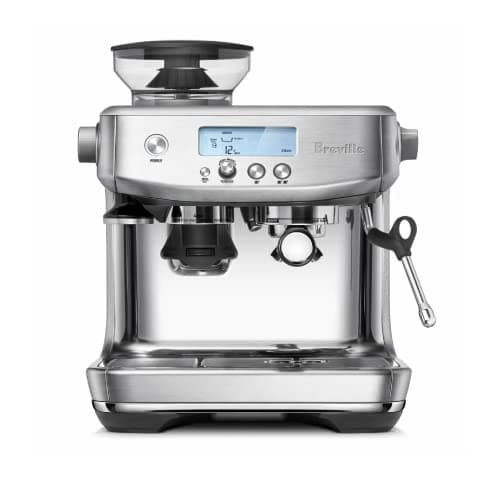 | One or two milk drinks a morning, with no patience for a warm-up | The machine reviewed | |
| 2 | 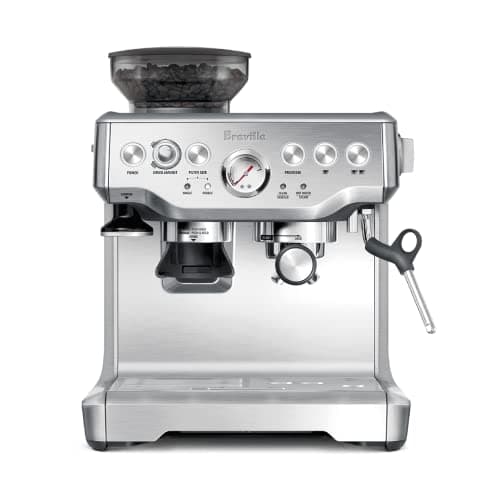 | A buyer who shops on specification rather than on speed | If you would rather have the published number | |
| 3 | 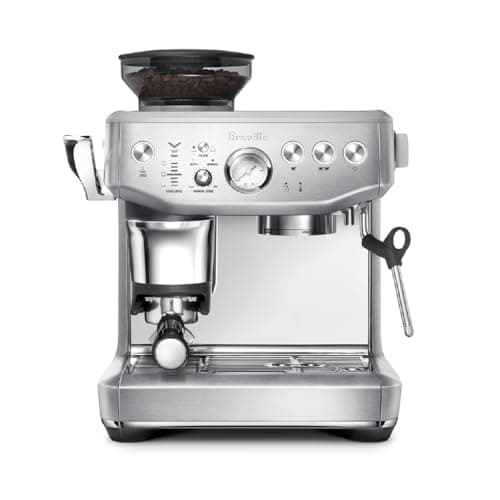 | Someone whose shots vary for reasons they cannot identify | If your shots are inconsistent | |
| 4 | 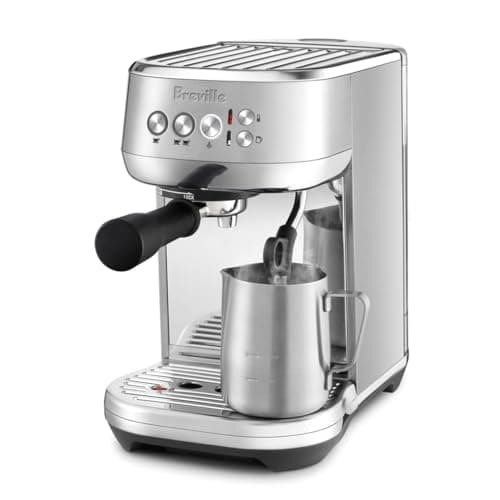 | Anyone who intends to own a real grinder anyway | If you would rather buy the grinder separately |
1. The machine reviewed
Breville Barista Pro
Mid tier · All-in-one with the fast ThermoJet heater and finer grind adjustment than the Express.
Three-second heat-up and 30 grind settings, in one box that still cannot brew and steam at once.
The Barista Pro is Breville's answer to the two complaints the Barista Express reliably generates. The first is waiting: Breville publishes a ThermoJet heating system that "achieves the optimum extraction temperature in 3 seconds". On a weekday that is the difference between making espresso and not bothering.
The second is grind resolution. Breville publishes "Baratza European Precision Burrs with 30 grind settings" on the Pro, against the Barista Express page's 16. Doubling the number of steps across the same usable range is the single most useful change here, because espresso dialing happens in small increments and a machine with coarse steps makes you choose between two settings that straddle the one you want.
Extraction is a 15 bar Italian pump running low-pressure pre-infusion before 9 bar, which is the same sequence Breville uses across this line. Milk is manual: Breville describes "hand-crafted microfoam" from its steam wand, so you texture it yourself rather than setting a temperature and walking away.
It is a large object at 16.1 x 13.8 x 13.1 inches, and the box includes the Dosing Funnel, single and dual wall filter baskets in 1 and 2 cup, the Razor dose-trimming tool, a 480 ml stainless milk jug, a cleaning kit and a water filter.
Two structural limits are worth being plain about. It is a single thermoblock, so brewing and steaming happen in sequence rather than together - fine for two drinks, tiresome for six. And the grinder is built into the machine, which means the grinder's lifespan and the machine's are now the same lifespan.
Specification
- Grinder
- Baratza European precision burrs, 30 settings
- Heating
- ThermoJet, 3-second heat-up
- Footprint
- 16.1 x 13.8 x 13.1 in
What it does well
- 30 grind settings - nearly double the Barista Express
- Three-second heat-up in an all-in-one body
- Burrs sourced from Baratza rather than a generic set
Where it gives ground
- Still a single thermoblock: no simultaneous brew and steam
- Large footprint
- Grinder is fixed to the machine lifespan
Skip it if
Skip it if you want a published brew temperature. Breville's page for this machine does not give one - see the section below before you decide that is acceptable.
2. If you would rather have the published number
Breville Barista Express
Mid tier · The all-in-one: espresso machine with a conical burr grinder built into the case.
Slower and coarser, and the only one of the two whose page states a brew temperature.
This is the machine the Pro replaces in most people's shortlists, and the comparison is less lopsided than the price suggests.
Breville's Barista Express page publishes a "Thermocoil heating system delivers 200°F with PID temperature control", a "54 mm stainless steel portafilter" and "the ideal dose of 18g". The Barista Pro's page publishes none of those three things.
What the Express gives up is real: 16 grind settings against 30, and a thermocoil that takes meaningfully longer to come up to temperature than the Pro's three seconds. If you make coffee on a schedule rather than at leisure, that wait is the thing you will notice every single day.
It is also slightly smaller at 15.9 x 13.1 x 12.4 inches, which matters under a wall cabinet.
The honest summary is that the Express is the better-documented machine and the Pro is the better machine to live with. Which of those you weight more is the actual decision - see Barista Express vs Barista Pro.
Specification
- Portafilter
- 54 mm stainless
- Grinder
- Integrated conical burr, 16 settings
- Heating
- Thermocoil, 200 F, PID controlled
- Footprint
- 15.9 x 13.1 x 12.4 in
What it does well
- One box, one price, one plug - nothing else to buy
- PID temperature control at this level is not a given
- Enormous owner base, so parts and answers are easy to find
Where it gives ground
- 16 grind settings is coarse resolution for espresso dialing
- The built-in grinder is the weakest component and cannot be upgraded
- Wide footprint for a single-boiler machine
Skip it if
Skip it if the morning wait is why you are shopping. That is precisely what the Pro's ThermoJet fixes and the Express does not.
3. If your shots are inconsistent
Breville Barista Express Impress
Mid tier · The Barista Express with assisted tamping and dose correction added.
Assisted tamping and dose correction, which removes the variable beginners struggle with most.
The Impress solves a different problem from the Pro. Where the Pro removes the wait, the Impress removes the tamp.
Its assisted lever applies a consistent 10 kg - 22 lb - with a 7-degree twist, and it adjusts grind time from the previous shot's puck depth, with a dose indicator on the front panel telling you when you are out of range. Tamp pressure is genuinely the hardest variable for a beginner to hold steady, so automating it is not a gimmick.
It runs 25 grind settings, between the Express's 16 and the Pro's 30, and takes up to a 19 g dose in its double basket.
What it does not have is the Pro's ThermoJet. If you want both the fast heat-up and the assisted tamp, Breville does not currently sell that combination in this bracket at this price.
It also costs more than the Express for automation rather than for better espresso hardware - see the Barista Express Impress review.
Specification
- Grinder
- Conical burr, 25 settings
- Basket
- Double basket, up to 19 g
- Tamping
- Assisted lever, 10 kg / 22 lb, 7-degree twist
- Dosing
- Adjusts grind time from the previous shot puck depth
What it does well
- Removes tamp pressure as a variable, which is the hardest one to keep consistent
- 25 grind settings against the Barista Express 16
- Dose feedback on the front panel tells you when you are out of range
Where it gives ground
- Solves a problem a calibrated tamper also solves, for far less
- Same integrated-grinder ceiling as the Barista Express
- The automation is the product; the espresso hardware is unchanged
Skip it if
Skip it if you already tamp consistently, or own a calibrated tamper. You would be paying for a solved problem.
4. If you would rather buy the grinder separately
Breville Bambino Plus
Entry tier · The Bambino with automatic milk texturing added.
The same three-second ThermoJet without the built-in grinder, for a good deal less.
This is the alternative worth taking seriously, because it attacks the Pro's one permanent weakness: the grinder is welded to the machine's lifespan.
The Bambino Plus uses the same ThermoJet approach to heating, so you keep the three-second start, and it adds automatic milk texturing where the Pro asks you to do it by hand.
What you lose is the grinder, which means the real budget is machine plus grinder rather than one number. That is usually the better way to spend it: a standalone grinder can be upgraded, serviced, or carried to the next machine, and an integrated one cannot.
It is also far smaller, which is the quiet argument for it in a normal kitchen.
The catch is that a good espresso grinder costs real money, so this route is only cheaper if you were buying one anyway - see is the Breville Bambino worth it and best espresso grinders.
Specification
- Portafilter
- 54 mm stainless, 18 g dose
- Heating
- ThermoJet, ready in 3 seconds
- Pump
- 15 bar Italian pump, 9 bar extraction
- Milk
- Automatic texturing, 16 fl oz / 480 ml jug
- Footprint
- 11.9 x 7.4 x 14.3 in
What it does well
- Automatic milk texturing gets a usable microfoam without practice
- Same three-second heat-up as the standard Bambino
- Fits a narrow counter with a grinder beside it
Where it gives ground
- You are paying for the milk automation, not better espresso
- Still no grinder
- Auto-steam removes the control an enthusiast eventually wants
Skip it if
Skip it if you want one box and one purchase. The whole point of the Pro is that everything is already in it.
Thirty settings against sixteen
The grind step count is the Pro's most practical upgrade and the one most worth understanding before you pay for it.
Espresso is dialed in small increments: the difference between a 25-second shot and a 35-second one is often one or two steps on the grinder. On a machine with coarse steps you end up choosing between a setting that runs slightly fast and one that runs slightly slow, with nothing in between. Doubling the number of steps across the same range halves that gap.
Breville also names the burr supplier on the Pro - Baratza European Precision Burrs - which it does not do on the Express page. Naming a supplier is not proof of a better grind, but it is a claim a manufacturer can be held to, which is more than most integrated grinders offer.
The single-thermoblock ceiling
One heater serves both brewing and steaming, which means they happen one after the other. For one or two drinks that is a few seconds of switching. For a houseful of milk drinks it becomes the thing that limits you, and no amount of grinder resolution helps.
That is the structural line between this machine and a dual boiler, and it is worth knowing you are buying it - see heat exchanger vs dual boiler and the Breville Dual Boiler review for what the next step up actually buys.
Who should buy it
- People who will not wait for a warm-up, which is the single most common reason a home espresso machine stops being used.
- Buyers who want one box, with the grinder, baskets, tamper tooling and milk jug already in it.
- Anyone upgrading from a Barista Express, where 30 settings against 16 is a change you feel on every dial-in.
- One- and two-drink mornings, which is where a single thermoblock never becomes the bottleneck.
Who should not
- Buyers who shop on published specifications, because this machine's page is quieter than its predecessor's on temperature.
- Households making several milk drinks back to back, where sequencing brew and steam gets old fast.
- Anyone who intends to own a serious standalone grinder, who is better served by a Bambino Plus and spending the difference on the grinder.
- Small kitchens - at 16.1 inches deep it is a large footprint, and smaller machines exist.