The short answer
Buy the Breville Dual Boiler if you make milk drinks back to back and want brew temperature as a number you set: two separate stainless boilers mean brewing and steaming at once, a PID holds the espresso side, and a 58 mm 22 g basket opens the whole commercial accessory market. Do not buy it if you drink one straight espresso a day - the entire premium is about steaming while brewing. And budget a grinder at a matching level, or the machine is wasted.
The one question that decides this purchase
Do you make milk drinks, more than one at a time? That is it. Everything expensive about a dual boiler exists to serve that single scenario.
If yes: a single boiler makes you choose between a shot that waits while the boiler heats for steam, and milk that waits while it cools back down for the next shot. Across two or three drinks that compounds into cold espresso or over-stretched milk. Two boilers remove the choice.
If no: a single-boiler machine with a PID will pull the same shot into the same cup. You would be buying a steam boiler that idles at temperature, using power, to do nothing. One straight espresso a day is a case where a far cheaper machine is not a compromise - it is the correct machine.
What dual boiler means, against the alternatives
Scroll the table sideways to see every column.
For the longer version of this comparison, see heat exchanger vs dual boiler and dual boiler vs single boiler espresso machines.
Why the 58 mm basket matters as much as the boilers
This is the specification people overlook and then come to value most. 58 mm is the commercial portafilter standard, and it means the accessory market is fully open: precision baskets, puck screens, bottomless portafilters, calibrated tampers and distribution tools are all made for 58 mm first.
On a 54 mm machine the same accessories exist but the selection is narrower and some categories barely exist. If the plan is to keep improving the setup over years rather than buying once, basket size quietly decides how far that can go - see best espresso machines with a 58 mm portafilter.
Quick picks
The answer first. Tap any row to jump to the full reasoning for that pick.
Prices shown are checked daily against the retailer, as of October 17, 2026. We never write a price into the text of a page.
| # | Product | Best for | Award | Price |
|---|---|---|---|---|
| 1 | 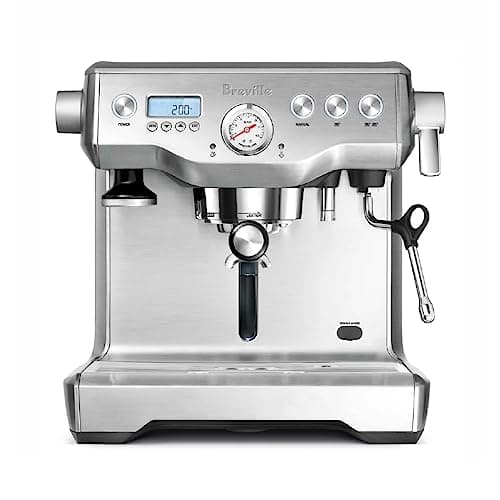 | A household making milk drinks back to back, every morning | The machine reviewed | |
| 2 | 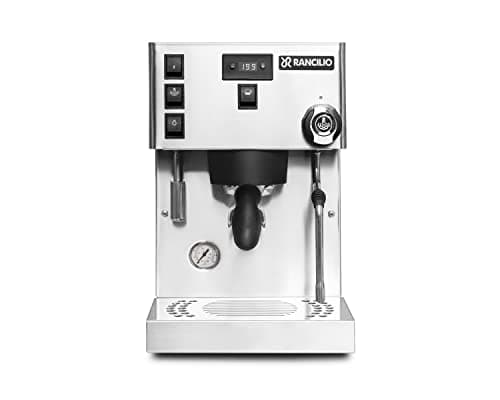 | Someone who wants temperature control on the steam side too | The prosumer alternative | |
| 3 | 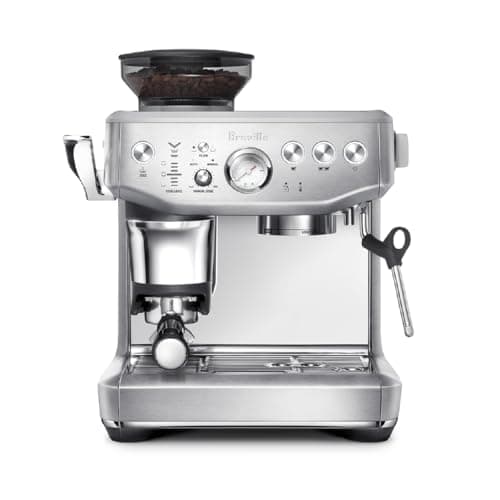 | A first real machine, where the grinder is still part of the budget | The cheaper step down |
1. The machine reviewed
Breville Dual Boiler
Prosumer tier · A true dual-boiler 58 mm machine: brew and steam at once, PID on the brew boiler.
Brew and steam at the same time, with brew temperature set as a number rather than learned as a routine.
The thing this machine does that a cheaper one cannot is simple: pull a shot and steam milk simultaneously. It has two separate stainless boilers, one held at espresso temperature and one at steam temperature, so neither has to wait for the other.
That sounds like a convenience and it is actually a quality difference. On a single-boiler machine you brew, then wait while the boiler climbs to steam temperature, then steam - and the shot sits oxidizing for 30 to 60 seconds. On a heat exchanger you can do both at once but brew temperature drifts with steam demand. Two boilers remove both compromises.
A PID controls the espresso boiler, which means brew temperature is a number you set and the machine holds. This is the difference between dialing in a coffee and learning a machine's warm-up superstitions.
The portafilter is 58 mm stainless taking a 22 g dose. 58 mm is the commercial standard, which matters more than it sounds: every basket, puck screen, bottomless portafilter, tamper and distribution tool on the market is made for it.
Extraction runs low-pressure pre-infusion then 9 bar, and the pre-infusion is programmable - a genuinely useful control for light roasts, which benefit from a gentler saturation before full pressure.
Specification
- Portafilter
- 58 mm stainless, 22 g dose
- Boilers
- Dual stainless steel, separate espresso and steam
- Control
- PID on the espresso boiler
- Extraction
- Low-pressure pre-infusion, then 9 bar
- Footprint
- 37.9 x 40.3 x 37.1 cm
What it does well
- Brew and steam simultaneously - the actual reason to buy dual boiler
- 58 mm commercial basket size opens the whole accessory market
- PID plus programmable pre-infusion
Where it gives ground
- Big, heavy and power-hungry
- Overkill if you drink one straight espresso a day
- Still needs a grinder at a matching level to be worth it
Skip it if
Skip it if you drink one straight espresso a day. Everything you are paying for here is about steaming milk while brewing, and you would never use it.
2. The prosumer alternative
Rancilio Silvia Pro X
Prosumer tier · The Silvia rebuilt as a dual boiler with a PID on each one.
Two boilers, two PIDs and a brass brewing unit - more machine, much less published about it.
The Silvia Pro X is the natural step past the Breville, and it differs in a way worth understanding rather than just costing more.
It also has two boilers, but it puts a PID controller on each one. The Breville's PID governs the espresso boiler; here the steam boiler is temperature-managed too, which gives more consistent steam pressure across a run of drinks.
Its brewing unit is brass. Thermal mass in the group is what stops temperature sagging between shots, and brass holds more of it than the alternatives - a real advantage when pulling several drinks in a row.
Soft infusion is adjustable from 0 to 6 seconds, so pre-infusion is a setting rather than a fixed behavior, as on the Breville.
Two honest cautions. It costs roughly twice the standard Silvia, and Rancilio publishes remarkably little: its own page states no boiler capacities, no wattage, no tank size, no dimensions and no weight. We will not fill those gaps with numbers we cannot source. Two boilers and two controllers is also materially more to service than one thermostat.
Specification
- Boilers
- Two - separate coffee and steam boilers
- Temperature
- Two PID controllers, one per boiler
- Group
- Brass brewing unit
- Pre-infusion
- Soft infusion, adjustable 0 to 6 seconds
- Steam
- Multi-directional stainless steel wand
- Not published
- Rancilio's page states no boiler capacities, wattage, tank size, dimensions or weight
What it does well
- Two PIDs mean brew temperature is a number you set rather than a routine you learn
- Brews and steams at once, which the single-boiler Silvia cannot do at any price
- Soft infusion is adjustable from 0 to 6 seconds, so pre-infusion is a setting
Where it gives ground
- Costs roughly twice the standard Silvia
- Rancilio publishes very little of its specification - capacities and power are absent
- Two boilers and two controllers is materially more to service than one thermostat
Skip it if
Skip it if you want to know what you are buying before you buy it. The Breville publishes its specification in full and this machine does not.
3. The cheaper step down
Breville Barista Express Impress
Mid tier · The Barista Express with assisted tamping and dose correction added.
An integrated grinder, assisted tamping and dose correction - automation instead of two boilers.
This is the honest alternative for most people looking at the Dual Boiler, because it answers a different question: not "how do I remove compromises" but "how do I get consistent shots without buying a separate grinder".
It has a conical burr grinder built in with 25 grind settings, against 16 on the standard Barista Express. Its double basket takes up to 19 g.
The assisted tamp is the interesting part. A lever applies 10 kg - 22 lb - with a 7-degree twist, which removes tamp pressure as a variable. Tamp consistency is genuinely the hardest thing for a beginner to hold steady, so automating it is not a gimmick.
It also adjusts grind time based on the previous shot's puck depth, and the front panel tells you when the dose is out of range. That is a feedback loop a beginner otherwise has to build by taste.
What it is not is a dual boiler. It brews and steams from one thermal system, so there is a wait between the two, and the integrated grinder is the same ceiling as the Barista Express - adequate for espresso, not a match for the Dual Boiler's hardware.
Specification
- Grinder
- Conical burr, 25 settings
- Basket
- Double basket, up to 19 g
- Tamping
- Assisted lever, 10 kg / 22 lb, 7-degree twist
- Dosing
- Adjusts grind time from the previous shot puck depth
What it does well
- Removes tamp pressure as a variable, which is the hardest one to keep consistent
- 25 grind settings against the Barista Express 16
- Dose feedback on the front panel tells you when you are out of range
Where it gives ground
- Solves a problem a calibrated tamper also solves, for far less
- Same integrated-grinder ceiling as the Barista Express
- The automation is the product; the espresso hardware is unchanged
Skip it if
Skip it if you already own a good grinder. You are paying for an integrated one you do not need - see Breville Barista Express Impress review.
The grinder is not optional
A dual boiler removes temperature and timing compromises. It does nothing about grind. Pulling shots on this machine with an inadequate grinder produces inconsistent, channeling shots that no amount of boiler control will rescue, because particle distribution is what sets how water moves through the puck.
So the real budget for this machine is machine plus grinder, and the grinder should be a stepless or fine-stepped espresso grinder rather than a filter grinder pressed into service. See best espresso grinders and best espresso setup under $1000 for how the split usually lands.
Who should buy it
- Households making several milk drinks each morning, which is the scenario the entire design exists for.
- Anyone who wants brew temperature as a setting, because a PID on the espresso boiler replaces warm-up routines with a number.
- Upgraders committed to 58 mm, who intend to keep buying baskets, screens and portafilters for years.
- Light-roast drinkers, for whom programmable pre-infusion is a genuinely useful control rather than a feature on a box.
Who should not
- Single-espresso drinkers, who would pay for a steam boiler that never earns its keep.
- Anyone without a grinder budget, since a mismatched grinder wastes everything the machine does well.
- Small kitchens, because it is big, heavy and power-hungry - see best espresso machines for small kitchens.
- Beginners who want help getting consistent, who are better served by assisted tamping and dose feedback than by removed compromises.