The short answer
Buy the Breville Barista Express Impress if you want a single machine to make your espresso repeatable before your technique is. Breville publishes 25 precision grind settings into steel conical burrs, an assisted tamping arm delivering a constant 22 lb impression with a 7-degree twist, a dose level indicator that auto-corrects the next grind, a 54 mm stainless portafilter, a 1750 W Thermocoil with PID temperature control at 200 F, low-pressure pre-infusion followed by 9 bar extraction from a 15 bar pump, and a 2-year warranty - in a 22.6 lb stainless body. Tamp pressure and dose are the two variables beginners cannot hold steady, and this is the only machine in Breville's range that removes both. What it does not change is the hardware underneath: 54 mm rather than the 58 mm commercial standard, a grinder built into the case that cannot be upgraded, and one Thermocoil, so you brew and then steam rather than both at once. Buy the plain Barista Express and a calibrated tamper if you are willing to learn to tamp - the espresso hardware is the same and only three rows of the sheet differ. Buy the Barista Pro if the thing you resent is waiting, since Breville publishes a ThermoJet ready in 3 seconds there. And buy a Gaggia Classic Evo Pro with a separate grinder if what you actually want is the 58 mm accessory standard and a grinder that outlives the machine.
The published specification
Taken from Breville's own product page for the BES876, with the rows Breville does not publish marked as gaps rather than filled in from a retailer.
Scroll the table sideways to see every column.
Quick picks
The answer first. Tap any row to jump to the full reasoning for that pick.
| # | Product | Best for | Award | Price |
|---|---|---|---|---|
| 1 | 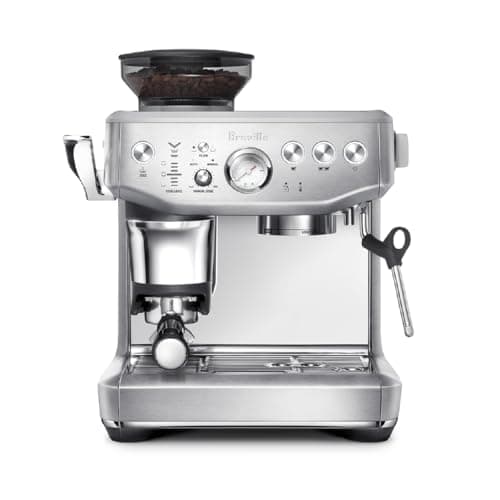 | A first proper machine where consistency matters more than ceiling | The machine reviewed | |
| 2 | 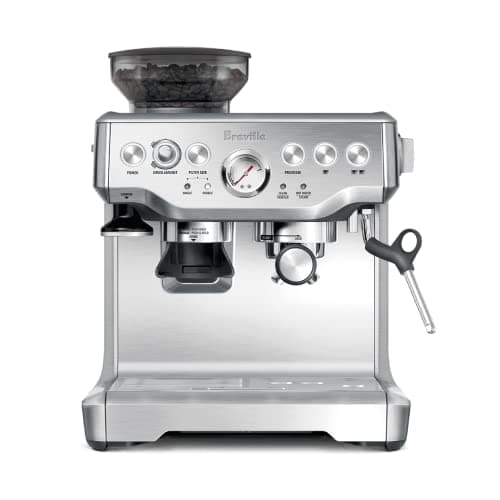 | Anyone willing to learn the routine and spend the difference elsewhere | If the tamp is not your problem | |
| 3 | 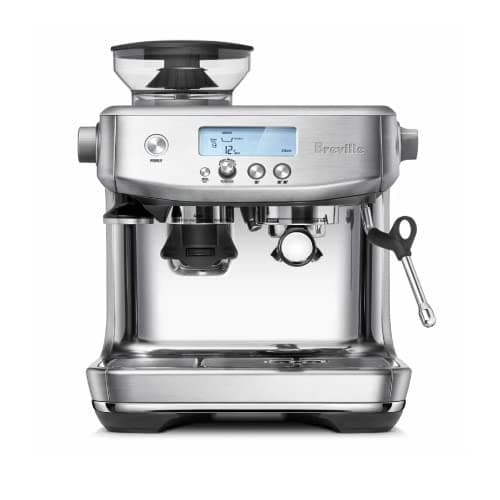 | Mornings where the wait is the thing you actually resent | If heat-up time is your problem | |
| 4 | 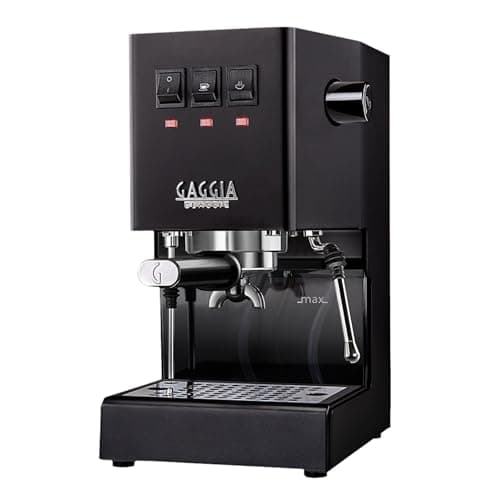 | Anyone whose real plan is a grinder they can keep | If you would rather buy the grinder separately |
1. The machine reviewed
Breville Barista Express Impress
Mid tier · The Barista Express with assisted tamping and dose correction added.
Tamping and dosing become machine jobs; the espresso hardware stays mid-tier.
Breville publishes 25 precision grind settings into steel conical burrs, a 250 g bean hopper, a 2 L water tank, a 54 mm stainless portafilter, a 1750 W Thermocoil with PID temperature control delivering 200 F, low-pressure pre-infusion followed by 9 bar extraction from a 15 bar Italian pump, an extraction-feedback pressure gauge and a manual steam wand, in a 16.6 by 14.4 by 12.2 inch body weighing 22.6 lb.
Two published figures are the entire reason this machine exists. The assisted tamping arm delivers what Breville calls a constant 22 lb impression finished with a 7-degree barista twist, and the dose level indicator reads the result and auto-corrects the next grind. Tamp pressure and dose are the two variables a beginner cannot hold steady by hand, and this is the only machine in Breville's range that takes both away from you.
The 25 grind settings matter more than they look. Dialing in espresso is a search for a window that is often a single step wide, and the Barista Express it replaces offers 16 steps across the same range. More steps is more chances of landing inside the window rather than stepping over it.
The quieter upgrade is the warranty: Breville lists 2 years on the Impress against 1 year on the Barista Express, on machines whose integrated grinder is the part most likely to need attention.
Its honest costs are structural. The 54 mm portafilter is Breville's own standard rather than the 58 mm commercial one, so the accessory bin is far shallower. The grinder is built into the case and cannot be upgraded, which sets the machine's ceiling permanently. One Thermocoil means you brew and then steam, never both at once. And the thing it automates is a thing a calibrated tamper also solves for a fraction of the difference.
Specification
- Grinder
- Conical burr, 25 settings
- Basket
- Double basket, up to 19 g
- Tamping
- Assisted lever, 10 kg / 22 lb, 7-degree twist
- Dosing
- Adjusts grind time from the previous shot puck depth
What it does well
- Removes tamp pressure as a variable, which is the hardest one to keep consistent
- 25 grind settings against the Barista Express 16
- Dose feedback on the front panel tells you when you are out of range
Where it gives ground
- Solves a problem a calibrated tamper also solves, for far less
- Same integrated-grinder ceiling as the Barista Express
- The automation is the product; the espresso hardware is unchanged
Skip it if
Skip it if you already tamp consistently, or if you expect to outgrow an integrated grinder within a year or two.
2. If the tamp is not your problem
Breville Barista Express
Mid tier · The all-in-one: espresso machine with a conical burr grinder built into the case.
The same espresso hardware with a manual tamper and a shallower grind range.
This is the machine the Impress is built on, and comparing the two published sheets shows how narrow the difference is where it is not about tamping.
Breville lists the same 54 mm stainless portafilter, the same steel conical burrs, the same Thermocoil-with-PID architecture and the same extraction-feedback pressure gauge. The water tank is 67 oz against 2 L and the hopper is half a pound against 250 g - within a rounding error of each other in both cases. The element is 1600 W against 1750 W.
What you give up is real and it is confined to three rows: 16 grind settings instead of 25, a manual removable magnetic tamper instead of the assisted arm, and a 1-year warranty instead of 2.
A calibrated tamper closes most of the first gap for a small fraction of the price difference, which is the argument this site has made since the Impress launched - the two compared directly and the tampers that do it.
What it cannot close is the dose correction, because that is the machine watching its own output. If your shots are inconsistent because your dose wanders rather than because your tamp does, the Express will not fix it and the Impress might. The Express also has the single largest owner base in home espresso, which makes parts, tutorials and secondhand values all better than they are for any newer model. Our review of it covers the machine on its own terms.
Specification
- Portafilter
- 54 mm stainless
- Grinder
- Integrated conical burr, 16 settings
- Heating
- Thermocoil, 200 F, PID controlled
- Footprint
- 15.9 x 13.1 x 12.4 in
What it does well
- One box, one price, one plug - nothing else to buy
- PID temperature control at this level is not a given
- Enormous owner base, so parts and answers are easy to find
Where it gives ground
- 16 grind settings is coarse resolution for espresso dialing
- The built-in grinder is the weakest component and cannot be upgraded
- Wide footprint for a single-boiler machine
Skip it if
Skip it if dose consistency is the thing going wrong. 16 grind settings and a hand tamper are the two places it is weakest.
3. If heat-up time is your problem
Breville Barista Pro
Mid tier · All-in-one with the fast ThermoJet heater and finer grind adjustment than the Express.
ThermoJet instead of Thermocoil, 30 grind settings, and no assisted tamp.
The Pro is the same generation of all-in-one answering a different complaint, and the specification differences are clean enough to decide on.
Breville publishes a ThermoJet system ready in 3 seconds in place of the Impress's 1750 W Thermocoil, 30 precision grind settings instead of 25, an LCD interface instead of buttons, 1680 W, and 20.92 lb against 22.6 lb. Both carry a 54 mm portafilter, steel conical burrs, a 15 bar Italian pump, PID temperature control, a half-pound hopper, a 67 oz tank and a 2-year warranty.
The published 3 seconds is the whole case for this machine. It is the difference between a machine you switch on and use and a machine you switch on and wait for, and on a weekday morning that difference is the one people notice.
What you trade away is the Impress's entire reason for being: Breville lists a manual removable magnetic tamper on the Pro, with no assisted arm and no dose correction. Breville also lists no pressure gauge for the Pro, where both the Impress and the Express publish an extraction-feedback gauge - so the Pro gives you less to read while you learn.
Worth knowing before you choose: on Amazon these two trade places regularly, and the Pro has recently sat above the Impress rather than below it. Check both buy buttons rather than assuming the faster machine is the dearer one. The Express and Pro compared sets out the same trade from the other end.
Specification
- Grinder
- Baratza European precision burrs, 30 settings
- Heating
- ThermoJet, 3-second heat-up
- Footprint
- 16.1 x 13.8 x 13.1 in
What it does well
- 30 grind settings - nearly double the Barista Express
- Three-second heat-up in an all-in-one body
- Burrs sourced from Baratza rather than a generic set
Where it gives ground
- Still a single thermoblock: no simultaneous brew and steam
- Large footprint
- Grinder is fixed to the machine lifespan
Skip it if
Skip it if you are buying a machine to make your technique repeatable. The Pro is faster, not more forgiving.
4. If you would rather buy the grinder separately
Gaggia Classic Evo Pro
Mid tier · A 58 mm single-boiler machine with commercial parts and a large modification community.
No grinder, no automation, and the 58 mm commercial standard instead.
This is the alternative the all-in-one category is built to hide, and on one specification it beats every Breville on this page.
Gaggia publishes a 58 mm commercial group, a 3-way solenoid valve, a two-hole professional steam wand, 1425 W total with 1375 W to a 140 ml boiler and a 2.1 L tank. There is no grinder in the box and no automation of any kind.
The 58 mm group is the part worth paying attention to. It is the standard the commercial world uses, which means baskets, bottomless portafilters, puck screens, gaskets and tampers from many suppliers for many years - against a 54 mm bin that is mostly Breville's own. Machines with a 58 mm portafilter is the longer version of why that outlives the machine.
The real argument, though, is budget shape. An Impress spends one price on a machine and a grinder that is welded to it. A Gaggia spends less than that on the machine and leaves the rest for a grinder you can take to your next machine, keep when this one dies, and upgrade on its own schedule - see the espresso grinder picks.
What you give up is everything the Impress automates plus the convenience itself: no built-in grinder, no dose correction, no assisted tamp, no PID, and a 140 ml boiler that is a one-or-two-drink boiler. You will also be doing all the work - this is the machine for someone who wants to learn, not someone who wants breakfast.
Specification
- Portafilter
- 58 mm
- Power
- 1425 W total; 1375 W to the boiler
- Boiler
- 140 ml max capacity, 105 ml operating
- Water tank
- 2.1 L / 72 fl oz
- Steam
- Two-hole professional wand
- Valve
- 3-way solenoid
What it does well
- 58 mm from the start - every basket, tamper and portafilter fits
- The 3-way solenoid gives a dry puck, which cheap machines do not
- Serviceable and heavily documented; parts are everywhere
Where it gives ground
- No PID as shipped; brew temperature drifts with the thermostat
- Long recovery between brewing and steaming
- The modification path is a hobby, not a feature
Skip it if
Skip it if one box at one price is the point. Two devices and a learning curve is the opposite of what the Impress sells.
What the Impress mechanism actually does
The name describes two separate systems that Breville sells as one feature, and they fix two different problems. It is worth separating them, because one of them has a cheap substitute and the other does not.
The first is the tamp. Breville publishes a constant 22 lb impression with a 7-degree twist finish, delivered by a lever rather than your arm. The figure matters less than the word constant: hand tamping varies shot to shot, by hand, by mood and by how level the counter is, and variance in tamp pressure is variance in how water finds its way through the puck.
The second is the dose, and this is the part with no cheap equivalent. The machine has a dose level indicator that reads where the puck sits in the basket and feeds that back into the next grind - Breville's auto dose correct. So a dose that came out light gets a longer grind next time without you weighing anything.
That is a genuinely different kind of help. A calibrated tamper fixes tamp pressure forever for a small fraction of what the Impress costs over the Express, and this site has said so consistently. Nothing in a tamper tells you your dose drifted by a gram. If your shots run inconsistent and you already tamp with a calibrated tamper, the dose is the variable left - and the dose is what this machine watches.
What neither system reaches is distribution inside the bed. Clumps form between the burrs and the basket, and no amount of correct pressure applied on top of a clumpy puck will even it out. That is what a WDT tool is for, and it costs almost nothing next to either machine.
What it does not change: 54 mm and a grinder you cannot replace
Everything in the paragraphs above is about repeatability. None of it is about ceiling, and the ceiling is set by two published facts that the Impress inherits unchanged from the Barista Express.
The first is the portafilter. Breville publishes 54 mm, which is Breville's own size rather than the 58 mm the commercial world uses. Baskets, bottomless portafilters, puck screens and tampers all exist for 54 mm, but the bin is shallower, the choices are fewer and a good deal of what you will read about on forums is sized for the other standard.
The second is that the grinder is inside the case. It is the component that most determines how good espresso from this machine can get, it is the component most likely to wear, and it is the one component you cannot change without changing the whole machine. Breville publishes neither burr diameter nor retention for it, which is itself a fair indication of where it sits in the market.
This is the honest limit of the category rather than a flaw in this model - machines with a built-in grinder exist to buy convenience, and convenience costs upgrade paths. If you expect to want a better grinder within a couple of years, buying one now and a grinder-less machine is the cheaper route in total, and upgrading from a Breville is the path a lot of this site's readers are already on.
Thermocoil, PID and the one thing 200 F does not buy you
Breville publishes a 1750 W Thermocoil with an integrated stainless steel water path, PID temperature control, and water delivered at 200 F. Those three claims are worth unpacking in order, because the middle one is the valuable one and the first is the one with a limit.
A thermocoil heats water as it passes through a coil rather than holding a tank of it at temperature. That is why a machine this size can be ready quickly and why there is no boiler capacity in the specification to report. PID control is the part that matters: it holds the set point instead of letting a thermostat cycle around it, which is the difference between shots that taste the same and shots that do not. At this price PID is not a given, and the site has said that about the Barista Express for as long as it has recommended it.
What one heating system cannot do is be at brew temperature and steam temperature at the same time. You brew, then the machine changes temperature, then you steam. For one or two drinks that is a few seconds of waiting. For four milk drinks in a row it is the thing you will get tired of, and no amount of wattage changes it - that is a dual-boiler argument, covered in heat exchanger versus dual boiler.
Breville does not publish a heat-up time for the Impress. It does publish ready in 3 seconds for the Barista Pro's ThermoJet, which tells you plainly which of the two was designed around the wait.
Impress, Express and Pro, as the three sheets read
All three are 54 mm all-in-ones with steel conical burrs, a 15 bar Italian pump and PID temperature control. These are the rows where they actually differ.
Scroll the table sideways to see every column.
Read as a set, the three machines are one piece of espresso hardware sold with three different kinds of help: the Express gives you the fewest grind steps and expects you to supply the technique, the Impress supplies the technique, and the Pro supplies the speed. Nothing in the three sheets suggests any of them makes better espresso than the others once a shot is dialed in.
Who should buy it
- This is your first machine and you do not want a project. Assisted tamp and auto dose correct remove the two variables that make beginner shots random.
- Your shots are inconsistent and your dose is the suspect. A tamper fixes tamp pressure; only the machine watches the dose.
- You want one box, one price and one plug. Grinder, machine and a usable milk wand with nothing else to buy.
- You value the longer cover. Breville publishes 2 years here against 1 on the Barista Express, on a machine whose grinder is integrated.
Who should not
- You already tamp consistently. You are paying mostly for the arm. Buy the Express and keep the difference.
- You expect to want a better grinder. The grinder is in the case. Buy a grinder-less machine and a grinder you can keep.
- You want the 58 mm accessory ecosystem. This is 54 mm, permanently. A Gaggia Classic Evo Pro gets you the commercial standard for less.
- You make several milk drinks back to back. One Thermocoil means brew, then steam, every time.
- Waiting is the thing you hate. Breville publishes a 3-second ThermoJet on the Pro and no heat-up figure at all here.
Verdict
The Impress is the most honest product in Breville's espresso range, in the sense that it is completely clear about what it is selling. It is not better espresso hardware than the Barista Express - the sheets say so plainly - it is the same hardware with the two least repeatable human steps taken over by the machine, plus nine more grind settings and a second year of warranty.
Whether that is worth the difference is a question about you rather than about the machine. If you would enjoy learning to tamp, a calibrated tamper and the plain Express is the cheaper and equally good answer. If you want to press a button and have the shot come out the same as yesterday's, this is the machine in the range that was built for that, and the dose correction is the part no accessory replaces.
What it will not do is raise your ceiling. The grinder is welded to the decision and the portafilter is 54 mm, so the way up from here is a different machine rather than a better part. Buy it knowing that, and it is a good two-to-four-year machine. Buy it expecting it to be your last one, and the 58 mm separates route was the better buy - dialing in espresso is the skill that transfers either way.