The short answer
Buy the Barista Express for the best balance of price and capability. Buy the Barista Pro if you make several drinks at once. Buy the Impress if you want consistency without technique. Buy the Magnifica Evo if you want no process at all.
Why the integrated grinder matters
Ground coffee begins losing the volatile compounds that make espresso taste like anything within minutes. Pre-ground coffee is not slightly worse for espresso than fresh - it is a different and much duller drink.
That is the single most common way a home espresso project fails. Someone buys a machine, uses pre-ground coffee, gets thin sour shots, and concludes the machine was the problem. An integrated grinder makes that failure impossible.
Quick picks
The answer first. Tap any row to jump to the full reasoning for that pick.
Prices shown are checked daily against the retailer, as of October 24, 2026. We never write a price into the text of a page.
| # | Product | Best for | Award | Price |
|---|---|---|---|---|
| 1 | 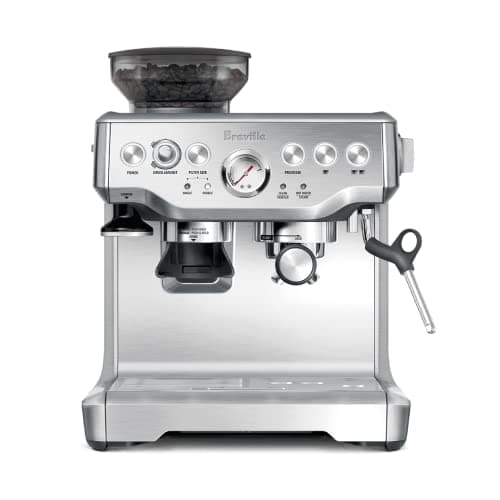 | A complete first espresso setup in one purchase | Top pick | |
| 2 | 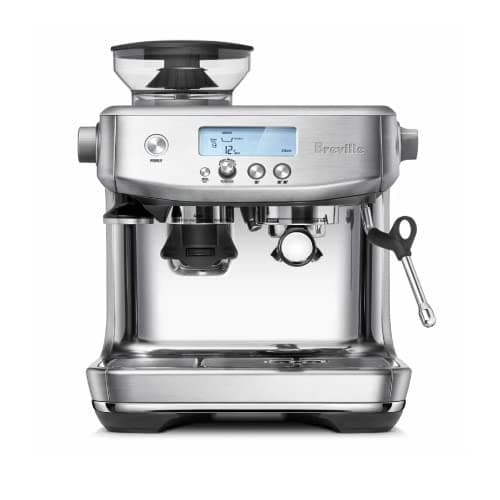 | Households making several drinks in a row | Fastest | |
| 3 | 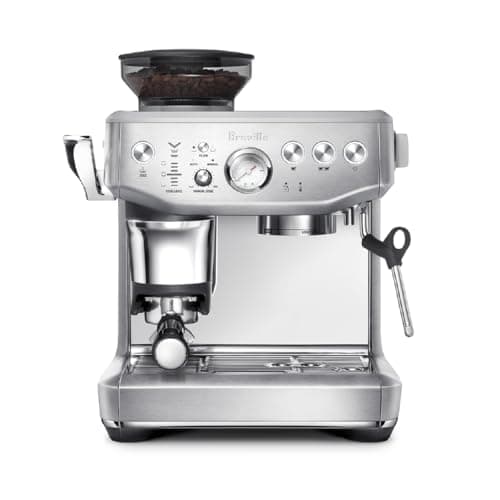 | Anyone who wants repeatable results without technique | Most consistent | |
| 4 | 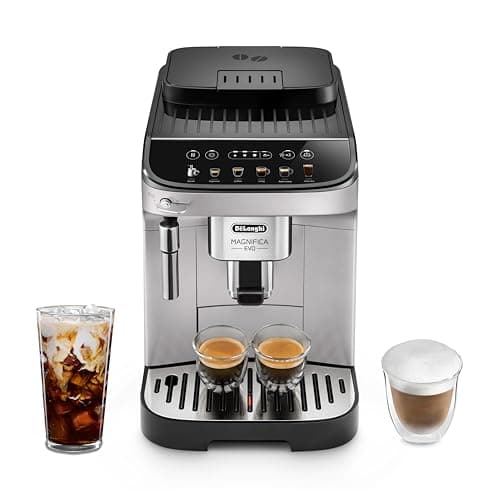 | A household that wants coffee, not a process | Least effort | |
| 5 | 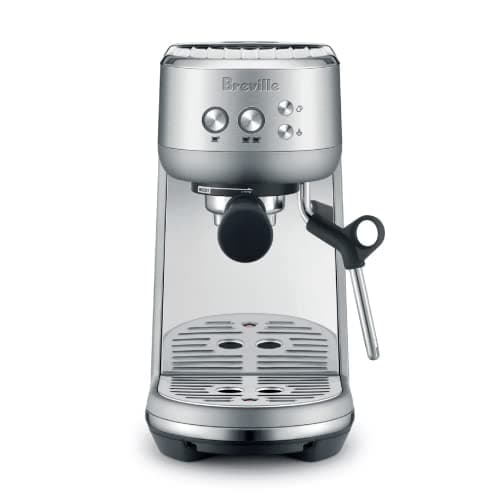 | Anyone willing to own two appliances | Skip this - unless you buy a grinder too |
1. Top pick
Breville Barista Express
Mid tier · The all-in-one: espresso machine with a conical burr grinder built into the case.
The default all-in-one for good reason: it grinds fresh and leaves the shot to you.
The Barista Express pairs a conical burr grinder with a 54 mm portafilter machine, and the combination is the reason home espresso stopped being a specialist hobby.
The integrated grinder is not merely convenient. It is the difference between grinding on demand and using coffee that was ground days ago, and freshness is a larger variable in espresso than almost anything else you can buy.
You dose into the portafilter, tamp, lock in and time the shot yourself. That is the right amount of involvement for most people: enough control to improve, not so much that a weekday morning becomes a project.
Its grinder is good rather than excellent. It holds some grounds in the chute between doses, and timed dosing drifts as beans age - both are normal for integrated units and neither prevents good espresso.
Specification
- Portafilter
- 54 mm stainless
- Grinder
- Integrated conical burr, 16 settings
- Heating
- Thermocoil, 200 F, PID controlled
- Footprint
- 15.9 x 13.1 x 12.4 in
What it does well
- One box, one price, one plug - nothing else to buy
- PID temperature control at this level is not a given
- Enormous owner base, so parts and answers are easy to find
Where it gives ground
- 16 grind settings is coarse resolution for espresso dialing
- The built-in grinder is the weakest component and cannot be upgraded
- Wide footprint for a single-boiler machine
Skip it if
Skip it if you also brew pour-over. Its grinder is set up for espresso, and one grinder cannot serve both ranges well.
2. Fastest
Breville Barista Pro
Mid tier · All-in-one with the fast ThermoJet heater and finer grind adjustment than the Express.
Same idea, thermojet heating, and a shot timer on the display where you can read it.
The Barista Pro is the Barista Express with its main frustration removed. Thermojet heating reaches temperature in seconds and the switch between brewing and steaming is short enough to stop interrupting your rhythm.
That only matters if you make more than one drink at a time. For a single morning espresso the difference is a few seconds; for four drinks it is most of the experience.
The digital display is more useful than it sounds. It shows the shot timer as the shot runs, and watching extraction time against what lands in the cup is how you learn to adjust the grind deliberately rather than by guesswork.
The grinder is comparable to the Barista Express's and the tamping is still manual, so if consistency rather than speed is your concern, the Impress addresses that instead.
Specification
- Grinder
- Baratza European precision burrs, 30 settings
- Heating
- ThermoJet, 3-second heat-up
- Footprint
- 16.1 x 13.8 x 13.1 in
What it does well
- 30 grind settings - nearly double the Barista Express
- Three-second heat-up in an all-in-one body
- Burrs sourced from Baratza rather than a generic set
Where it gives ground
- Still a single thermoblock: no simultaneous brew and steam
- Large footprint
- Grinder is fixed to the machine lifespan
Skip it if
Skip it if you make one drink a day. You are paying for speed you will not use.
3. Most consistent
Breville Barista Express Impress
Mid tier · The Barista Express with assisted tamping and dose correction added.
Assisted tamping, so the shot that worked yesterday works again today.
Integrated grinders solve freshness. They do not solve tamping, and inconsistent tamping is why a beginner gets a nine-second shot and a forty-second shot from identical settings.
The Impress adds a lever-driven tamping mechanism that applies consistent force and levels the bed. It removes the variable rather than teaching you to control it, which for most households is the outcome they wanted.
Its dosing is smarter too, adjusting grind time based on what actually went into the basket, which reduces the drift that affects every timed integrated grinder.
It is the most expensive of the Barista family here, and what you are buying is fundamentally a better tamping arm. That is a legitimate purchase if you would rather not learn, and an unnecessary one if you would - the full review weighs the assisted tamp against the 54 mm ceiling it does not move.
Specification
- Grinder
- Conical burr, 25 settings
- Basket
- Double basket, up to 19 g
- Tamping
- Assisted lever, 10 kg / 22 lb, 7-degree twist
- Dosing
- Adjusts grind time from the previous shot puck depth
What it does well
- Removes tamp pressure as a variable, which is the hardest one to keep consistent
- 25 grind settings against the Barista Express 16
- Dose feedback on the front panel tells you when you are out of range
Where it gives ground
- Solves a problem a calibrated tamper also solves, for far less
- Same integrated-grinder ceiling as the Barista Express
- The automation is the product; the espresso hardware is unchanged
Skip it if
Skip it if learning the craft is part of the appeal. Tamping is a week's practice and the standard Barista Express costs less.
4. Least effort
De Longhi Magnifica Evo
Upper-mid tier · A bean-to-cup machine that grinds, doses, tamps and brews at a button press.
Grinds, tamps, brews and ejects the puck - the built-in grinder taken to its conclusion.
A super-automatic is the logical end of the integrated-grinder idea. There is no portafilter at all: the machine grinds, doses into a sealed brew unit, compresses, extracts and ejects the puck.
Its steel conical burr grinder runs 13 settings, which is generous for the class and matters because grind is the only extraction variable you are given.
The cup is heavier than most super-automatics because its brew unit uses a small-hole basket, which builds more resistance. Coming from a pressurized-basket machine, this will taste more familiar than a lighter bean-to-cup machine would.
What you give up is everything else. You cannot set the dose, cannot set the yield, cannot time the extraction and cannot pour latte art. That is the trade, stated plainly.
Specification
- Grinder
- Steel conical burr, 13 settings
- Format
- Super-automatic, bean to cup
- Milk
- Manual frother - a steam wand, not an automatic milk system
What it does well
- Genuinely one-touch - no portafilter, no tamping, no cleanup between drinks
- 13 grind settings is more adjustment than most super-automatics offer
- Its brew unit uses a small-hole basket, which builds more body than most machines in the class
Where it gives ground
- You cannot control dose, yield or shot time - the machine decides all three
- A sealed brew unit means the ceiling is fixed and cannot be raised
- Grinder and brew group both need regular cleaning or the cup degrades quietly
Skip it if
Skip it if you want to improve. Nothing you learn will change the shot, because you control almost none of it - see super-automatics in full.
5. Skip this - unless you buy a grinder too
Breville Bambino
Entry tier · A compact 54 mm espresso machine with a manual steam wand and no grinder.
No grinder at all, and the better coffee if you pair it with a real one.
This is the honest counter-argument to everything above. A Bambino plus a good standalone grinder generally makes better espresso than any all-in-one at comparable total cost.
The reason is where the money went. With no grinder inside, the Bambino's budget went into the brew group and a thermojet heater that reaches temperature in about three seconds. A separate grinder bought with the difference will out-perform any integrated unit.
It also decouples the upgrade path. A standalone grinder can be replaced, serviced or repurposed for pour-over independently of the machine, and when you eventually change machines it comes with you.
The catch is real: two appliances take more counter space, cost more decisions, and mean two things to clean. Plenty of people who bought the split setup on advice quietly wish they had bought one box.
Specification
- Portafilter
- 54 mm, 18 g dose
- Heating
- ThermoJet, ready in 3 seconds
- Extraction
- Low-pressure pre-infusion, then 9 bar
- Footprint
- 11.9 x 6.1 x 13.5 in
- Grinder
- None - buy separately
What it does well
- Three-second heat-up means it is genuinely usable on a weekday
- The narrowest footprint of any machine here
- Real steam wand you control yourself
Where it gives ground
- No grinder, so the real budget is machine plus grinder
- Manual milk texturing has a learning curve
- Small tank means frequent refills if you pull several drinks
Skip it if
Skip it if the second appliance is not happening. Without a grinder the Bambino is the worst machine on this page, and with one it is arguably the best - see espresso grinders.
What an integrated grinder cannot do
- It cannot be upgraded. The burrs and motor are fixed for the life of the machine.
- It cannot serve two brew methods. An espresso-range grinder handles pour-over badly, and adjusting between them constantly is impractical.
- It retains grounds. Some coffee stays in the chute between doses, so the first shot after changing beans is not clean.
- It doses by time. As beans age and change density, a fixed grind time delivers a drifting weight.
None of these prevent good espresso. All of them are reasons an enthusiast eventually buys a standalone grinder - usually while keeping the machine.
One box or two
Scroll the table sideways to see every column.
Tamping is the remaining variable
An integrated grinder removes the freshness problem and leaves the tamping problem. Uneven or inconsistent tamping produces channeling, where water finds a path through the puck instead of passing evenly through it, and channeled shots taste sour and thin no matter how good the beans were.
The Impress mechanizes it. On the other machines it is a skill, and a distribution tool does most of the same work for far less money than the price difference between models.