The short answer
Measure your clear counter width before anything else. Under 6 inches: the De'Longhi Dedica at 5.9 in, or a Nanopresso that lives in a drawer. Around 6 to 8 inches: the Breville Bambino at 6.1 in, which is the smallest machine here that still rewards a good grinder. Almost nothing: the Nespresso Essenza Mini. And remember the grinder needs space too - which is why the all-in-one that looks space-saving usually is not.
What to look for when space is the constraint
- Published width and depth, not the photograph. Every machine here lists real numbers; use them against a tape measure.
- Height clearance under a cabinet. Machines with hoppers or top-fill tanks need room above them to open.
- Whether a grinder is in the plan. A compact machine plus a hand grinder often beats an all-in-one on total space.
- Tank position. A rear-fill tank against a wall means pulling the machine out every time; front or side access does not.
- Portafilter swing. You need clear space in front to lock a portafilter in, which no spec sheet lists.
The all-in-one trap
The instinct in a small kitchen is to buy one machine that does everything. It is usually the wrong move: a Barista Express is 15.9 in wide, while a Bambino at 6.1 in plus a hand grinder that stores in a drawer comes to less occupied counter and lets you upgrade either half later.
A hand grinder is the small-kitchen answer to the grinder problem generally: no footprint when not in use, no outlet, no noise - see best hand grinders for espresso.
Quick picks
The answer first. Tap any row to jump to the full reasoning for that pick.
| # | Product | Best for | Award | Price |
|---|---|---|---|---|
| 1 | 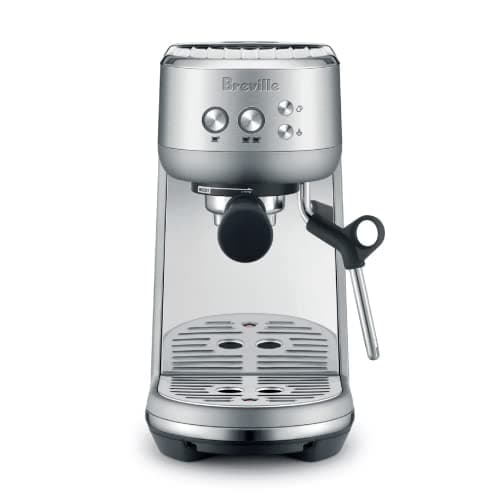 | The smallest machine that still makes proper espresso | Top pick | |
| 2 | 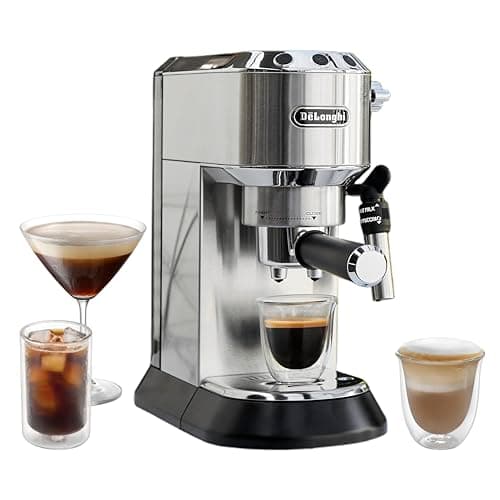 | The tightest counter, no grinder in the plan | Narrowest pump machine | |
| 3 | 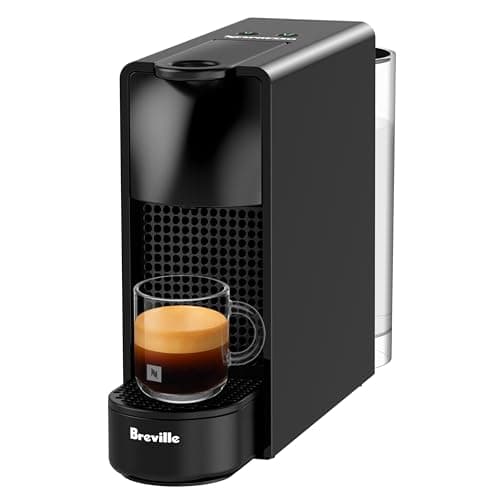 | A counter with almost no space at all | Smallest overall | |
| 4 | 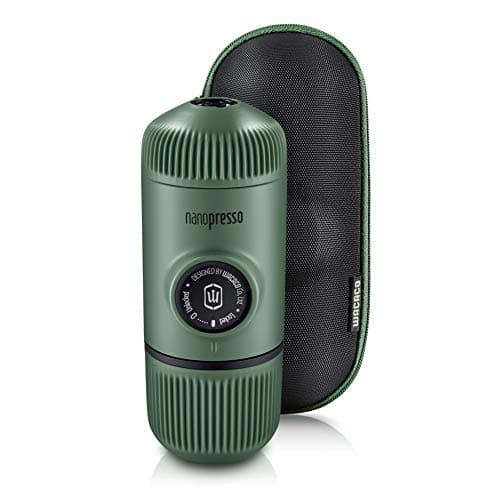 | A kitchen with no free counter space | Smallest with no power at all | |
| 5 | 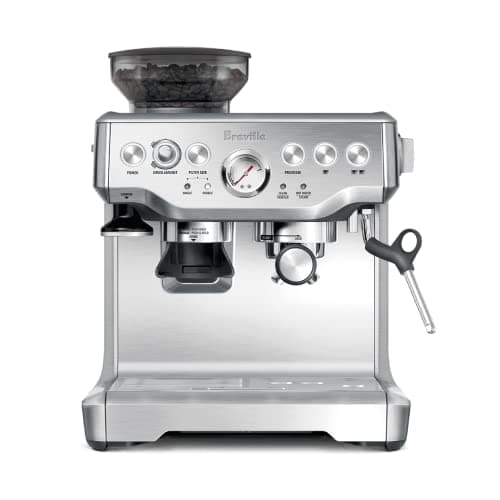 | A kitchen with room, not this list | Skip this one |
1. Top pick
Breville Bambino
Entry tier · A compact 54 mm espresso machine with a manual steam wand and no grinder.
6.1 inches wide, three-second heat-up, and a real 54 mm basket.
At 11.9 x 6.1 x 13.5 in the Bambino is the narrowest machine here that takes non-pressurized baskets - meaning the coffee bed creates the pressure and your grind actually matters.
ThermoJet heating is ready in three seconds, which matters more in a small kitchen than a large one: there is nowhere to leave a machine warming up.
It has a real steam wand you control, so milk drinks are on the menu without a second appliance.
Extraction is low-pressure pre-infusion then 9 bar - the same approach as Breville's larger machines.
It has no grinder, so the footprint you actually need is machine plus grinder, and the tank is small enough that refilling is routine.
Specification
- Portafilter
- 54 mm, 18 g dose
- Heating
- ThermoJet, ready in 3 seconds
- Extraction
- Low-pressure pre-infusion, then 9 bar
- Footprint
- 11.9 x 6.1 x 13.5 in
- Grinder
- None - buy separately
What it does well
- Three-second heat-up means it is genuinely usable on a weekday
- The narrowest footprint of any machine here
- Real steam wand you control yourself
Where it gives ground
- No grinder, so the real budget is machine plus grinder
- Manual milk texturing has a learning curve
- Small tank means frequent refills if you pull several drinks
Skip it if
Skip it if the counter cannot also hold a grinder. Look at the Dedica or a capsule machine instead.
2. Narrowest pump machine
De Longhi Dedica EC685
Budget tier · A six-inch-wide thermoblock machine with a pressurized 51 mm portafilter.
5.9 inches wide, and forgiving of pre-ground coffee.
The Dedica EC685 is 5.9 in wide, 13 in deep and 13 in high. Nothing else with a pump is narrower, and for a lot of kitchens that single number ends the search.
Its 1350 W thermoblock heats fast, and its 35 oz tank is respectable for the size.
The 51 mm basket is pressurized, which means it produces a crema-topped drink from supermarket pre-ground coffee - no grinder needed on a counter that has no room for one.
That same basket caps how good the shot can be, and 51 mm is close to an accessory dead end.
Its Panarello-style frother makes foam easily and microfoam poorly - see the Dedica review.
Specification
- Portafilter
- 51 mm, pressurized
- Water tank
- 35 oz / 1 L
- Pump
- 15 bar
- Power
- 1350 W thermoblock
- Footprint
- 5.9 in W x 13 in D x 13 in H
What it does well
- Genuinely tiny - fits where nothing else will
- Forgiving with supermarket beans thanks to the pressurized basket
- Fast to heat
Where it gives ground
- The pressurized basket manufactures crema; it hides grind quality rather than rewarding it
- 51 mm is an accessory dead end compared with 54 mm or 58 mm
- Panarello-style frother, not a bare steam wand
Skip it if
Skip it if you own a burr grinder. The pressurized basket will not let it show.
3. Smallest overall
Nespresso Essenza Mini
Budget tier · The smallest and cheapest Original-line machine Nespresso makes.
The smallest Original-line machine Nespresso makes, and a 0.6 L tank to match.
The Essenza Mini is the smallest and cheapest Original-line Nespresso machine - genuinely the least counter space any powered espresso device here occupies.
Its 19 bar pump and the Original capsule range mean the drink is the same one the far more expensive Nespresso machines make.
There is no grinder, no dosing and no cleanup: capsule in, button, done. In a kitchen with one free outlet and a foot of counter, that is a real answer.
Its 0.6 L tank means constant refilling if more than one person drinks coffee, and there is no milk system of any kind.
Two cup sizes is the whole menu, and capsules are a permanent running cost - see best Nespresso machines.
Specification
- Capsule system
- Nespresso Original
- Pump
- 19 bar
- Water tank
- 0.6 L
What it does well
- Genuinely tiny - the smallest way to get a capsule espresso on a counter
- Same Original capsule range as the far more expensive machines
- Cheapest entry into the Nespresso ecosystem
Where it gives ground
- 0.6 L tank means refilling constantly if more than one person drinks coffee
- No milk system of any kind
- Two cup sizes only
Skip it if
Skip it if you want to grind your own coffee. Capsules are the entire point of this machine.
4. Smallest with no power at all
Wacaco Nanopresso
Manual tier · A pocket-sized hand-pumped espresso maker built for travel rather than the counter.
336 g and 15.6 cm tall, hand-pumped, stores in a drawer.
The Nanopresso is 15.6 cm tall and weighs 336 g. It does not live on the counter at all - it lives in a drawer and comes out when you want coffee.
It is hand-pumped, so it needs no outlet. In a small kitchen where every socket is taken, that is a bigger deal than it sounds.
It takes ground coffee or, with the adapter, Nespresso Original capsules, which keeps it useful when you travel.
Its basket is pressurized, so it manufactures crema rather than rewarding your grind.
It makes one small shot at a time, and on a counter with space almost anything else is better - see best manual espresso makers.
Specification
- Weight
- 336 g
- Height
- 15.6 cm
- Basket
- Pressurized
- Capsule option
- Nespresso Original compatible with the adapter
What it does well
- Small enough for a jacket pocket - nothing else pressurizes coffee at this size
- Hand-pumped, so it works with no power at all
- Takes ground coffee or Original capsules, which matters when traveling
Where it gives ground
- Pressurized basket, so it manufactures crema rather than rewarding your grind
- Single small shot at a time
- A travel tool - on a kitchen counter almost anything else is better
Skip it if
Skip it if you have any counter space at all. It is a compromise chosen for size, not quality.
5. Skip this one
Breville Barista Express
Mid tier · The all-in-one: espresso machine with a conical burr grinder built into the case.
Excellent machine, 15.9 inches wide, and the classic small-kitchen regret.
The Barista Express is 15.9 x 13.1 x 12.4 in. It is a genuinely good all-in-one and it is the machine most often bought for a kitchen that cannot hold it.
It is here as a warning rather than a criticism: people choose it because it includes a grinder, then discover it occupies more counter than a compact machine and a separate grinder side by side.
Its 16 grind settings and PID thermocoil at 200 F are real strengths in a kitchen with space.
It also needs clearance above for the hopper and in front for the portafilter swing, which published width does not capture.
If your counter is over about 16 inches clear, ignore this entry and read the Barista Express review instead.
Specification
- Portafilter
- 54 mm stainless
- Grinder
- Integrated conical burr, 16 settings
- Heating
- Thermocoil, 200 F, PID controlled
- Footprint
- 15.9 x 13.1 x 12.4 in
What it does well
- One box, one price, one plug - nothing else to buy
- PID temperature control at this level is not a given
- Enormous owner base, so parts and answers are easy to find
Where it gives ground
- 16 grind settings is coarse resolution for espresso dialing
- The built-in grinder is the weakest component and cannot be upgraded
- Wide footprint for a single-boiler machine
Skip it if
Skip it in a small kitchen specifically. In a normal one it is one of the best all-in-ones sold.
Footprints, side by side
Scroll the table sideways to see every column.
Measure the space properly before you buy
Width is the number people check and the least likely to be the constraint. Three others catch buyers out: height under a cabinet with the lid open, depth including the tank behind the machine, and clear space in front to swing a portafilter into the group.
Do it with a tape measure and a sheet of paper cut to the footprint. Put the paper on the counter and live with it for a day - it costs nothing and it settles the argument better than any specification list.
Then add the grinder, a tamper and somewhere to knock the puck out, because the setup is what has to fit rather than the machine.
The hand-grinder solution
In a small kitchen the grinder is the real space problem, and a hand grinder answers it completely: it stores in a drawer, needs no outlet, makes no noise and - at 48 mm burrs with 16 microns per click - reaches genuine espresso resolution.
The trade is effort. An 18 g espresso dose ground by hand is real work, every morning, and it is the reason people eventually buy an electric grinder and find the space for it.
What small machines give up
Tank size. Every compact machine here holds less water, so refilling is part of the routine. The Essenza Mini's 0.6 L is the extreme case.
Steam power. A small thermoblock steams a small jug. Milk for two large lattes back to back is not what these machines are for.
Accessory range. The 51 mm Dedica in particular has very little available to it compared with 54 mm or 58 mm - see bottomless vs pressurized portafilter.
Somewhere to put the used puck. A knock box takes counter space too, and a small kitchen often means knocking into a bin liner instead, which is messier than it sounds.