The short answer
Buy the Barista Pro if you want to learn to steam milk, and the Barista Touch if you want the machine to do it. Their grinders (30 settings), heaters (three-second ThermoJet) and portafilters (54 mm) are the same, so the espresso itself is not the variable here - the milk workflow and the interface are.
What is identical
Both machines use an integrated conical burr grinder with 30 settings, a 15 bar pump, a 54 mm portafilter and fast heating from standby. Both include single and dual-wall baskets, a magnetized tamper and a milk pitcher in the box.
That shared platform is why cross-shopping these two is a question about workflow. A dialed-in shot on one is a dialed-in shot on the other.
What actually differs
Scroll the table sideways to see every column.
Automatic milk: what you gain and lose
Auto-texturing measures temperature and stops at a set foam level. It produces a consistent, drinkable microfoam without practice, which is exactly right for a household that wants a cappuccino at 7 a.m. and has no interest in the craft.
What it will not do is teach you anything. Latte art needs you to feel the pitcher change and adjust the wand, and a machine that finishes the job removes the feedback loop. Every owner who moves from automatic to manual describes the same learning curve arriving late.
If milk is the whole point of your coffee, read best espresso machines for latte art before choosing - the answer there is a bare wand every time.
Quick picks
The answer first. Tap any row to jump to the full reasoning for that pick.
| # | Product | Best for | Award | Price |
|---|---|---|---|---|
| 1 | 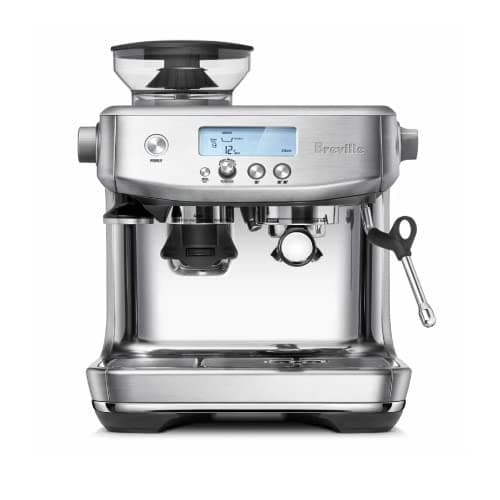 | Learning milk texture on an all-in-one | If you want to steam the milk yourself | |
| 2 | 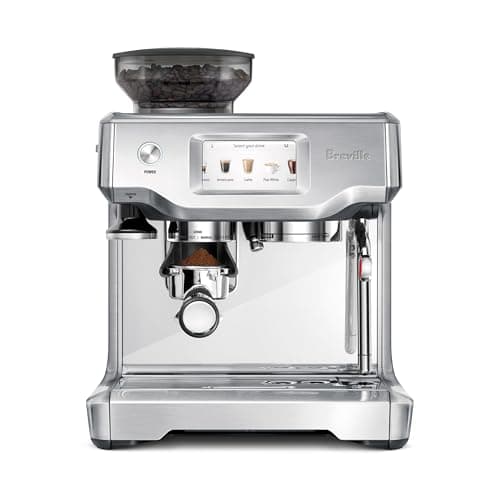 | A household where everyone orders something different | If you want the machine to do the milk |
1. If you want to steam the milk yourself
Breville Barista Pro
Mid tier · All-in-one with the fast ThermoJet heater and finer grind adjustment than the Express.
30 grind settings, three-second ThermoJet heat-up, and a wand you control.
The Barista Pro pairs Baratza European precision burrs across 30 settings with ThermoJet heating that is ready in three seconds. Both of those are meaningful upgrades over the Barista Express, and both are shared with the Touch.
Its milk wand is manual. You judge the pitcher by hand, which is how latte art is learned and the reason experienced owners prefer it.
Thirty grind settings is nearly double the Barista Express's sixteen, which is the difference between dialing in and stepping over the setting you wanted.
It is a single thermoblock, so brewing and steaming happen in sequence rather than at once. For one or two drinks that is invisible; for four it is the machine's real ceiling.
Its footprint is 16.1 x 13.8 x 13.1 in, and the grinder is fixed to the machine's lifespan like every all-in-one.
Specification
- Grinder
- Baratza European precision burrs, 30 settings
- Heating
- ThermoJet, 3-second heat-up
- Footprint
- 16.1 x 13.8 x 13.1 in
What it does well
- 30 grind settings - nearly double the Barista Express
- Three-second heat-up in an all-in-one body
- Burrs sourced from Baratza rather than a generic set
Where it gives ground
- Still a single thermoblock: no simultaneous brew and steam
- Large footprint
- Grinder is fixed to the machine lifespan
Skip it if
Skip it if nobody in the house wants to learn steaming. The Touch removes that job entirely.
2. If you want the machine to do the milk
Breville Barista Touch
Upper-mid tier · The Barista Express idea with a touchscreen, fast heat-up and automatic milk texturing.
The same grinder and heater, plus automatic texturing and eight saved drinks.
The Touch runs the same integrated conical burr grinder with 30 settings on the US model, the same 15 bar pump, and heats in about three seconds from standby.
What you pay extra for is automation: milk texturing with adjustable temperature and texture, a touchscreen, and up to eight saved drink profiles.
Those profiles are the underrated part. In a house of three, each person's drink is a tap rather than a negotiation, and nobody re-learns the machine.
It ships with a 54 mm stainless portafilter, single and dual-wall baskets, a 54 mm magnetized tamper and a 480 ml pitcher - the same kit the Pro comes with.
Automation means less hands-on learning, and it sits above the Barista Express in Breville's range. Its built-in grinder cannot be upgraded either.
Specification
- Grinder
- Integrated conical burr, 30 settings (US model)
- Heat-up
- About 3 seconds from standby
- Pump
- 15 bar
- Interface
- Touchscreen; power is the only physical button
- Milk
- Automatic texturing with adjustable temperature and texture
- Profiles
- Up to 8 saved drink profiles
- Included
- 54 mm stainless portafilter, single and dual-wall baskets, 54 mm magnetized tamper, 480 ml pitcher
What it does well
- Automates milk and programming without giving up the portafilter
- Saved profiles give each person in a household the same drink every time
- Fast heat-up from standby
Where it gives ground
- Its built-in grinder cannot be upgraded, like any all-in-one
- Sits above the Barista Express in Breville's range
- Automation means less hands-on learning than a manual wand
Skip it if
Skip it if latte art is the goal. Auto-texturing gives a fixed result rather than something you shape.
The grinder is the shared ceiling
Thirty settings is good resolution for an all-in-one and modest next to a standalone grinder's forty or a stepless one's infinite adjustment. More importantly, on both machines the grinder is welded to the machine's life: when it wears, the espresso machine wears with it.
That is the honest argument for buying a grinder-less machine and a separate grinder instead - see how to choose an espresso machine.
It cuts the other way too. An all-in-one is one purchase, one plug and one footprint, and for a household that wants espresso without a project that is worth real money. Just buy it knowing the grinder is the part you cannot change.
Which one is yours
- You want to pour latte art: the Pro, for its manual wand.
- Several people, several drinks, one machine: the Touch, for the saved profiles.
- You are upgrading from a Barista Express: either is the same grinder upgrade; pick on milk.
- You want the cheapest route to this platform: the Pro sits below the Touch and brews the same shot.
- You make four milk drinks back to back: neither - a single thermoblock makes you wait. See dual boiler vs single boiler.