The short answer
Buy the Gaggia Classic Evo Pro if you want to learn espresso, own a burr grinder, and would rather keep one serviceable 58 mm machine for years. Buy the De'Longhi Dedica if counter space decides everything, you use supermarket coffee, and you want a small machine that makes a decent milk drink with no fuss. They are not competitors so much as answers to different questions.
Portafilter size is the decision nobody sees coming
The Gaggia is 58 mm, the commercial standard. The Dedica is 51 mm. That difference does not change the first shot you pull, and it changes everything after it.
Precision baskets, bottomless portafilters, distribution tools, puck screens and tampers are made in volume for 58 mm and in smaller numbers for 54 mm. At 51 mm the shelf is close to bare - see best bottomless portafilters.
If espresso turns out to be a passing interest, none of that matters. If it turns into a hobby, the 51 mm machine becomes the thing you replace first.
Size is the other irreversible decision
The Dedica's 5.9 in width is not a marketing figure - it is the reason this machine exists, and no amount of enthusiasm for 58 mm changes the width of your counter. The Gaggia is a standard-footprint machine that also needs a grinder beside it and clearance above it for the tank.
Weigh that honestly before the specifications. A machine that does not fit gets used twice and then moved to a cupboard, which is a worse outcome than a pressurized basket.
The 3-way solenoid, explained once
When a shot finishes, the water above the puck is still under pressure. A 3-way solenoid valve vents it, which leaves a dry puck you can knock straight out into a knock box.
Without one, the puck stays wet and sloppy and the group head needs wiping each time. It is a small thing that happens two or three times a day, which is exactly the kind of small thing that determines whether a machine keeps getting used.
Quick picks
The answer first. Tap any row to jump to the full reasoning for that pick.
| # | Product | Best for | Award | Price |
|---|---|---|---|---|
| 1 | 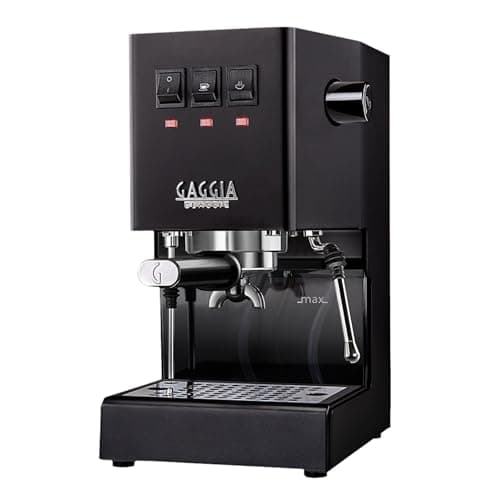 | Learning espresso properly and keeping the machine for a decade | If espresso is the point | |
| 2 | 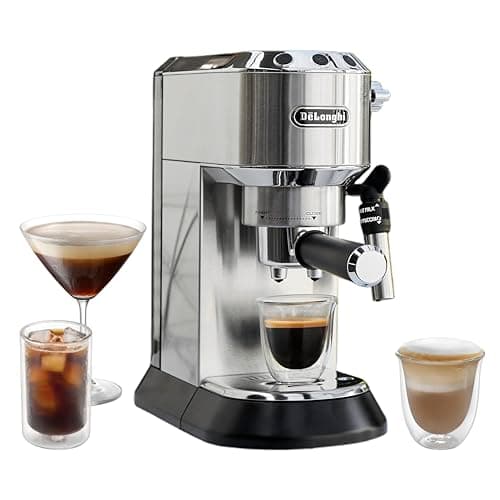 | Small kitchens and supermarket beans | If the counter is the problem |
1. If espresso is the point
Gaggia Classic Evo Pro
Mid tier · A 58 mm single-boiler machine with commercial parts and a large modification community.
58 mm, a 3-way solenoid and a parts supply that outlives the machine.
The Classic Evo Pro takes a 58 mm portafilter - the commercial standard. Every basket, tamper, distribution tool and bottomless portafilter on the market fits it, which is not true of 51 mm or 54 mm machines.
Its 3-way solenoid valve releases pressure after the shot, so the puck comes out dry and the group stays clean. Cheap machines omit this, and it is the single most obvious difference in daily use.
The boiler holds 140 ml at maximum with about 105 ml in operation, fed by 1375 W of the machine's 1425 W. A small brass boiler heats quickly and recovers quickly; it also means steaming and brewing are separate acts, not simultaneous ones.
Its 2.1 L tank is the largest in this comparison by a wide margin, and its two-hole professional steam wand is a bare wand you control.
It ships without PID, so brew temperature drifts with the thermostat, and the famous modification path - PID kits, OPV adjustment, better baskets - is a hobby rather than a feature.
Specification
- Portafilter
- 58 mm
- Power
- 1425 W total; 1375 W to the boiler
- Boiler
- 140 ml max capacity, 105 ml operating
- Water tank
- 2.1 L / 72 fl oz
- Steam
- Two-hole professional wand
- Valve
- 3-way solenoid
What it does well
- 58 mm from the start - every basket, tamper and portafilter fits
- The 3-way solenoid gives a dry puck, which cheap machines do not
- Serviceable and heavily documented; parts are everywhere
Where it gives ground
- No PID as shipped; brew temperature drifts with the thermostat
- Long recovery between brewing and steaming
- The modification path is a hobby, not a feature
Skip it if
Skip it if you want an appliance. This machine rewards attention and quietly expects it.
2. If the counter is the problem
De Longhi Dedica EC685
Budget tier · A six-inch-wide thermoblock machine with a pressurized 51 mm portafilter.
5.9 inches wide, fast to heat, forgiving with any coffee you put in it.
The Dedica is 5.9 in wide by 13 in deep by 13 in high. Nothing else with a pump is that narrow, and for a lot of kitchens that single number settles the argument.
Its 1350 W thermoblock heats fast, and its 51 mm pressurized basket produces a crema-topped drink from pre-ground supermarket coffee without a grinder in the picture.
The 35 oz / 1 L tank is respectable for the size, and the machine is simple enough to be reliable.
The Panarello-style frother makes foam easily and microfoam poorly - fine for a cappuccino, limiting for latte art.
The ceiling is real and it is double: a pressurized basket caps extraction, and 51 mm caps the accessories you can ever buy - see the Dedica review.
Specification
- Portafilter
- 51 mm, pressurized
- Water tank
- 35 oz / 1 L
- Pump
- 15 bar
- Power
- 1350 W thermoblock
- Footprint
- 5.9 in W x 13 in D x 13 in H
What it does well
- Genuinely tiny - fits where nothing else will
- Forgiving with supermarket beans thanks to the pressurized basket
- Fast to heat
Where it gives ground
- The pressurized basket manufactures crema; it hides grind quality rather than rewarding it
- 51 mm is an accessory dead end compared with 54 mm or 58 mm
- Panarello-style frother, not a bare steam wand
Skip it if
Skip it if you own or want a proper grinder. The basket will not let it show.
Side by side
Scroll the table sideways to see every column.
What each one costs you beyond the price
The Gaggia needs a burr grinder to be worth owning, and its non-pressurized baskets make that non-negotiable. Budget for the machine and the grinder together - see the best espresso grinders under $300.
The Dedica does not need a grinder, which is most of its appeal. It will also never reward one, which is most of its limit.
Which one is yours
- You own a burr grinder: the Gaggia, without hesitation.
- Your counter is under a foot wide: the Dedica is the only machine that fits.
- You want latte art: the Gaggia's bare two-hole wand, not the Panarello sleeve.
- You want coffee with no learning curve: the Dedica, and pre-ground beans are fine.
- You expect to still own this machine in ten years: the Gaggia. Parts are everywhere and the design is heavily documented.