The short answer
Buy the Stilosa to find out whether home espresso is something you want to do, for the least money that still buys a pump and a steam wand. Do not buy it expecting cafe espresso: its pressurized baskets manufacture crema rather than extract it, and no grinder, tamper or technique changes that.
What a pressurized basket actually does
In a normal espresso basket, the resistance that builds pressure comes from the coffee itself: a fine, evenly tamped bed. Get the grind wrong and the shot runs fast and sour or slow and bitter, which is why espresso needs a good grinder.
A pressurized - dual-wall - basket moves that job into the hardware. A second wall with a small hole creates the back pressure instead, and the coffee pushed through it foams on the way out. You get crema-looking foam from nearly any grind, including supermarket pre-ground.
The cost is that the extraction underneath is not espresso in the usual sense: pressure is being produced by an orifice rather than by the bed, so grind quality barely changes the result. That is forgiving when you are starting and a hard ceiling once you are not - see bottomless vs pressurized portafilter.
What you actually get for the money
A 15 bar pump. More than espresso needs - 9 bar is the target at the puck - but a real vibratory pump rather than a steam-pressure toy.
A 34 oz / 1 L tank. Larger than several machines at three times the price, which quietly removes the most common daily irritation.
A manual steam wand. Not a Panarello sleeve: a bare wand you position yourself. Microfoam is hard on a single thermoblock machine, but the skill you learn here transfers to any machine you buy later.
Where it stops
Extraction quality is capped. The dual-wall basket is the whole story - see above. Third-party non-pressurized baskets exist for some De'Longhi machines, but the thermoblock and pump were designed around the pressurized ones.
Plastic construction. It feels like what it costs. Nothing about that affects the coffee, and everything about it affects how the machine ages.
Temperature stability. There is no PID here, so brew temperature moves with the thermostat cycle. Back-to-back drinks are less repeatable than on a PID machine like the Infuser.
Quick picks
The answer first. Tap any row to jump to the full reasoning for that pick.
| # | Product | Best for | Award | Price |
|---|---|---|---|---|
| 1 | 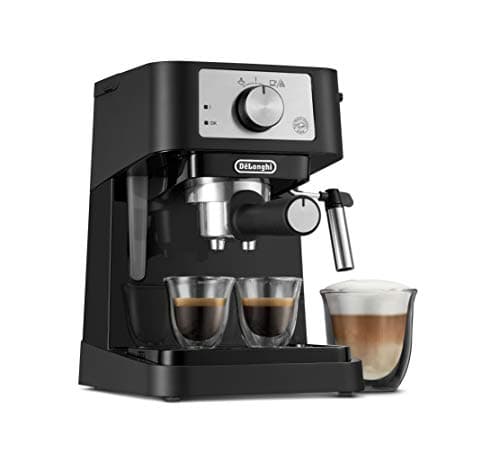 | Finding out whether you actually want espresso | The machine reviewed | |
| 2 | 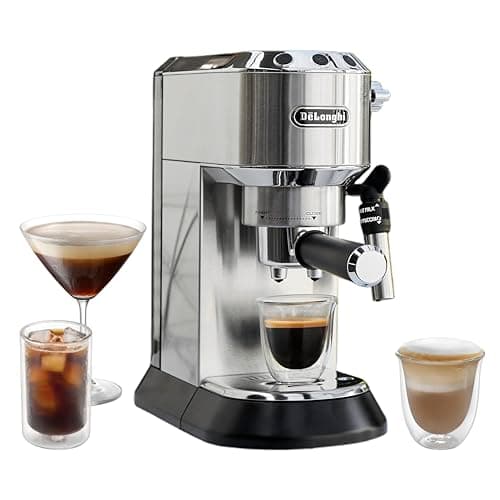 | The narrowest counter in the house | The step up in the same family | |
| 3 | 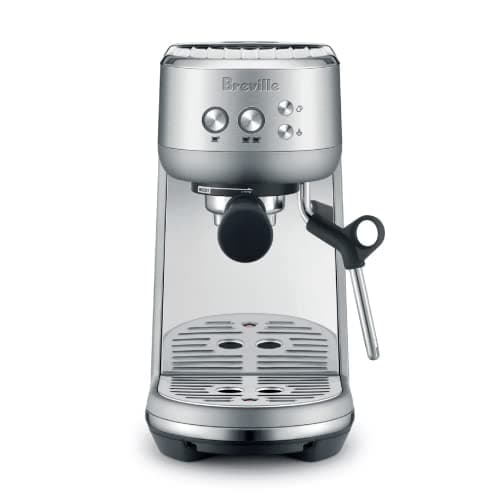 | Starting once, properly | The first machine without a ceiling |
1. The machine reviewed
De Longhi Stilosa EC260
Budget tier · About the cheapest pump espresso machine worth naming, with a manual steam wand.
A real pump and a real steam wand at a price where neither is normal.
The Stilosa is a 15 bar pump machine with a 34 oz / 1 L tank and a manual steam wand. At this price the alternative is usually a steam-toy with a sleeved frother, so a bare wand you control yourself is the headline.
Its tank is larger than several machines costing three times as much, which is a genuine daily convenience rather than a specification-sheet win.
It ships with pressurized dual-wall baskets. These hold back pressure behind a small hole rather than relying on the coffee bed to create it, which is what makes the machine forgiving of a cheap grinder - and what caps how good the coffee can get.
Construction is plastic throughout and the machine is simple enough that very little can fail. That simplicity is part of the value at this price.
The honest framing is this: the Stilosa is the best of a compromised field, not a small version of a good machine. It answers the question 'do I want to do this?' for the least money.
Specification
- Pump
- 15 bar
- Water tank
- 34 oz / 1 L
- Baskets
- Pressurized dual-wall
- Milk
- Manual steam wand
What it does well
- A real manual steam wand at a price where sleeved frothers are the norm
- Larger tank than most machines in the bracket
- Simple enough that there is very little to go wrong
Where it gives ground
- Pressurized baskets cap extraction quality and hide what your grind is doing
- Plastic construction throughout
- The bracket's ceiling is low; this is the best of a compromised field
Skip it if
Skip it if you already know you want espresso. The money is better spent once, a bracket up.
2. The step up in the same family
De Longhi Dedica EC685
Budget tier · A six-inch-wide thermoblock machine with a pressurized 51 mm portafilter.
Six inches wide, faster to heat, and still a pressurized 51 mm basket.
The Dedica EC685 is 5.9 in wide, 13 in deep and 13 in high - genuinely the narrowest pump machine on sale, and the reason it sells.
Its 1350 W thermoblock heats fast, and its 35 oz tank is comparable to the Stilosa's.
It keeps the pressurized basket, this time at 51 mm, and adds a Panarello-style frother rather than a bare wand - easier to get foam from, harder to get microfoam.
51 mm is an accessory dead end: bottomless portafilters, precision baskets and tampers are far easier to find in 54 mm and 58 mm.
It is a better-built Stilosa rather than a different class of machine - see the Dedica review.
Specification
- Portafilter
- 51 mm, pressurized
- Water tank
- 35 oz / 1 L
- Pump
- 15 bar
- Power
- 1350 W thermoblock
- Footprint
- 5.9 in W x 13 in D x 13 in H
What it does well
- Genuinely tiny - fits where nothing else will
- Forgiving with supermarket beans thanks to the pressurized basket
- Fast to heat
Where it gives ground
- The pressurized basket manufactures crema; it hides grind quality rather than rewarding it
- 51 mm is an accessory dead end compared with 54 mm or 58 mm
- Panarello-style frother, not a bare steam wand
Skip it if
Skip it if you want to grow into espresso. The pressurized basket and 51 mm size both fence the hobby in.
3. The first machine without a ceiling
Breville Bambino
Entry tier · A compact 54 mm espresso machine with a manual steam wand and no grinder.
54 mm, three-second heat-up, low-pressure pre-infusion and a real wand.
The Bambino is a 54 mm machine with ThermoJet heating that is ready in three seconds, low-pressure pre-infusion and then 9 bar extraction.
It takes non-pressurized baskets, which means the coffee bed creates the resistance and your grinder finally matters. That is the line between a machine that hides grind quality and one that rewards it.
Its footprint - 11.9 x 6.1 x 13.5 in - is narrow enough to sit beside a grinder on a normal counter.
It has no grinder, so the real cost is machine plus grinder, which is several times the Stilosa's price.
That is the honest comparison: the Stilosa is the cheap way in, the Bambino is the cheap way to a cup you will not want to replace - see is the Breville Bambino worth it.
Specification
- Portafilter
- 54 mm, 18 g dose
- Heating
- ThermoJet, ready in 3 seconds
- Extraction
- Low-pressure pre-infusion, then 9 bar
- Footprint
- 11.9 x 6.1 x 13.5 in
- Grinder
- None - buy separately
What it does well
- Three-second heat-up means it is genuinely usable on a weekday
- The narrowest footprint of any machine here
- Real steam wand you control yourself
Where it gives ground
- No grinder, so the real budget is machine plus grinder
- Manual milk texturing has a learning curve
- Small tank means frequent refills if you pull several drinks
Skip it if
Skip it if the budget cannot also cover a burr grinder. Paired with pre-ground coffee it is wasted.
How it compares at the bottom of the market
Scroll the table sideways to see every column.
Who should buy it
- People testing the water, who want to know whether they will actually pull shots before spending properly.
- Households drinking milk-based coffee, where a forgiving basket and a wand cover most of what gets made.
- Anyone on a strict budget who would otherwise buy a capsule machine and stop there.
Who should not
- Anyone who already owns a burr grinder, because the pressurized basket wastes it.
- People chasing espresso itself rather than coffee with milk in it.
- Anyone who upgrades slowly and hates buying twice - the under $500 bracket is where the ceiling lifts.