The short answer
Buy the Bialetti Moka Express in the size that matches how much coffee you actually make. Buy the Brikka if you want the richest, most concentrated stovetop cup. Buy the Moka Induction only if your hob requires it.
What a moka pot actually does
Water in the bottom chamber is heated until steam pressure builds above it. That pressure pushes the water up through a funnel, through a bed of coffee, and out into the upper chamber. It is percolation driven by steam.
That gives you roughly 1 to 2 bar. Espresso is around 9 bar. The gap explains everything about how the two drinks differ: moka coffee is strong and heavy but has little genuine crema and a different texture entirely.
Quick picks
The answer first. Tap any row to jump to the full reasoning for that pick.
Prices shown are checked daily against the retailer, as of October 25, 2026. We never write a price into the text of a page.
| # | Product | Best for | Award | Price |
|---|---|---|---|---|
| 1 | 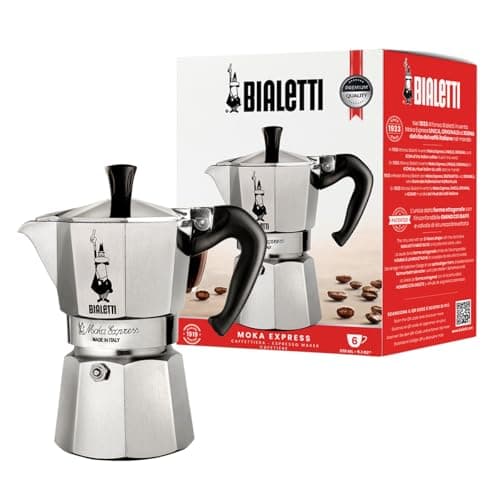 | Almost everyone, at almost every household size | Top pick | |
| 2 | 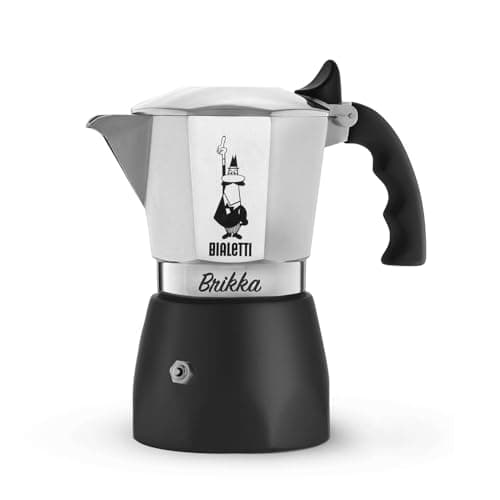 | Someone who wants the richest possible stovetop cup | Closest to crema | |
| 3 | 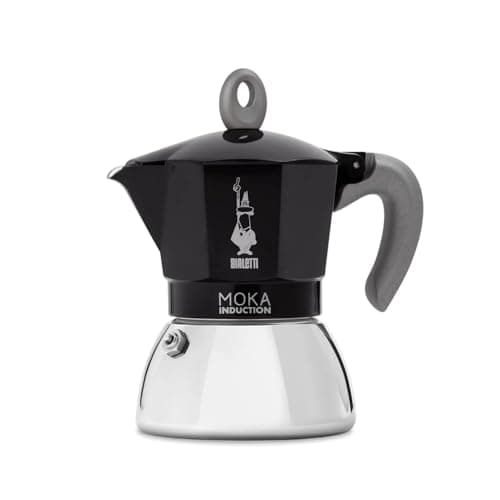 | Anyone with an induction cooktop | Best for induction hobs | |
| 4 | Flair NEO FlexNot a moka pot. The cheapest thing here that makes genuine 9 bar espresso. | Anyone whose real goal was espresso | Skip this - if you actually want espresso |
1. Top pick
Bialetti Moka Express
Budget tier · The octagonal aluminum stovetop pot that defines the category.
The original, in sizes from 1 to 12 cup, and still the one to buy.
The octagonal Moka Express is the pot the whole category is named after, and it remains the default recommendation because nothing has improved on it at the price.
The size range is the practical reason. It is sold from 1 cup up to 12 cup, which no competitor matches, and moka pots must be brewed at their rated size - you cannot half-fill a large one. Buying the size that matches your actual habit is the single most important decision here.
Cast aluminum conducts heat quickly and evenly, which is what you want in the boiler. A stainless line is also sold if you would rather not brew in aluminum.
Parts are the quiet advantage. Gaskets and filter plates are stocked everywhere and cost very little, which means a pot that develops a leak gets a new gasket rather than being thrown away. These pots last decades.
Specification
- Material
- Cast aluminum (a stainless line is also sold)
- Sizes
- 1 to 12 cup
- Cooktops
- Gas and electric; needs an adapter plate for induction
What it does well
- Sizes from 1 to 12 cup - by far the widest range in the category
- No paper, no capsules, no electronics, and almost nothing to break
- Parts and gaskets are stocked everywhere and cost very little
Where it gives ground
- Aluminum will not work on an induction cooktop without a separate adapter
- You must fill the basket and boiler properly, so a big pot cannot make a small brew
- Produces little or no crema - it is not espresso
Skip it if
Skip it if you have an induction hob. Aluminum will not work on induction without a separate adapter plate - buy the Induction version instead.
2. Closest to crema
Bialetti Brikka
Budget tier · A moka pot with a weighted pressure valve that builds a crema-like layer.
A weighted pressure valve holds back the brew until it can push through with real force.
The Brikka adds one component to the standard design: a weighted valve sitting on the column. The brew cannot escape until pressure beneath it is high enough to lift the weight, at which point it comes through in a burst rather than a steady trickle.
The result is a heavier, more concentrated cup with a foam layer on top that looks like crema. It is not crema in the espresso sense - there is no 9 bar extraction here - but it is genuinely richer than a Moka Express produces.
It comes in 2 cup, at roughly 100 ml, and 4 cup, at roughly 170 ml. Those are small volumes, and deliberately so: the concentration is the point.
It is fussier than the standard pot. Fill levels have to be right and the grind has to suit, or the valve never lifts properly and you get a weak, sputtering brew. It rewards attention and punishes carelessness.
Specification
- Material
- Cast aluminum
- Sizes
- 2 cup (about 100 ml) and 4 cup (about 170 ml)
- Mechanism
- Weighted pressure valve
- Cooktops
- Gas and electric; a stainless-boiler Induction variant exists
What it does well
- The pressure valve gets closer to a crema than any other stovetop pot
- Richer, heavier cup than a standard Moka Express
- Same low running cost as any moka pot
Where it gives ground
- Only two sizes, so it does not scale for a household
- The valve is fussy - underfill it or use the wrong grind and it will not build pressure
- Still not espresso, whatever the crema layer suggests
Skip it if
Skip it if you make coffee for a household. Two sizes, both small, and the fussiness gets tiring when you are brewing repeatedly.
3. Best for induction hobs
Bialetti Moka Induction
Budget tier · The Moka Express reworked with a stainless steel boiler so it runs on induction.
A stainless boiler, so it works on induction with no adapter plate.
Induction hobs work by inducing a current in ferrous metal. Aluminum is not ferrous, which is why a standard Moka Express simply sits there doing nothing on an induction cooktop.
This version solves it properly with a stainless steel boiler section rather than asking you to buy an adapter plate. Adapter plates work, but they add a thermal layer, slow everything down and are one more thing to store.
Stainless is also more durable than cast aluminum and does not develop the oxide layer that aluminum does over years of use.
It brews identically to the standard pot, costs more for the same coffee, and comes in fewer sizes. If you do not have induction, there is no reason to choose it.
Specification
- Material
- Stainless steel boiler with aluminum upper
- Cooktops
- Induction, glass-ceramic, gas and electric
What it does well
- Works on an induction cooktop with no adapter plate
- Stainless boiler is more durable than cast aluminum
- Brews the same way as the standard Moka Express
Where it gives ground
- Costs more than the aluminum original for the same coffee
- Fewer size options than the Moka Express line
- Heavier than the aluminum version
Skip it if
Skip it if you have gas or a standard electric hob. You are paying extra for compatibility you do not need.
4. Skip this - if you actually want espresso
Flair NEO Flex
Manual tier · The entry Flair: a single direct-lever press with an integrated pressure gauge.
Not a moka pot. The cheapest thing here that makes genuine 9 bar espresso.
A great many people buy a moka pot wanting espresso, get something strong but different, and conclude they need a better moka pot. They do not. They need a different device.
A moka pot brews at roughly 1 to 2 bar of steam pressure. Espresso is defined by around 9 bar, and that difference is not a matter of degree - it is what emulsifies oils into crema and produces the texture espresso is known for.
The NEO Flex is a manual lever press. You supply the pressure by hand, which gets you into genuine espresso territory for not much more than a good moka pot costs, and lets you shape the pressure curve as the shot runs.
None of this is a criticism of moka pots. A moka pot makes excellent moka coffee, and it is one of the best value brewers in any kitchen. It just does not make espresso, and no moka pot does.
Specification
- Mechanism
- Single direct lever
- Gauge
- Integrated pressure gauge (2024 relaunch)
- Brew cylinder
- Thin-walled, designed to need no preheat
- Power
- None
What it does well
- The cheapest way into genuine lever espresso
- Single-lever action is simpler to learn than a dual-lever press
- Disassembles completely for cleaning and packs down small
Where it gives ground
- Less mechanical advantage than a dual-lever design, so it takes more force
- Needs a kettle for the brew water - it heats nothing itself
- No steam wand
Skip it if
Skip it if you like moka coffee for what it is. It is a genuinely good drink, and the lever is a different ritual entirely - see manual espresso makers.
Why moka coffee often tastes burnt
The usual complaint is bitterness, and the usual cause is heat rather than coffee. Most people brew a moka pot on high heat and walk away, which drives the last of the water through as superheated steam and scorches the bed.
Step 1
Start with hot water
Fill the boiler with water that is already hot. This shortens the time the coffee spends sitting over a heat source before brewing starts.
Step 2
Grind medium-fine
Finer than drip, coarser than espresso. Too fine and pressure builds until the safety valve becomes relevant.
Step 3
Fill the basket level, do not tamp
Tamping a moka basket restricts flow the pot cannot overcome. Level it off and leave it.
Step 4
Medium heat, lid open
Low enough that it takes its time. Leaving the lid open lets you see the moment it changes.
Step 5
Pull it off when it sputters
The brew should run out as a steady stream. When it turns pale and starts spitting, extraction is finished.
Step 6
Cool the base
Run the bottom under a cold tap for a second to stop it dead. This is the step that prevents the burnt aftertaste.
Aluminum or stainless
Scroll the table sideways to see every column.
Neither makes better coffee. Aluminum is the traditional material and heats fastest; stainless is more durable and induction-compatible. Both should be rinsed rather than scrubbed with detergent, because the seasoning inside a well-used pot is part of why it tastes good.
Where a moka pot fits
As a value proposition it is very hard to beat. It costs a fraction of any electric brewer, has no electronics, runs on any hob, and makes a strong, satisfying cup that works beautifully with milk.
It is also excellent for travel and camping, since it needs no power and nothing on it can break - see coffee makers for camping. What it will not do is give you a light, clear, delicate cup; for that you want pour-over.