The short answer
Buy the Espro P7 if sediment bothers you, because its double filter and lip seal are the only real fix here. Buy the Bodum Chambord for the classic method done well at a fair price. Buy the Frieling for durability, and the Stanley for camping.
Sediment is the whole conversation
A French press separates coffee from water with a mesh screen, and a mesh screen is a compromise. Make the holes small enough to stop fines and the press becomes very hard to push; leave them large and fines get through.
There is a second route that gets ignored. On most presses, a significant share of the grounds in your cup never passed through the mesh - they went around the edge of it, between the screen and the glass. That is what a lip seal addresses, and it is why the Espro is noticeably cleaner rather than marginally so.
Scroll the table sideways to see every column.
Quick picks
The answer first. Tap any row to jump to the full reasoning for that pick.
Prices shown are checked daily against the retailer, as of October 24, 2026. We never write a price into the text of a page.
| # | Product | Best for | Award | Price |
|---|---|---|---|---|
| 1 | 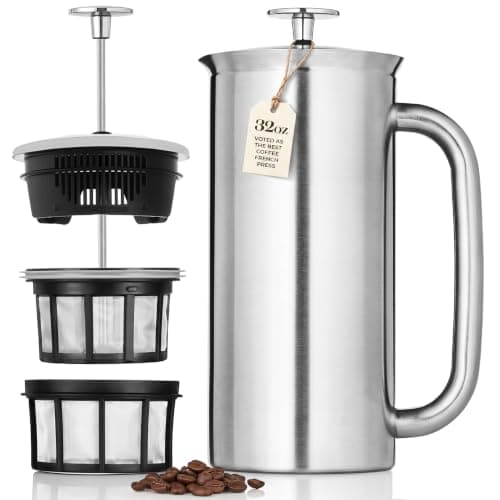 | Anyone who likes French press coffee but not the last inch of it | Top pick | |
| 2 | 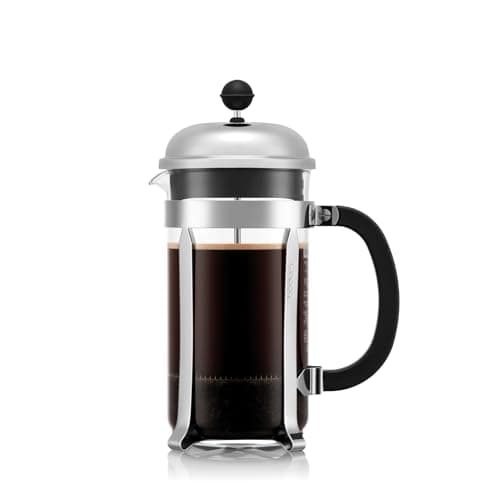 | Good French press coffee without overthinking it | Best value | |
| 3 | 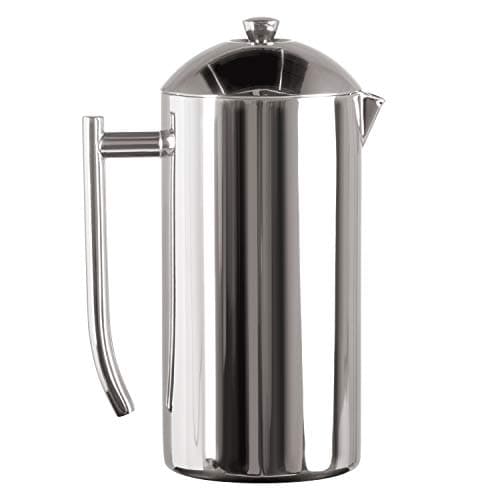 | A press that will outlast several kitchens, or serving a table | Most durable | |
| 4 | 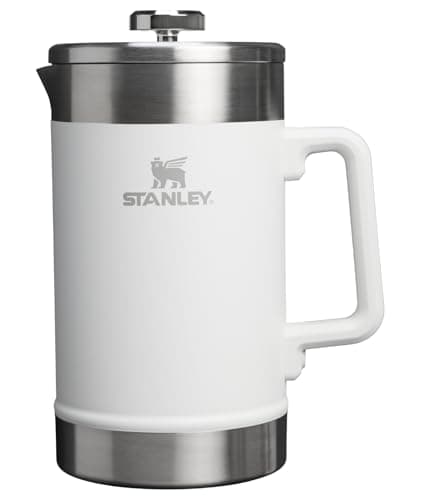 | Camping, cabins and brewing a big batch | Best for travel | |
| 5 | 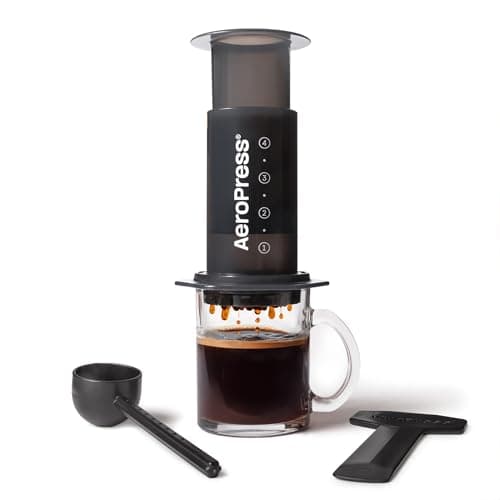 | One or two cups, cleanly, in about a minute | Skip this - or rather, consider it instead |
1. Top pick
Espro P7 French Press
Upper-mid tier · A vacuum-insulated stainless press with two stacked micro-mesh filters.
Two stacked micro-mesh filters and a lip seal, which is the only real fix for sediment.
Almost every complaint about French press coffee is a complaint about sediment: the silt at the bottom of the cup, the grit in the last mouthful, the muddiness that grows as the pot sits. The P7 is the only press here that treats that as a design problem rather than a fact of life.
It uses two stacked micro-mesh filters, each roughly ten times finer than a standard press screen. Fines that would sail through a single coarse mesh are caught, and the difference in the cup is immediate rather than subtle.
The second half of the fix is the double lip seal at the filter edge. On an ordinary press, a large share of the grounds that reach your cup never went through the mesh at all - they slipped around the outside of it. The seal closes that gap.
It is vacuum-insulated double-wall stainless, so a full press holds brewing temperature through a four-minute steep and stays hot afterwards. Because filtration continues after plunging on a normal press, coffee left sitting keeps getting stronger and more bitter. Here it does not.
Specification
- Filtration
- Double micro-mesh; each about ten times finer than a standard press screen
- Body
- Vacuum-insulated double-wall stainless steel
- Seal
- Double lip seal at the filter edge
- Brew time
- About 4 minutes
What it does well
- The double filter removes most of the sediment a normal press leaves in the cup
- The lip seal stops grounds slipping past the edge, which is where most presses fail
- Insulated walls hold brew temperature and keep the outside cool
Where it gives ground
- Costs several times a glass press for the same brewing method
- Two filters mean more parts to rinse
- You lose the visual of watching the brew, which glass gives you
Skip it if
Skip it if the sediment is the point. Some people want that heavy, silty texture, and finer filtration removes exactly what they like.
2. Best value
Bodum Chambord French Press
Budget tier · The classic 34 oz French press: borosilicate carafe in a chrome-plated steel frame.
The classic design, done properly, at a fraction of what the specialists cost.
The Chambord is what most people picture when they hear French press, and it earns its place by being a genuinely good version of the standard design rather than a cheap one.
A 34 oz borosilicate carafe sits in a chrome-plated steel frame, made in Portugal. Borosilicate handles thermal shock properly, and the frame means a knock does not automatically end the pot's life.
Its stainless mesh screen lets oils and fines through, which is the defining characteristic of French press coffee - a heavy, textured body that no paper filter can produce. That is the reason to choose this method at all.
The trade is the sediment. It is a single coarse screen with no lip seal, so grounds get past both through it and around it, and the carafe loses heat quickly. Decant into a warm vessel if you are not drinking it straight away.
Specification
- Capacity
- 34 oz, 3-4 cups
- Carafe
- Borosilicate glass
- Filter
- Stainless steel mesh plunger
- Frame
- Chrome-plated steel, made in Portugal
What it does well
- No paper, no capsules, no consumables at all
- Full-bodied cup that no paper filter can produce
- Every part is replaceable and cheap
Where it gives ground
- Metal mesh lets fines and oils through - that is the trade, not a defect
- Punishes an inconsistent grinder harder than any other brewer
- Glass carafe in a household with a tile floor
Skip it if
Skip it if you own an entry-level grinder. A press with a coarse screen is unforgiving of a grinder producing lots of fines, and the cup will be muddy.
3. Most durable
Frieling Stainless Steel French Press
Mid tier · A mirror-finished 18/10 stainless press built for commercial-grade durability.
Mirror-finished 18/10 stainless with double walls - effectively unbreakable and properly insulated.
The Frieling is built to a commercial standard rather than a domestic one. The welds, the finish and the weight are all a clear step above what a glass press offers.
Double insulated walls mean it holds temperature for a long time, which matters more with a press than with almost any other brewer, because the coffee sits in the vessel for the entire brew and often for a while afterwards.
The larger sizes, including a 36 oz, make it a genuine option for serving several people - the situation where a glass carafe cooling on the table is most obvious.
It uses a single mesh screen, so it does not solve sediment the way the Espro does. What you are buying here is durability and heat retention, not filtration.
Specification
- Material
- 18/10 stainless steel, mirror finish
- Construction
- Double insulated walls
- Sizes
- Multiple, including a 36 oz for serving groups
What it does well
- Genuinely commercial build - welds and finish are a step above domestic presses
- Double-walled, so a full press stays hot for a long time
- Effectively unbreakable compared with a glass carafe
Where it gives ground
- Single mesh screen, so more sediment than the Espro
- Expensive relative to a glass press
- You cannot see the brew
Skip it if
Skip it if sediment is your complaint. This is a beautifully made press with an ordinary screen, and the Espro filters far better for similar money.
4. Best for travel
Stanley Stay-Hot French Press 48 oz
Budget tier · A 48 oz vacuum-insulated stainless press built for camp and for pouring hot hours later.
48 oz of vacuum-insulated steel, built for camp and for pouring hot hours later.
The Stanley Stay-Hot is a large press - 48 oz - built for a crowd rather than a single mug, and it is vacuum insulated. Its listing states up to 4 hours hot and 9 hours cold.
That insulation is what makes it a camp press: at a cold campsite an uninsulated press goes lukewarm in minutes, and this one does not. Being vacuum insulated, it is not a pot for the flame - heat water separately.
The build is Stanley's usual: heavy stainless, designed to be thrown in a truck rather than looked after. Nothing about it will break in a pack.
In a kitchen it is overbuilt and bulky, and it uses a standard mesh screen. It is a good camping press, not a good press that happens to travel - see our camping coffee makers for how it compares outdoors.
Specification
- Capacity
- 48 oz
- Construction
- Double-wall vacuum-insulated stainless steel
- Filter
- Stainless steel mesh
- Heat
- The listing states up to 4 hours hot and 9 hours cold
- Stovetop
- No - vacuum insulated, so heat water separately
What it does well
- 48 oz serves a group from one brew
- Vacuum insulated, so coffee stays hot at a cold campsite
- Built to be thrown in a truck rather than looked after
Where it gives ground
- Heavy and bulky next to purpose-built backpacking brewers
- Not for the flame - you still need a way to heat water
- Coffee left in it keeps extracting, so decant what you will not drink soon
Skip it if
Skip it for kitchen use. It is heavy, awkward on a counter, and out-filtered by everything else here.
5. Skip this - or rather, consider it instead
AeroPress Original
Manual tier · A hand-pressed immersion brewer using a paper or metal filter.
Not a French press, and the answer for most people whose complaint is sediment.
This is here because the most common reason people go shopping for a better French press is sediment, and there is a brewer that removes it entirely for less than any press on this page.
The AeroPress is immersion, same as a press: the grounds sit in the full volume of water. The difference is what happens next. Instead of a mesh screen that separates by settling and straining, you press the water out through a paper filter under pressure.
That means no silt, no grit and no continued extraction afterwards, and it takes about a minute rather than four. It is also effectively unbreakable and cleans up in seconds.
What it will not do is serve a table. It makes one or two cups at a time, and it does not produce the heavy oily body a mesh screen gives you. If that body is what you want from a French press, none of this applies.
Specification
- Capacity
- 10 oz, 1-3 cups
- Weight
- About 6.5 oz
- Filters
- Paper or metal mesh
What it does well
- Almost impossible to brew a bad cup with
- Forgiving of grinder inconsistency in a way pour-over is not
- Cleans up in about ten seconds
Where it gives ground
- Not espresso, whatever the marketing around it says
- One or two cups at a time
- Plunging takes real hand pressure
Skip it if
Skip it if you brew for more than two people, or if the oily body is exactly what you want - see the full comparison.
Your grinder matters more here than anywhere
French press is the least forgiving brew method for a bad grinder, which is the opposite of what most people assume. The assumption is that a coarse grind is easy, so any grinder will do.
The problem is that a poor grinder does not produce a coarse grind. It produces a mixture of coarse chunks and fine dust, and the mesh screen has no answer for the dust. It goes straight into the cup and keeps extracting there, which is why so much French press coffee tastes muddy and bitter.
A capable burr grinder set coarse produces particles of a similar size with few fines - see burr grinders under $100 for where that starts.
Step 1
Grind coarse
Similar to coarse sea salt. Coarser than you think, and from a burr grinder rather than a blade one.
Step 2
Add water off the boil
Just off a full boil is fine. Saturate all the grounds - dry pockets do not extract.
Step 3
Stir, then lid on
Break the crust at about a minute and stir gently. Put the lid on with the plunger up.
Step 4
Steep about four minutes
Longer makes it stronger and more bitter, not just stronger.
Step 5
Press slowly
If it fights you, your grind is too fine. Forcing it pushes fines through the screen.
Step 6
Decant immediately
Coffee left on the grounds keeps extracting. Pour it all out, even what you are not drinking yet.
Insulated or glass
Glass looks better and lets you watch the brew, which is genuinely part of the appeal. It also loses heat over a four-minute steep, and a press that drops temperature mid-brew under-extracts.
Insulated stainless holds temperature and survives being dropped. If your press lives on a counter and gets used daily by several people, that is the more practical answer, and the visual appeal is a real thing to weigh against it rather than dismiss.