The short answer
Buy the Chambord if you drink the press quickly and want the cheapest good version of this brewer, with replaceable parts and a view of the brew. Buy the Frieling if a full press gets drunk over half an hour, or if glass in your kitchen is a bad idea - double-walled stainless keeps the last cup drinkable and survives being knocked off a counter.
Heat retention is the whole comparison
A French press brews for about four minutes and then keeps sitting there. Single-wall glass sheds heat continuously, so a 34 oz press poured at minute twenty is noticeably cooler and flatter than the first cup.
Double-walled stainless slows that dramatically. It is the same physics as a thermal carafe on a drip machine, for the same reason - see thermal carafe vs glass carafe.
One thing neither material fixes: coffee left on the grounds keeps extracting. If you are not drinking the whole press quickly, decant it rather than relying on insulation.
Sediment, and what a mesh screen does
Both presses use a single stainless mesh. That passes oils and fine particles, which is precisely what gives French press coffee its body - and also what leaves silt in the last inch of the cup.
Grind coarse and consistently and the silt is minimal. Grind unevenly and it is the first thing you taste, which is why a French press is the brewer that exposes a cheap grinder fastest - see best grinders for French press.
Quick picks
The answer first. Tap any row to jump to the full reasoning for that pick.
| # | Product | Best for | Award | Price |
|---|---|---|---|---|
| 1 | 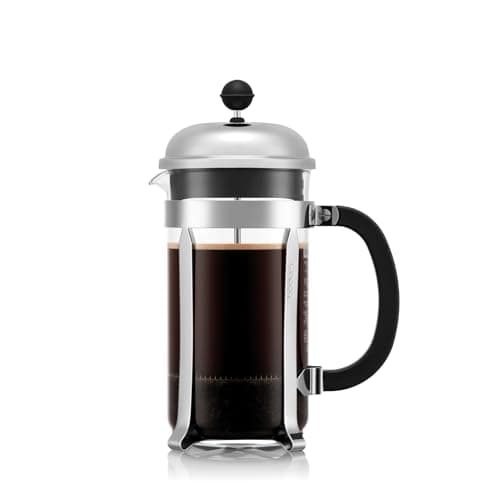 | French press coffee at the lowest sensible price | If you want the classic | |
| 2 | 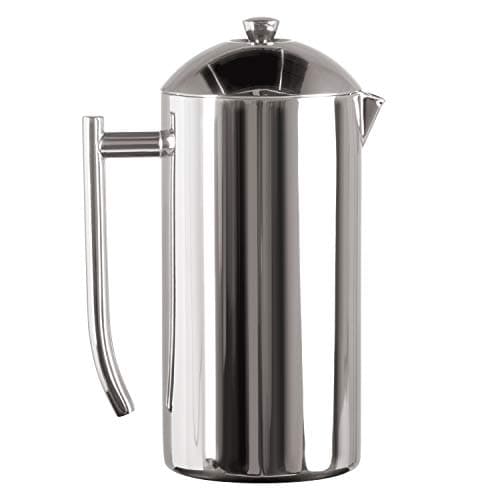 | A full press drunk over half an hour | If you want it to stay hot |
1. If you want the classic
Bodum Chambord French Press
Budget tier · The classic 34 oz French press: borosilicate carafe in a chrome-plated steel frame.
34 oz of borosilicate in a chrome-plated frame, with every part replaceable.
The Chambord is the reference French press: a 34 oz borosilicate carafe - three to four cups - in a chrome-plated steel frame made in Portugal, with a stainless mesh plunger.
Glass means you can see the brew, which is genuinely useful while you are learning: you watch the bloom, the crust and the drawdown rather than guessing.
There are no consumables at all - no paper, no capsules - and every part is replaceable and cheap. A twenty-year-old Chambord with a new beaker and screen is a normal object.
The metal mesh lets fines and oils through, which is the trade rather than a defect: that is where a French press gets its body.
It punishes an inconsistent grinder harder than any other brewer, and a glass carafe in a household with a tile floor is a calculated risk.
Specification
- Capacity
- 34 oz, 3-4 cups
- Carafe
- Borosilicate glass
- Filter
- Stainless steel mesh plunger
- Frame
- Chrome-plated steel, made in Portugal
What it does well
- No paper, no capsules, no consumables at all
- Full-bodied cup that no paper filter can produce
- Every part is replaceable and cheap
Where it gives ground
- Metal mesh lets fines and oils through - that is the trade, not a defect
- Punishes an inconsistent grinder harder than any other brewer
- Glass carafe in a household with a tile floor
Skip it if
Skip it if the press sits for twenty minutes. Glass loses heat fast and there is no insulation.
2. If you want it to stay hot
Frieling Stainless Steel French Press
Mid tier · A mirror-finished 18/10 stainless press built for commercial-grade durability.
Double-walled 18/10 stainless, mirror finished, and effectively unbreakable.
The Frieling is a double-insulated 18/10 stainless press with a mirror finish, built to a standard closer to commercial equipment than domestic - the welds and finish are a visible step above.
Double walls are the functional argument: a full press stays hot long enough that the second and third cups are not a disappointment, which is exactly where glass presses fail.
It comes in multiple sizes including a 36 oz for serving a group, and it is effectively unbreakable, which matters in a busy kitchen.
Its single mesh screen passes more sediment than a double-filter press like the Espro P7 - see Espro P7 vs Bodum Chambord.
It is expensive relative to a glass press, and you cannot see the brew, so bloom and crust are done by feel and timing.
Specification
- Material
- 18/10 stainless steel, mirror finish
- Construction
- Double insulated walls
- Sizes
- Multiple, including a 36 oz for serving groups
What it does well
- Genuinely commercial build - welds and finish are a step above domestic presses
- Double-walled, so a full press stays hot for a long time
- Effectively unbreakable compared with a glass carafe
Where it gives ground
- Single mesh screen, so more sediment than the Espro
- Expensive relative to a glass press
- You cannot see the brew
Skip it if
Skip it if you finish a press in ten minutes. You would be paying for insulation you do not use.
Side by side
Scroll the table sideways to see every column.
Cleaning and what wears out
A French press is three parts and a screen assembly, and the screen is what wears. Mesh stretches, the spiral plate loses tension, and a press that lets grounds past is usually telling you the screen needs replacing rather than that the method has failed.
Coffee oils accumulate on mesh and in the frame. Both presses come apart for washing, and the Frieling's stainless body tolerates more aggressive cleaning than a glass beaker in a chrome frame does.
Do not pour used grounds down a sink. Knock them into a bin or compost - a French press produces a wet puck that blocks drains faster than any other brewer.
One point in the glass press's favor here: you can see when it is actually clean. A stainless press hides a film of coffee oil on its inner wall, which is worth a periodic scrub with hot water and a brush whether or not it looks necessary.
Which one is yours
- One or two cups, drunk immediately: the Chambord.
- A full press across a morning: the Frieling.
- Children, dogs or a tile floor: the Frieling.
- You are learning the method and want to watch it: the Chambord's glass.
- You hate sediment: neither - a double-filter press like the Espro P7 is the answer.