The short answer
Buy the Virtuoso+ if you brew filter coffee and want the same dose every morning without weighing beans - the 40-second timer adjustable to a tenth of a second is the feature, and the metal body and backlit bin are real daily improvements over an Encore. Do not buy it for espresso. Baratza lists espresso as a supported brew method on the Encore, the Virtuoso+ and the Encore ESP, but only the ESP publishes an adjustment range designed for it, and the ESP is the cheaper machine. If you weigh every dose anyway, buy the Encore and keep the difference. If filter coffee is the whole point and budget allows, the Fellow Ode Gen 2's 64 mm flat burrs beat all three at it.
The espresso question, answered properly
This is the thing people actually search for, so it goes first. The Virtuoso+'s own listing title says its 40 grind settings give access to an extensive range of brew methods including espresso, and its feature bullets name espresso first in the list. Taken at face value, that reads like a yes.
Now read the same sentence on the other two grinders in the family. The Encore - the cheapest of the three - lists exactly the same brew methods, espresso included. The Encore ESP lists espresso too, but it adds something neither of the others has: a dual-range adjustment system, with micro-steps from #1 to #20 for high-resolution espresso grinding and macro-steps from #21 to #40 for filter brewing.
That is the whole answer. All three can be turned fine enough to produce something you could call espresso grind. Only one of them has an adjustment mechanism built so that a single step is small enough to dial a shot with. Forty settings spread across the entire range from espresso to French press move in bigger jumps than twenty settings covering the espresso end alone - which is this site's standing position on grinders generally: the count of settings tells you nothing about resolution.
The part that catches people out is the price order. The espresso-capable Baratza in this family is not the expensive one - the ESP sits below the Virtuoso+. So "I bought the better Baratza for espresso" is usually a mistake made in good faith, and it costs more than the right answer would have.
What Baratza does not restate for this model
One documentation gap is worth flagging, because it is the kind of thing a specification review exists to notice. Baratza prints the burr diameter in the Encore's own listing title and bullets - 40 mm conical steel - and again for the Encore ESP, as 40 mm hardened alloy steel made in Liechtenstein.
For the Virtuoso+, it does not. The listing describes "enhanced commercial-grade conical burrs" and "European-manufactured hardened steel burrs" and leaves the number out. This site has recorded the Virtuoso+ as running the same 40 mm conical platform as the rest of the family - it is the same chassis, and both siblings publish that figure - but the Virtuoso+'s current listing does not confirm it, and no micron-per-step figure, burr speed or motor wattage appears there either.
None of that makes it a worse grinder. It does mean the word "enhanced" is doing work that no published number backs up, and that is worth knowing before paying a premium over an Encore for burrs that may well be the same ones.
Quick picks
The answer first. Tap any row to jump to the full reasoning for that pick.
Prices shown are checked daily against the retailer, as of November 1, 2026. We never write a price into the text of a page.
| # | Product | Best for | Award | Price |
|---|---|---|---|---|
| 1 | 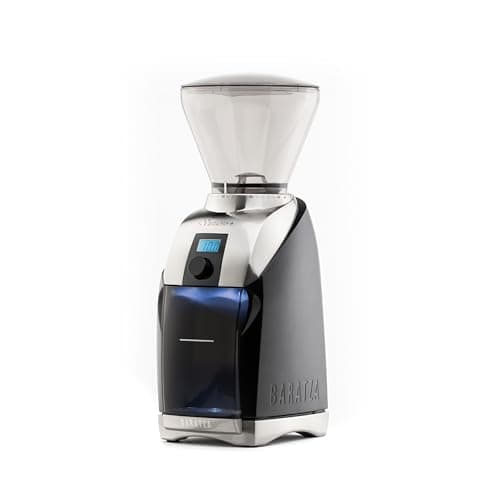 | Drip, press and pour-over coffee, made the same way every morning | The grinder reviewed | |
| 2 | 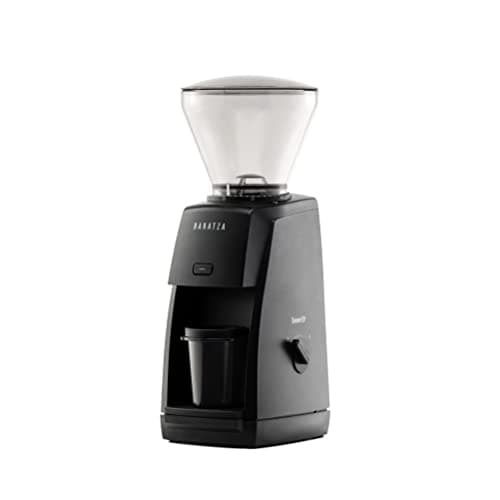 | Shots, with filter coffee as the secondary job | Buy this instead for espresso | |
| 3 | 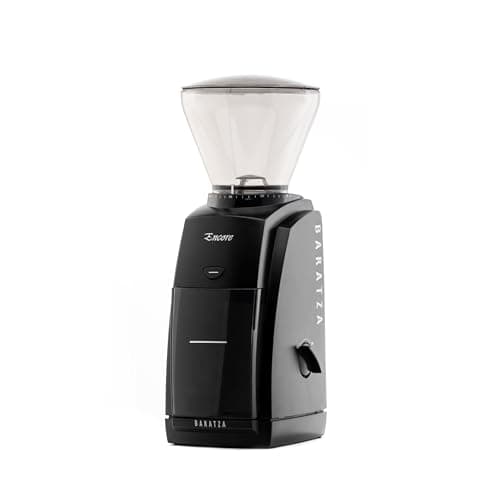 | Filter coffee on the smallest sensible budget | Buy this instead if you weigh your dose | |
| 4 | 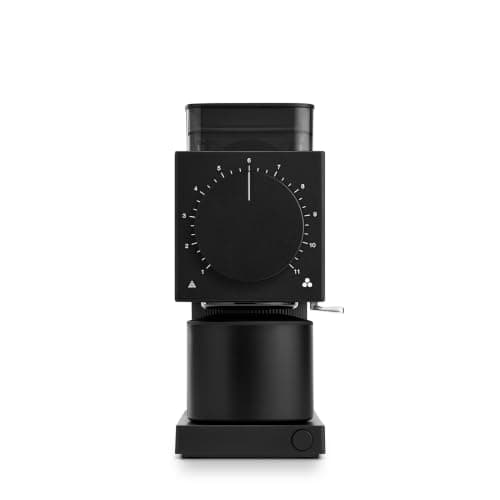 | Pour-over where cup clarity is the point | The filter step-up |
1. The grinder reviewed
Baratza Virtuoso+
Mid tier · The Encore chassis upgraded with a metal body and a digital dosing timer.
Repeatable filter dosing without a scale in the loop, in a metal body.
The Virtuoso+ is the Baratza Encore chassis with the three things upgraded that you touch every day: a timer, a metal body and a lit grounds bin.
The timer is the real feature. Baratza publishes a 40-second digital timer adjustable to a tenth of a second, which means you set a dose once and get the same dose every morning without putting beans on a scale first. On a machine that lives next to a drip brewer and makes one carafe a day, that is the whole value proposition.
The body is the second difference, and it is measurable rather than cosmetic. The Virtuoso+ weighs 6.88 lb against the Encore's 5.58 lb in exactly the same 13.39 x 5.91 x 5.12 inch footprint - that extra pound and a bit is the sculptured metal top and base replacing plastic, and it is why owners consistently report it runs quieter than the Encore.
An LED backlit grounds bin sounds like a gimmick and turns out to be the detail people mention most: you can see how much coffee is actually in the bin without lifting it out into the light.
Baratza describes the burrs as enhanced commercial-grade conical, European-manufactured hardened steel, driven by a DC motor, and backs the machine for one year.
Specification
- Burrs
- 40 mm conical
- Settings
- 40 stepped, 200-1200 microns
- Timer
- 40-second digital, adjustable to 0.1 s
- Burr speed
- 550 rpm
What it does well
- Repeatable dosing without a scale in the loop
- Metal body and a noticeably quieter run than the Encore
- Grind range starts finer than the standard Encore
Where it gives ground
- Built for filter brewing, not espresso
- Timed dosing is not weight dosing - beans age and the dose drifts
- Same 40 mm burr set as grinders costing much less
Skip it if
Skip it if you pull espresso shots, and skip it if you weigh every dose anyway - in that second case you are paying for a timer a scale has already replaced. See Encore vs Virtuoso+.
2. Buy this instead for espresso
Baratza Encore ESP
Entry tier · The Encore re-geared for espresso: the same 40 mm burrs on a dual-resolution collar.
The one Baratza in this family with an adjustment range built for espresso - and it costs less.
If espresso is anywhere in the plan, this is the grinder to buy instead of the Virtuoso+, and the reason is printed on the box rather than a matter of taste.
Baratza's own description of the ESP is a dual-range adjustment system: micro-steps from #1 to #20 for high-resolution espresso grinding, and macro-steps from #21 to #40 for filter brewing. The Virtuoso+ spreads its 40 steps across the whole range instead. Same number of settings, very different resolution where a shot is won or lost.
Its burrs are 40 mm hardened alloy steel made in Liechtenstein - and note that Baratza prints that diameter in the ESP's own title and bullets, which it does not do for the Virtuoso+.
The burr mount is redesigned for quick release, so the burrs come out for cleaning without dismantling the grinder. On an espresso grinder that gets dialed and cleaned often, that matters more than it sounds.
It is also the cheaper machine of the two. Check the buttons on this page, because that is the part people get wrong: the espresso-capable Baratza is not the expensive one.
Specification
- Burrs
- 40 mm M2 steel conical (Etzinger)
- Settings
- 40 stepped, dual resolution
- Espresso range
- Steps 1-20, 20 microns per click
- Filter range
- Steps 21-40, 90 microns per click
- Burr speed
- 550 rpm
What it does well
- 20 microns per click in the espresso range is real dialing resolution
- Redesigned burr housing makes cleaning and shimming easy
- Shims included in the box
Where it gives ground
- Still a stepped grinder - you cannot land between clicks
- Retention is normal-for-the-class, not low
- Same plastic body and noise as the Encore
Skip it if
Skip it if you never pull espresso and want the timer - the ESP has no timer at all, so every dose is weighed or guessed. Full detail in the Baratza Encore ESP review.
3. Buy this instead if you weigh your dose
Baratza Encore
Entry tier · The standard entry burr grinder for filter brewing.
The same 40 mm conical platform and 40 settings, without the timer or the metal.
This is the machine the Virtuoso+ is built on, and the honest cross-shop for most of the people reading a Virtuoso+ review.
It runs 40 mm commercial-grade conical burrs - hardened alloy steel made in Liechtenstein - across 40 stepped settings, with the same DC motor family and the same one-year warranty.
What you give up is the timer, the metal top and base, and the backlit bin. What you keep is the grind, because the burr platform is shared. If a scale is already part of your routine, the timer is the only thing you were paying extra for.
Baratza lists the same brew methods for it that it lists for the Virtuoso+ - espresso, AeroPress, Hario V60, Chemex, French press and automatic brewers - which is exactly the overclaim this review is about. Neither machine has an espresso-specific adjustment range.
Against it: the plastic body is louder, and its published range starts coarser than the Virtuoso+'s.
Specification
- Burrs
- 40 mm conical, made in Europe
- Settings
- 40 stepped
- Grind range
- 250-1200 microns
- Burr speed
- Roughly 450-550 rpm to limit heat and static
What it does well
- The reference answer for pour-over, drip and French press
- Fully serviceable, with parts sold individually for years
- Low burr speed keeps static and heat down
Where it gives ground
- Bottom of its range is too coarse for espresso - that is the ESP model job
- Stepped settings only
- Plastic body and a loud motor
Skip it if
Skip it if the point is pressing one button and getting the same dose without thinking. See the Baratza Encore review.
4. The filter step-up
Fellow Ode Brew Grinder Gen 2
Upper-mid tier · A 64 mm flat-burr grinder built only for filter coffee - it does not do espresso.
64 mm flat burrs and single dosing, for filter coffee taken seriously.
If the Virtuoso+ is on your list because filter coffee is the whole job, this is the machine that beats it at that job rather than sideways.
It runs 64 mm flat burrs against the Virtuoso+'s 40 mm conical set. Flat burrs narrow the particle distribution, which in a cup reads as clarity - individual flavors separating rather than blending into body. That is the trade: conical burrs give more body, flat burrs more definition.
It is built for single dosing, is anti-static, and is markedly quieter than either Baratza - so it suits a kitchen where the grinder runs before anyone else is awake.
Against it: it costs substantially more, it is a filter grinder with no espresso pretension at all, and single dosing is a more involved routine than filling a hopper.
The head-to-head is set out in full on Baratza Virtuoso+ vs Fellow Ode Gen 2.
Specification
- Burrs
- 64 mm uncoated stainless flat
- Settings
- 31
- Load bin
- Single dose, up to 100 g
- Motor
- PID-held 1400 rpm
- Size
- 9.4 x 4.1 x 9.8 in
- Espresso
- No - bottoms out around 250-300 microns
What it does well
- 64 mm flats aimed squarely at clarity in filter brewing
- Single-dose bin, magnetic catch cup and a knocker to clear retention
- One of the quietest electric grinders you can buy
Where it gives ground
- Cannot grind fine enough for espresso, by design
- 31 settings is modest if you brew many methods
- Buying it and then wanting espresso means buying a second grinder
Skip it if
Skip it if you want beans sitting in a hopper and a timed dose at the touch of a button, which is precisely the Virtuoso+'s argument.
What you actually pay for over an Encore
Strip out the marketing and three differences survive, all of them about using the machine rather than about the coffee:
- The timer. Forty seconds of range, adjustable to a tenth of a second. Set it once, press one button, get the same dose daily. This is the reason to buy this grinder.
- The body. 6.88 lb against the Encore's 5.58 lb in an identical footprint - a sculptured metal top and base instead of plastic, which is also why it runs quieter. See best quiet coffee grinders.
- The backlit grounds bin. An LED-lit bin so you can see the dose without lifting it out. Small, and the thing owners mention most.
What does not change is the thing that decides how the coffee tastes. Both run Baratza's conical burr platform at the same speed, so a cup from an Encore and a cup from a Virtuoso+ at the same setting are the same cup. You are buying workflow, not extraction.
And the honest limit on that workflow: timed dosing is not weight dosing. Beans change density as they age and as the roast level changes, so the same number of seconds delivers a different mass next month. A scale does not disappear from the routine - it just stops being needed every single morning.
How it compares in its class
Scroll the table sideways to see every column.
Who should buy it
- Daily filter brewers who do not want a scale in the morning, which is the single clearest case for this machine.
- Households where more than one person grinds, because a saved time is a far more reliable interface than "about this much".
- Anyone upgrading from a blade grinder who also wants the dosing solved in the same purchase.
- Kitchens where the grinder runs early, since the metal body makes it noticeably quieter than the Encore it is based on.
Who should not
- Anyone pulling espresso. The Encore ESP is both better at it and cheaper, and that is not a close call.
- Anyone who weighs every dose, for whom the timer is the only thing being bought and the Encore is the same grinder without it.
- Pour-over drinkers chasing clarity, where 64 mm flat burrs are a real step up and conical burrs are the wrong tool.
- Single dosers, since this is a hopper grinder and retention is normal for the class rather than low.